Marta Lázaro, Finance Manager, Embat
Marta Lázaro shares insights on treasury automation, agentic AI in finance, and the evolution of the modern CFO role at Embat.
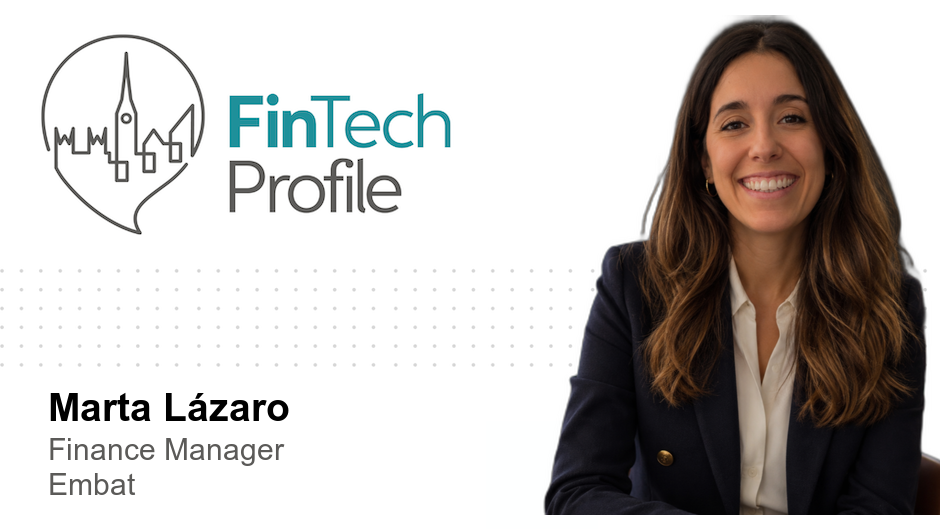
Today we're delighted to speak with Marta Lázaro, Finance Manager at Embat, a sophisticated treasury management platform leveraging AI to streamline financial operations. With a decade of experience spanning industrial finance and high-growth tech, Marta brings a unique perspective on the intersection of finance leadership and fintech innovation. In this interview, she discusses Embat's rapid growth, the shift from advisory to agentic AI, and what it takes to be a modern CFO in an increasingly technology-driven landscape.
This is our second conversation with Embat: we spoke to Theo Wasserberg, Head of UK&I, in January.
My questions are in bold - over to you Marta:
Who are you and what's your background?
I'm a Finance Manager with about ten years of experience across finance. My career has followed a fairly classic upward path, built function by function, starting from the ground up.
I studied Business Administration and Management, with an Erasmus year in Austria that gave me an early taste for working across borders and different business cultures.
After graduating, I joined Pikolin (a large industrial company) where I spent four and a half years moving from Accountant to Financial Controller. It was a really solid foundation; working in a traditional industrial environment gives you a kind of financial rigour that's hard to replicate elsewhere, including hands-on experience with IFRS consolidated accounts and the complexity that comes with a big group structure.
From there I made the jump into tech, joining Sennder, a fast-growing logistics and freight-tech scale-up, where I spent nearly five years. I progressed from Financial Controller to Team Lead of Finance Controlling and eventually to Manager of the Finance Department. The pace was entirely different - hypergrowth companies throw challenges at you constantly - and that's where I really discovered my appetite for fast-moving, high-stakes environments.
I also led the implementation of NetSuite as our ERP system there, which was a significant transformation project and gave me a real appreciation for how the right technology can reshape a finance function. (In a nice full-circle moment, Sennder is now an Embat customer.)
I've kept investing in the academic side too. I have an MBA from 2019, and more recently, a Master's in Labour, Tax and Accounting Advisory. Joining Embat as Finance Manager felt like a natural next step: a fintech where finance sits at the very heart of the product.
What is your job title and what are your general responsibilities?
I'm the Finance Manager at Embat, which means I oversee the full finance function end-to-end. Day-to-day that covers accounting, tax compliance, financial planning, budgeting, and cash flow management.
I also work closely with our executive leadership on strategic decisions and am also responsible for investor relations, an area I have been particularly active in this year. Our €30 Series B fundraising closed in May, so it was a very proud milestone for me individually and as a company.
Beyond the core pillars, I lead risk management and ensure we meet our compliance obligations as we scale internationally. Right now, a significant part of my focus is building our financial infrastructure for expansion into new markets. That includes establishing banking relationships, navigating local tax frameworks, and putting in place the financial controls you need to operate credibly across multiple jurisdictions.
I've also been driving a broader push towards digitalisation within the finance team: automating processes like invoicing and reconciliation that used to be entirely manual, which has made a real difference to how efficiently we work.
It's a broad remit, and I genuinely like it that way.
Can you give us an overview of your business?
Embat is a treasury management platform built for mid-to-large enterprises. In plain terms, we connect a company's banks, ERPs, and payment systems into one unified place and use AI to automate the manual work that typically consumes finance teams: reconciliation, cash forecasting, payment processing, accounting entries.
The problem we solve is more universal than most people realise. The vast majority of finance teams are still working with a combination of spreadsheets, manual bank downloads, and end-of-day data. They're spending hours every week on tasks that should be automated: matching transactions, chasing cash positions across multiple accounts, reconciling bank feeds with their ERP. Embat eliminates that entire manual layer.
What sets us apart is the combination of breadth and intelligence. We connect to over 15,000 financial institutions across Europe, integrate natively with all major ERPs such as SAP, Oracle, Microsoft Dynamics, Sage, and offer genuinely AI-powered tooling.
That includes TellMe, our autonomous treasury AI agent that can answer real-time questions about your cash position, flag anomalies before they become problems, and handle accounting workflows end-to-end.
Finance teams using Embat typically save up to 75% of the time previously spent on manual tasks. One of our customers, the CFO of HOFF, told us that a task which used to consume one person's full working day now takes 10–15% of their time.
We have over 400 corporate customers across Europe - companies like Fever, Treatwell, Northern Data, Sennder, and R2 Hotels - and the market reaction has been strong. We were named among Europe's hottest startups by WIRED in 2024 and ranked #8 fastest-growing start-up in Southern Europe by Sifted. We also hold G2 Leader badges in both Treasury Management Systems and Cash Flow Management.
The space is clearly having its moment, and we're well-positioned in it.
Tell us how you are funded?
We've been on an active funding journey since our founding in 2021. We started with a pre-seed round to get the product off the ground, followed by a seed round as we proved the model. In early 2024, we closed a €15 million Series A led by Creandum (one of the top European VCs, behind companies like Spotify and Bolt), with Samaipata, 4Founders Capital, and Venture Friends also participating.
What was particularly meaningful about that round was the calibre of the angels involved: Kilian Thalhammer, formerly of Deutsche Bank, and Martin Blessing, former CEO of Commerzbank. Having people with that depth of banking experience backing the vision was a real validation.
In May 2026, we announced our Series B: a €30 million fundraising led by Cathay Innovation, with our existing investors including Creandum returning to back us. So in total, we've raised over €50 million since launch. That capital is now fuelling our expansion into the UK and Germany, and accelerating the development of our agentic AI capabilities.
From where I sit as Finance Manager, each funding milestone also represents a significant operational undertaking: complex capital reconciliation, coordination across auditors and legal and tax advisors, and ensuring the financial infrastructure is ready to support what comes next.
The Series B closing involved a lot of moving parts, and getting an unqualified opinion from EY on our annual accounts in parallel was a credibility milestone I'm particularly proud of.
What's the origin story? Why did you start the company? To solve what problems?
Embat was founded in 2021 by three people who saw the same problem from complementary angles. Antonio Berga and Carlos Serrano, our co-CEOs, had both spent years at J.P. Morgan in investment banking.
In that world, they'd seen large corporates wrestling with fragmented, outdated treasury tools. They noticed that the technology to fix this - open banking APIs, cloud infrastructure, AI - already existed, but only for very large enterprises, while mid-sized companies were completely neglected.
Tomás Gil, Embat's technical co-founder, had previously led technology at Fintonic and brought the technical depth to build it properly.
The timing was deliberate. The EU's PSD2 directive had opened up the data connectivity layer that makes a product like Embat possible - for the first time, you could programmatically access banking data across institutions.
The pandemic also made the inadequacy of spreadsheet-based treasury management impossible to ignore. Companies suddenly needed real-time visibility of their cash position and simply couldn't get it through their existing tools.
The core insight was that finance teams at medium and large companies deserve the same intelligent tooling that trading desks have always had - real-time data, automated workflows, AI-powered decision support - but designed for the people actually running the day-to-day treasury function. That's what Embat was built to deliver, and it's a mission I find genuinely compelling, which is a big part of why I joined.
Who are your target customers? What's your revenue model?
Our sweet spot is mid-to-large enterprises. Typically companies with meaningful complexity in their financial operations, such as multiple bank accounts, multiple entities, exposure to multiple currencies, or high transaction volumes. That might be a fast-scaling tech company managing payments across several European markets, or an established business with subsidiaries in multiple countries that needs real visibility across the whole group.
In practice, our customer base is quite diverse. Fever operates in the live entertainment space; Treatwell in European beauty marketplaces; and Northern Data in digital infrastructure. We also have hotel groups, consumer brands, and logistics companies. What they all share is a finance team that was spending too much time on manual processes and not enough time on actual financial strategy.
Embat operates on a SaaS subscription model. Pricing is tailored to the customer's size and the combination of modules they use - core treasury, payments, AI-powered reconciliation, forecasting - so it scales with the business. The ROI tends to be very tangible: when we can point to a customer managing their daily treasury function in a fraction of the time it used to take, the conversation about value becomes pretty straightforward.
If you had a magic wand, what one thing would you change in the banking and/or FinTech sector?
I'd standardise real-time, open banking connectivity across Europe. That means genuinely standardising it, not just mandating it on paper.
Right now, every bank exposes data and payment rails differently - different formats, different latency, different APIs (when there's an API at all). That forces every company, and every platform like ours, to build and maintain dozens of bespoke integrations just to get a real-time view of cash. PSD2 had the right intent, but the implementation has been fragmented in a way that's created enormous inefficiency.
If connectivity were truly standardised, finance teams could stop reconciling manually and focus on decision-making and strategic value, instead of data-wrangling. It would unlock productivity gains across the entire sector - not just for fintechs like us, but for every CFO and treasurer trying to run a modern finance function. The infrastructure is the bottleneck, and solving it lifts everyone.
What is your message for the larger players in the Financial Services marketplace?
Treat treasury fintechs as connectivity allies, not threats. We're not trying to replace banks — we're trying to make the relationship between banks and corporates faster, smarter, and more transparent.
The banks that open real-time APIs and actively support the ecosystem being built on top of their infrastructure will attract more corporate business, not less. CFOs and treasurers want one place to see everything, make decisions, and execute. If that experience is built on top of a bank's connectivity and trust infrastructure, that's a win for everyone involved.
The banks that slow-walk every integration or treat fintech partnerships as something to be managed rather than embraced will find their corporate clients gravitating toward the competitors who made things easier. The opportunity for a genuine partnership model is right there. The ones who see it clearly will win.
Where do you get your Financial Services/FinTech industry news from?
Two sources I consistently go back to:
The Financial Times is my anchor for anything macro: monetary policy, banking regulation, M&A and the broader economic context that shapes what we do in treasury, payments and banking. It's not fintech-specific, but that's almost the point; if you only read fintech media you end up in an echo chamber.
The Global Treasurer is where I go for anything treasury-specific: product developments, market trends, interviews with CFOs and treasurers who are actually dealing with the same challenges I am. It's more niche, but that's exactly what makes it useful when you work in this space.
I'd add that LinkedIn has genuinely become an underrated news source in itself. If you're following the right people - practitioners and analysts who write with real substance rather than just sharing headlines - you get a fairly well-curated view of what's actually moving in the industry.
Can you list 3 people you rate from the FinTech and/or Financial Services sector that we should be following on LinkedIn, and why?
Leda Glyptis — Leda is one of the sharpest thinkers I follow on what digital transformation in banking actually means in practice versus what it means in press releases. She's written a book on it (Bankers Like Us) and she posts with a clarity and honesty that's refreshing in an industry that can be quite prone to jargon.
Anne Boden MBE — Founder of Starling Bank and one of the most visible examples of a woman who built something genuinely significant in European fintech. Beyond the product itself, she's been a consistent voice for women building and leading in this sector — which matters to me personally, and I think matters to the industry.
James Kelly — James is the founder of Your Treasury and a former corporate treasurer at Pearson, where his team won the 2023 TMI award for best AI deployment in treasury. He now hosts the Treasury Storyteller podcast and writes with real practical authority on AI and automation in corporate treasury; the kind of perspective that cuts through the hype because it comes from someone who's actually done the job at scale. Essential follow if treasury is your world.
What FinTech services and/or apps do you personally use?
Mastercard's Agent Pay has really caught my attention. The concept is elegant: rather than making a payment yourself, you give an AI agent permission to pay on your behalf, but within the limits you define upfront, such as how much it can spend, where, and for how long. It operates with a secure, revocable token rather than your actual card number, so if anything looks wrong you can cut it off instantly, exactly like freezing a card.
What I find genuinely compelling about it is that it's not theoretical AI, it's AI actually transacting, not just advising or summarising. That's a meaningful shift, and as someone who thinks professionally about payment automation and treasury workflows, it's a useful early signal of where agentic finance is heading. The guardrail model - defined permissions, revocable access, full audit trail - is also the right design philosophy for anything touching corporate payments.
What's the best new FinTech product or service you've seen recently?
Payhawk has caught my attention lately, particularly their recent launch of AI agents for corporate finance tasks. They've built four purpose-built agents that handle things like invoice processing, expense categorisation, and spend policy enforcement autonomously, not just surfacing recommendations, but actually executing the workflow.
What I find interesting about it is the design philosophy: each agent has a narrow, well-defined remit with clear guardrails, rather than trying to be one AI that does everything. That's the right way to build trust in agentic tools in a finance context. Payhawk sits in spend management and AP rather than treasury, so it's very complementary to what we do at Embat. Between us, finance leaders are covering most of the modern CFO stack.
Finally, let's talk predictions. What trends do you think are going to define the next few years in the FinTech sector?
A few things feel genuinely significant to me right now:
Agentic AI moving from insight to execution. Most AI tools in finance today are still advisory. They surface information, flag patterns, produce reports. The shift that's already beginning is AI that actually executes: initiating payments, closing reconciliations, triggering hedging positions, managing cash sweeps. The infrastructure for this is maturing fast: secure tokenisation, revocable credentials, auditable trails. Within the next few years I'd expect autonomous workflow execution to become a standard feature of serious treasury platforms, not a differentiator.
Real-time treasury becoming the baseline expectation. The SEPA Instant mandate is pushing European banks toward instant payment infrastructure, and that's going to fundamentally shift what finance teams expect in terms of cash visibility. Intraday liquidity management will stop being a premium feature and become table stakes. Companies still running on end-of-day data snapshots will feel that pressure acutely.
The CFO as a technology decision-maker. The role is evolving faster than the traditional career path prepares people for. Finance leaders are increasingly being asked to own the fintech stack, understand what connects to what, how AI tools handle data governance, and what the audit implications are. The finance leaders who build genuine technical fluency, without needing to become engineers, will be significantly more effective than those who leave those decisions to IT.
And one personal observation: women leading finance in tech is becoming less of a talking point and more of a norm. The pipeline is improving, the role models are more visible, and the conversation is shifting from "representation" to "performance." I'm optimistic. The next generation of finance leaders in this space will have a very different experience to the one mine sometimes did, and that's genuinely exciting.
Many thanks to Marta for taking the time to share her insights with FinTech Profile. You can learn more about Embat on their website.