My Advice to Banks on AI: Matt Waxman of Precisely
Precisely's CPO Matt Waxman on why banks must fix their data foundations before scaling AI, and the governance crisis waiting to happen.
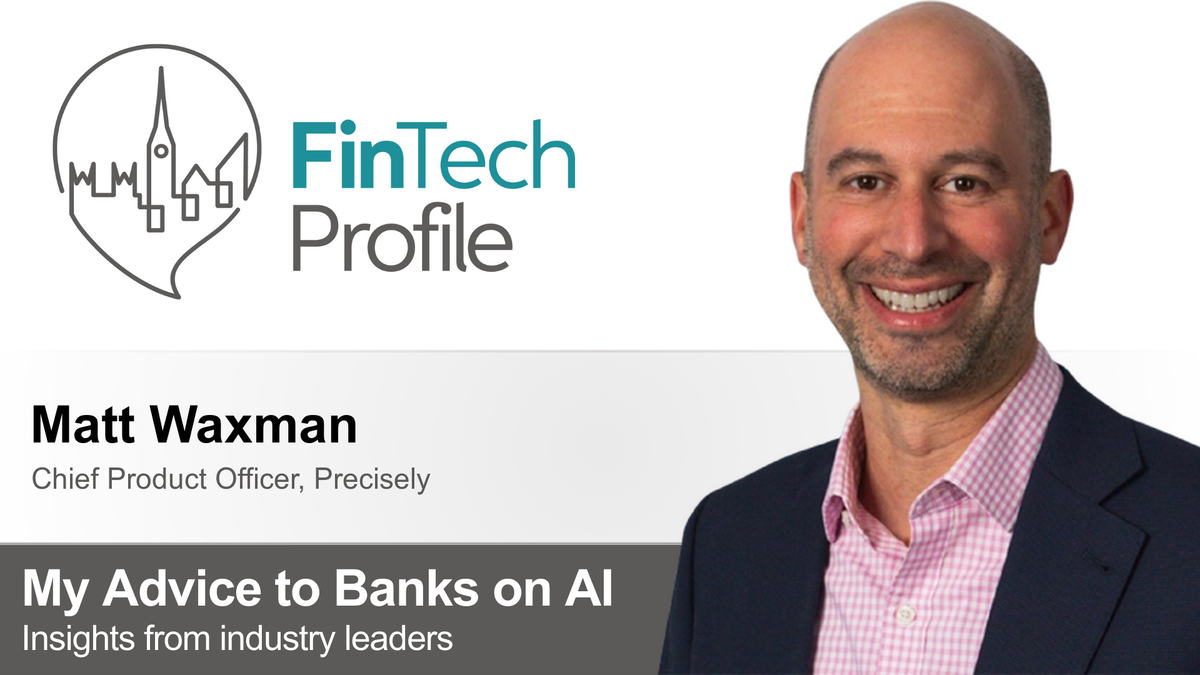
I spoke with Matt Waxman, Chief Product Officer at Precisely, about the data integrity challenges holding back AI adoption in financial services. With a career spanning Veritas, Cohesity, Puppet, Dell EMC, and most recently leading the $400M Arctera spinout, Matt brings deep expertise in enterprise data management to one of banking's most urgent strategic questions: how to make AI work at scale when the underlying data isn't ready.
My questions are in bold - over to you Matt:
Can you give us an introduction to you and an overview of Precisely?
I've spent most of my career inside enterprise software companies, building product organisations from the ground up. Veritas, Cohesity, Puppet, Dell EMC, and most recently Arctera, where I led the spinout of a $400M data management business from Veritas. The through-line across all of it has been data: how you protect it, move it, govern it, and make it usable at scale.
I joined Precisely earlier this year as chief product officer. The thing that drew me here is the problem we're solving. Every company I talk to is racing to get value from AI. And every one of them is hitting the same wall, which is that their data isn't ready for it. Precisely sits exactly at that intersection. We're a global leader in data integrity, and our job is to make sure that the data powering these AI systems is accurate, consistent, and in context. That's not a nice-to-have anymore. It's the prerequisite for any of this working.
If you were advising a bank CEO today, what's the single biggest mistake they're making with data and AI?
Scaling AI before they've dealt with the data underneath it.
I hear this constantly from financial services customers. They've invested heavily in AI. They've got the models, the tools, the mandate from the board. But when those systems start producing outputs that don't match what analysts know to be true, or when the compliance team starts asking hard questions about where a number came from, the whole initiative stalls.
The data was always the problem. AI just surfaces it faster. Banks have more data than they've ever had, but a lot of it is scattered across systems that don't talk to each other, or it's missing the context and governance that makes it trustworthy. You cannot safely automate decisions at scale on data you can't fully account for. The strategy conversation has to start there.
Everyone wants AI outcomes, but the data underneath is often messy. How much of "AI readiness" is really a data-integrity problem, and what does fixing it involve?
More than most organisations want to admit. I'd say the majority of the gap between what AI promises and what enterprises are actually seeing in production comes back to data.
Here's the dynamic we're watching play out. AI adoption in financial services has accelerated dramatically in the last two years. The tooling has gotten accessible, the pressure to move is real, and so organisations are deploying. But they're deploying on top of data foundations that were never designed for autonomous, real-time decision-making at scale.
In the agentic era, that gap has real consequences. An agent that's triggering actions based on faulty data doesn't just produce a bad dashboard. It can file an incorrect tax document, flag the wrong account, or make a credit decision that can't be audited. The errors compound before anyone catches them.
Fixing it means shifting focus from the intelligence of the model to the integrity of the data underneath it. That means lineage, so you know where every piece of data came from. It means quality scoring, so you can detect problems before they propagate. And it means governance, so there's accountability when something goes wrong. These aren't new concepts. They're just newly urgent.
What's one AI or data capability banks should prioritise in the next 12-18 months, and why?
Getting ahead of the democratisation problem before it becomes a governance crisis.
What's happening right now is that GenAI has given every employee in a bank direct access to data. They're running their own prompts, generating their own dashboards, pulling their own analytics without any involvement from IT or data teams. On the surface that looks like productivity. In practice it's creating a shadow data layer that nobody controls.
You end up with competing numbers across the organisation. Decisions that can't be traced back to a common source of truth. And when a regulator asks how a particular figure was derived, there's no clean answer.
The banks that get ahead of this in the next 12-18 months will be the ones building governance into the access layer itself, not bolting it on afterward. That means lineage tracking that follows data as it moves through these new AI-driven workflows. It means quality scoring that surfaces problems before they reach the output. This isn't about slowing down access. It's about making sure the access is trustworthy.
Where do you see banks overestimating AI, and where are they underestimating it?
Overestimating: how fast AI alone can change operations. There's pressure from every direction to move, and financial services has moved faster than most sectors. But speed without a data foundation underneath it creates a different kind of risk. Faulty decision-making in risk assessment, credit, or customer support doesn't just produce bad outputs. It produces bad outputs at scale, automatically, before anyone notices. The ROI case falls apart when you factor in the remediation.
Underestimating: the data problem itself. The issue in financial services almost never comes down to not having enough data. It comes down to quality and completeness. A lot of organisations are treating their data infrastructure as a legacy concern, something to address after the AI initiative is running. That's backwards. The data readiness question has to come first.
The banks getting the most out of AI are the ones that accepted early on that they had a data work to do, and did it. The ones still chasing the model are still chasing.
What does "good" actually look like when AI and data are working well inside a bank?
I think about this less in terms of metrics and more in terms of what changes in the room.
When data and AI are working well together, the conversations at the executive level shift. You stop relitigating whether a number is correct and start acting on it. Compliance reviews get shorter because the lineage is already there. Risk models update in time to matter, not after the fact.
The operational version of this is that the people who used to spend most of their time finding, cleaning, and reconciling data are spending that time on the work that actually requires judgment. That's what we're seeing at the companies that are furthest along: not that AI has replaced anyone, but that the work that only people can do has moved to the front.
Regulation fits into this too. The banks where AI and data are working well aren't treating compliance as a constraint on their AI programmes. They've built governance into the foundation, and that governance is what gives them confidence to move faster than their competitors. I'd genuinely be curious what that looks like inside the institutions your readers work in.
What's the hardest AI or data decision bank executives are avoiding right now, and why?
Whether to rebuild the data foundation or work around it.
Most of the executives I talk to know there's a gap between where their data is and where it needs to be for AI to work reliably. The harder question is whether you fix that gap directly or keep layering AI capabilities on top of infrastructure that was never designed for this.
The pressure to move is real. Boards want to see AI progress. Competitors are announcing things. So the path of least resistance is to keep deploying and hope the data problems don't surface in ways that matter.
But in financial services, the consequences of that bet are significant. Wrongly approved or denied loans. Compliance findings that trace back to a system no one fully understood. Reputational exposure from automated decisions that can't be explained.
The executives I respect most right now are the ones having the honest internal conversation about data readiness, even when it's slower. Regulation in this sector isn't going to get lighter. The anchor that keeps AI adoption safe and sustainable is the data foundation underneath it. That's not a constraint. That's the thing that lets you actually move.
Many thanks to Matt for taking the time to share his insights with FinTech Profile. You can learn more about Precisely on their website.