My Advice to Banks on AI: Maximilian Groth of Decentriq
Decentriq's CEO shares why banks must unite data governance and AI strategy, prioritise secure collaboration, and move beyond flashy LLM demos to unlock real value.
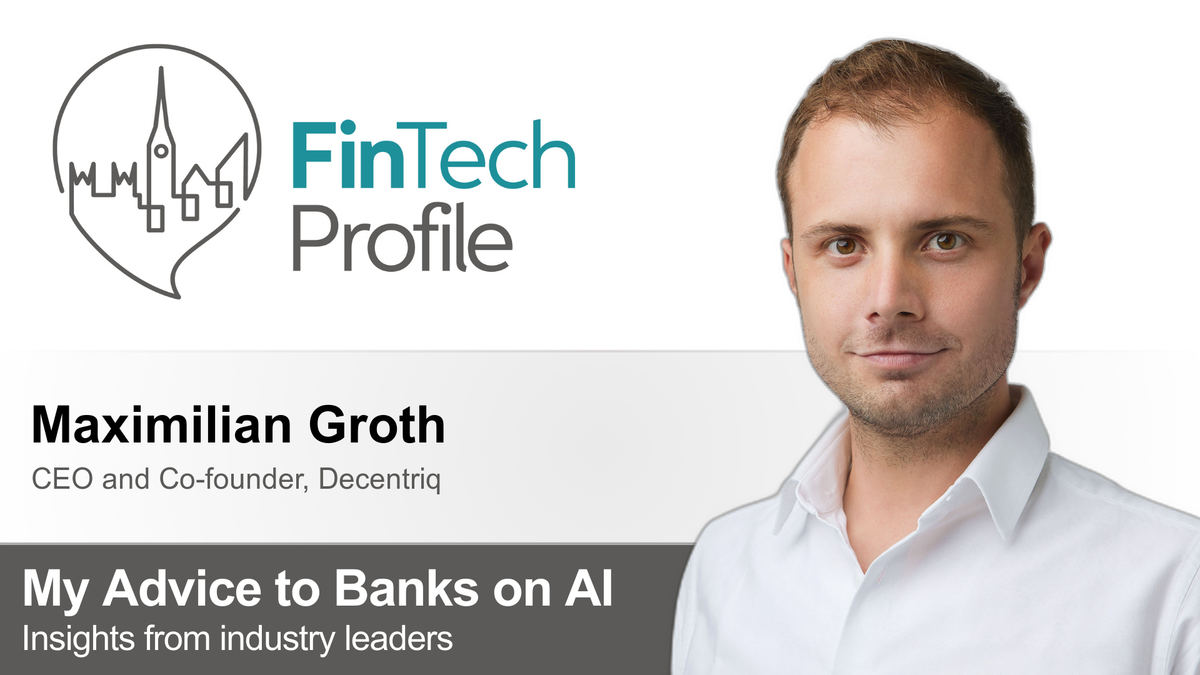
Maximilian Groth is CEO and Co-founder of Decentriq, a Swiss company building privacy-preserving data clean rooms that enable organisations to collaborate on sensitive data without exposing raw datasets. With deep experience in strategy and technology roles, Max has seen firsthand how institutional mistrust locks away data value - and he's built the infrastructure to solve it. In this Q&A, he shares his practical advice for bank executives navigating the gap between AI ambition and data reality.
My questions are in bold - over to you Maximilian:
Can you give us an introduction to you and an overview of your organisation?
I am the CEO and Co-founder of Decentriq, a Swiss company that builds privacy-preserving data clean rooms.
Our technology lets organizations collaborate on sensitive data with partners (and even with competitors) without ever exposing the underlying data itself, because the data stays encrypted even while it is being processed, not just at rest or in transit.
We work across advertising and media, as well as regulated industries such as banking, healthcare, and insurance. Our technology serves the need wherever two or more parties need to combine data to generate value but cannot simply hand each other raw datasets.
Financial services is one of the sectors where this matters most, given the regulatory scrutiny and reputational stakes involved, and it is a big part of why I am speaking with you today. Before founding Decentriq, I spent years in strategy and technology roles where I saw how much value gets locked away because organisations cannot trust each other, or even their own internal silos, with sensitive data. That experience convinced me that the real bottleneck to unlocking that value sits in infrastructure, which is the problem we set out to solve.
If you were advising a bank CEO today, what would you say is the single biggest mistake they're making with data and AI?
The single biggest mistake I see is treating data governance and AI strategy as two separate workstreams owned by two separate teams. Banks tend to hand AI ambitions to innovation or digital teams while data governance, compliance, and security stay firmly with risk and legal. That split creates a constant tug-of-war, where promising AI use cases stall at the exact point where they need to touch real customer or transaction data.
The banks making real progress have closed that gap. They treat privacy-preserving infrastructure as a prerequisite for AI experimentation rather than a separate hurdle to clear afterward, which lets initiatives move from pilot to production in months instead of years.
What's one AI or data capability banks should prioritise in the next 12-18 months, and why?
If I had to pick one capability, it would be secure, scalable data collaboration, both between institutions and across internal silos. Most banks already run AI pilots on data they fully own and control, but the highest value use cases, such as fraud detection, anti-money laundering, and credit risk modelling, all improve dramatically when you can bring in signal from other institutions or third parties.
The reason this has not happened at scale is a combination of regulatory constraints and institutional trust. Clean room technology based on confidential computing addresses both by letting multiple parties run computations together while each keeps full control over its own data and never sees the other side's raw records, which satisfies data protection requirements that would otherwise block this kind of collaboration entirely.
Over the next 12 to 18 months, I expect the banks that invest here to pull meaningfully ahead of peers who keep trying to solve collaboration problems with contracts and manual data sharing agreements alone.
Where do you see banks overestimating AI, and where are they underestimating it?
Banks tend to overestimate how quickly a single large language model (LLM) deployment will transform their operations, and underestimate how much of the real work sits in the unglamorous plumbing around it. There is a lot of enthusiasm for chatbots and copilots, and those are useful, but they are also the least structurally important part of the AI opportunity.
What gets underestimated is the value of connecting and maintaining data across departments and partners so that any model, whether a large language model or a simpler statistical one, has something reliable to work with. Plenty of executives get excited about a flashy AI demo while the underlying customer data is still fragmented across a dozen legacy systems that never talk to each other. Fixing that is less exciting to announce, but it is where the actual return on investment comes from.
What does "good" actually look like when AI and data are working well inside a bank?
Good looks like AI initiatives that touch real, sensitive data without a six-month legal and security review for every new use case.
In a bank where data and AI are working well, product, risk, and compliance teams are not adversaries. Instead, they operate on shared infrastructure with privacy guarantees built in, so a new fraud model or a new cross-departmental analysis can be tested and validated quickly because the underlying data access is already provably safe.
You also see collaboration extending beyond the bank's own walls, whether that is working with other financial institutions on shared fraud signals or partnering with retailers and telcos on customer insight, all without raw data ever leaving its source. The end result is that AI stops being a series of isolated pilots and becomes a genuine operating capability that compounds over time.
What's the hardest AI or data decision bank executives are avoiding right now, and why?
The hardest decision bank executives are avoiding is whether to actually collaborate on sensitive data with other institutions, even when the technology exists to do it safely.
There is understandable caution here given decades of regulatory scrutiny and reputational risk around data handling, but that caution has become a habit that persists even after the underlying trust problem has been solved.
Executives worry more about the perception of data collaboration than about the actual technical risk, which today can be reduced to close to zero with confidential computing and cryptographic guarantees. The institutions that get ahead of this will be the ones willing to pilot cross-institutional collaboration now, while it still counts as a competitive advantage rather than a catch-up move. Waiting for the rest of the industry to move first is itself a decision, and usually the wrong one.
Thank you Maximilian! You can connect with Maximilian on his LinkedIn Profile and find out more about the company at decentriq.com.