Stephen Flood, CEO and Co-Founder, GoldCore
Stephen Flood shares his journey from Goldman Sachs to founding GoldCore, a platform enabling direct ownership of physical precious metals outside the banking system.
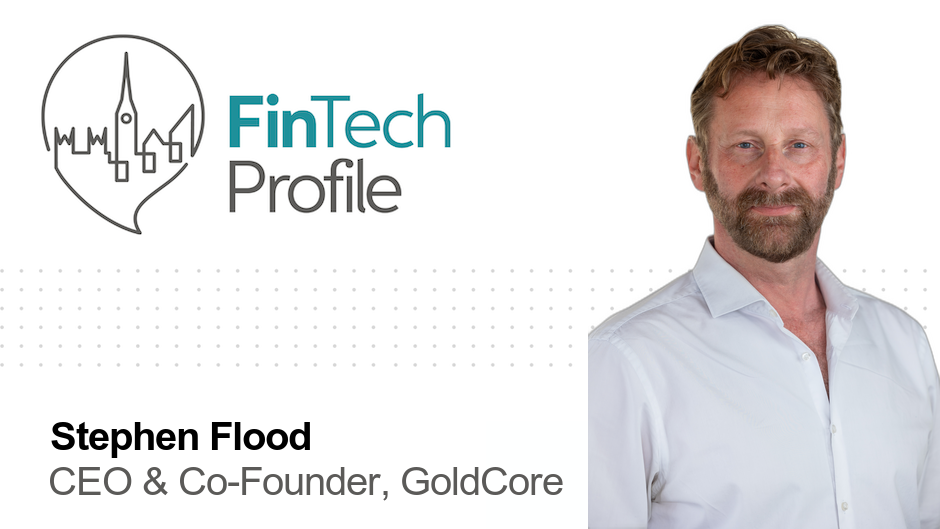
Today we're delighted to speak with Stephen Flood, CEO and Co-Founder of GoldCore, an international precious metals dealer and investment platform. Stephen's journey from Goldman Sachs equity derivatives trader to building a wealth preservation business offers fascinating insights into market risks, client asset protection, and the future of physical asset ownership in an increasingly digital world.
My questions are in bold - over to you Stephen:
Who are you and what's your background?
I studied business in Dublin, and like many young graduates in the late 1990s, found myself drawn to the promise of Wall Street. I moved to New York with zero connections and spent several years working across various trading roles before landing a job on the equity derivatives desk at Goldman Sachs.
Spending seven years as a sales trader was an incredible education, it forced me to understand the inner workings of institutional risk, market psychology, and the sheer scale of global capital. But it also showed me how easily financial products can lose touch with the real world. By 2003, I was newly married and my priorities changed. I wanted to use what I'd learned about market risks to build a business of my own, which brought me back home to Ireland to start GoldCore.
What is your job title and what are your general responsibilities?
As the CEO and Co-Founder, I ensure the business runs effectively and is working towards our growth plans. I'm responsible for both the day-to-day management of the business, and I work with select clients and strategic partners to cultivate new business opportunities. Equally, my job is maintaining the culture of accountability we've built over the past two decades.
While my main objective each day is ensuring that our operations match the promises we make to our clients, my daily routine is heavily influenced by the lessons learned during my time on Wall Street. In New York, I worked long and crazy hours. Today, I protect my work-life balance. I live in the rural Dublin Mountains with my wife and three boys, so my weekends are reserved for family, mountain walking, and cycling.
Can you give us an overview of your business?
GoldCore is a specialist platform for physical precious metals. When a client uses our platform, either through our app or our website, they are purchasing physical bullion bars and coins that are individually allocated, segregated, and securely vaulted across top-tier sovereign jurisdictions.
Historically, this industry was split down the middle: you either dealt with old-school bullion brokers, or modern digital platforms that only traded paper assets. We built the missing link. We have spent years constructing a secure global logistics network that ties directly to government mints and international vault operators, then wrapping it in a highly intuitive digital interface. The result is an application that makes holding physical wealth just as straightforward as managing any other investment portfolio.
Tell us how you are funded?
When you are in the business of wealth preservation, partnering with investment funds that want a quick payout and operate on fixed exit timelines makes absolutely no sense.
External investors inevitably push for fast growth to hype up the company's value, which can lead to taking risks and cutting corners. As such, we have purposely avoided venture capital and remain self-funded.
What's the origin story? Why did you start the company?
The catalyst for GoldCore was seeing how almost everyone was ignoring the massive risks hidden inside the banking system. My time on Wall Street showed me that when things go wrong, market confidence can fade in an instant. Everyone was chasing the next complex financial product, while the basic concepts of wealth protection were often being completely overlooked.
We wanted to address a common misconception. Most people think that the money sitting in their everyday bank account is safely locked away as their personal property. Legally, it isn't. The moment you hand your cash over to a bank, you are essentially lending it to them. If that bank runs into trouble, your money is on the line. GoldCore was founded to break down those barriers and give people a simple, direct way to own real, physical assets that sit completely outside the banking system.
Who are your target customers? What's your revenue model?
Anyone who recognises that over-reliance on traditional banking networks is a distinct financial risk. Our demographic spans from regular savers allocating £100 a month through our automated regular savings plans, to financial advisers, multi-family offices, and institutional managers protecting multimillion-pound portfolios. We also work with a lot of investors who simply want a secure, tangible anchor to protect their broader wealth, balancing out the riskier ventures or higher-growth investments in their portfolios.
GoldCore's revenue model is clean, transparent, and completely free from hidden fees. We generate a commercial margin on the wholesale buy-and-sell spreads of the bullion, alongside a steady stream of recurring revenue from our annual vaulting and secure custody services, which is calculated as a percentage of the total value held under our care.
If you had a magic wand, what one thing would you change in the banking and/or FinTech sector?
I would stop financial companies from using customer assets to fund their own bets. Right now, the investment world is full of situations where the exact same asset is effectively promised to multiple people at the same time across different markets.
If we forced companies to keep client assets completely separate and safely under the customer's direct ownership, it would protect people from a firm's own financial troubles. Technology should be used to make direct ownership simpler, not to invent new ways to package and trade debt.
What is your message for the larger players in the Financial Services marketplace?
My message to those running private banks and wealth funds is that you are overestimating how safe your digital investments are. Putting money into ten different funds isn't real diversification if they all rely on the exact same banking system.
When a crisis hits the market, everything tends to drop simultaneously, and those digital assets can become incredibly hard to turn into cash. If you are genuinely committed to protecting your clients' wealth, you have to step outside the standard banking network and hold a meaningful portion of it in real, tangible assets.
Where do you get your Financial Services/FinTech industry news from?
I am a big fan of the Financial Times. Beyond the main articles, I find diving into the reader commentary incredibly useful; it shows you what actually resonates and has a real-world impact. I also subscribe to the Payments Industry Intelligence newsletter, which consistently offers insights into everything from crypto and regulation to payments innovation. For global coverage, I use a Summate subscription, which scours articles and videos from around the world and feeds me back concise, bulleted summaries.
Can you list 3 people you rate from the FinTech and/or Financial Services sector that we should be following on LinkedIn, and why?
- Colum Lyons (ID-Pal): Colum is a thought leader in identity verification. Despite what libertarian maximalists might think, every secure transaction ultimately hinges on knowing the true bona fides of the other party. ID-Pal makes identifying yourself as painless as possible. Colum has worked incredibly hard in a less sexy, yet utterly pivotal sector of the landscape - and he is a terrific human being to boot.
- Ray Dalio (Bridgewater Associates): Some people don't know who he is, which surprises me. For me, his incredible writings have been life-changing. He authentically writes and educates people about a changing world, and bangs on the table for change because he knows where our current financial misadventures end - hint: it's not a good place. He has made his money, and then some. His work today is about trying to teach future generations that they need not make the mistakes of the past. By looking at history and understanding mega-trends, we can do a better job. He strikes me as someone who still has faith in leadership - I admire him greatly.
- Sean Blanchfield (Jentic): You probably don't know him, but I have a sneaky feeling you will someday. He is an Irish entrepreneur and deep thinker with a background in coding, gaming, and large-scale systems. Sean is fascinated by AI and where it will take us. He constantly muses about what is to come and has just launched a new company that activates API and data repositories for an AI world. He writes annoyingly smart posts complete with cartoons that will really get you thinking. He is definitely one to watch.
What FinTech services (and/or apps) do you personally use?
It's not so cool anymore, but I do have a play with the Revolut app and their investment tools from time to time. They are UX/UI leaders. Recently, I was blown away by how easy it was to buy a SpaceX CFD with four-times leverage! I wanted to get an allocation as a way to manage the FOMO impact should they start to shoot up, figuratively and physically. Yes, I am aware of my mental frailties, and allocating play money on a whim is one of the best ways to manage them. My trade is currently losing money, but I feel completely fine!
What's the best new FinTech product or service you've seen recently?
Oraion.ai. Full disclosure: I liked these guys so much I actually invested in them. They have created a space that allows financial and research firms to trawl through every single piece of data they have ever generated and surface the company's core essence into a series of "golden rules." While they are sector-agnostic, they have made massive inroads into research functions. They put the company data to work, generating heavy-lifting tasks like deep research reports and investment theses in a fraction of the time, with a significantly higher quality output. If the markets are fundamentally about capital finding the best projects, tools like this are vital. I know the team, I love the problem they are solving, and the product is excellent. They are gaining serious traction and signing up some big hitters.
Finally, let's talk predictions. What trends do you think are going to define the next few years in the FinTech sector?
I believe the coming years will see a continued shift toward private wealth sovereignty. As government debt grows and money loses its value to inflation, investors are going to look more closely at the risks of holding their entire portfolio in purely digital formats.
When a panic hits, everyone tries to get their hands on physical assets at the same time, and standard systems simply can't handle the sudden demand. Because of this, financial technology will move past digital tokens and focus on building the tools needed to trade real, physical assets safely. The long-term winners won't be the platforms chasing short-term trends; it will be the businesses that can combine easy digital access with real, secure protection for your savings.
Many thanks to Stephen Flood for taking the time to share his insights with us. You can learn more about GoldCore and their precious metals investment platform at their website.