Hana Rolles, Commercial Director EMEA, Lorum
Hana Rolles on building specialist clearing infrastructure, why settlement delays persist, and how Lorum is rebuilding correspondent banking for the next age of banking.
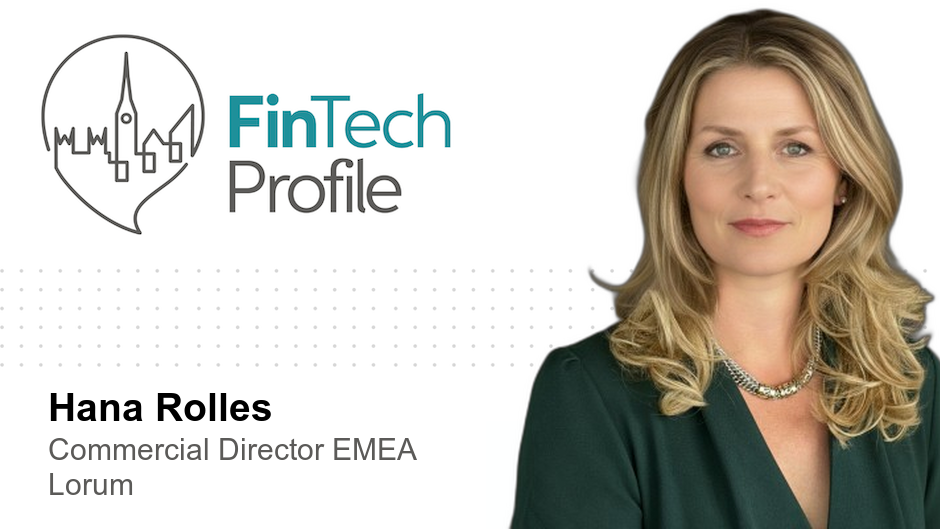
Today we're delighted to speak with Hana Rolles, Commercial Director EMEA at Lorum. With a background spanning McKinsey, Visa, and senior roles at Paynetics UK and Bank of London, Hana brings deep perspective on why traditional correspondent banking is structurally flawed - and how specialist infrastructure providers are rebuilding the rails that global institutions depend on.
My questions are in bold - over to you Hana:
Who are you and what's your background?
I'm Hana Rolles, Commercial Director EMEA at Lorum. By training I'm a civil engineer, and that instinct for building something new never left me after I moved into financial services. My career has taken me from McKinsey consulting to Visa, where I closed and managed global partnerships with companies like Klarna and Amazon, then on to CEO UK at Paynetics UK and Chief Commercial Officer at Bank of London. Along the way I completed an MBA at London Business School, which opened my thinking to new industries, geographies, and ways of working.
I'm happiest in mid-size fintechs achieving double-digit month-on-month growth, where building happens in real time and you can see the impact quickly. Lorum sits squarely in that space: serious infrastructure ambition, serious execution pace, rebuilding how institutions clear and settle money globally. In some ways we're building a new-age BNY, a bank for banks.
What is your job title and what are your general responsibilities?
I'm Commercial Director EMEA at Lorum, and my mandate is straightforward: build the commercial function across the region to support our growth targets this year. That means hiring and leading the team, defining how we go to market, and owning the relationships with the regulated institutions, platforms, and fintechs we work with.
But there's a bigger thread running through it. We're not selling a product into an established category. We're building the infrastructure for the next age of banking, where clearing is a specialist function with full reserves and no lending conflict, not an afterthought inside a traditional balance sheet. That context shapes everything commercially: the clients we go after, the conversations we have, and how we position Lorum as genuinely different. EMEA is my patch, and I'm here to make sure the right institutions understand why that difference matters.
What's the origin story? Why did you start the company? To solve what problems?
Lorum is multi-currency clearing and treasury infrastructure for regulated institutions. Founded by George Davis, Lorum was built on a clear-eyed view of correspondent banking's real problem: settlement taking two to five days, not because the system itself is broken, but because clearing has lived inside banks whose core business is lending, so settlement gets subordinated to balance-sheet priorities. We built Lorum as a specialist clearing function in its own right, with treasury built into the core, so liquidity, settlement, and reconciliation sit in one controlled system rather than scattered across providers.
Clients access global and local licences, direct central bank connectivity, and domestic payment rails through a single API, opening named customer accounts in each market we support while retaining full ownership of their end-customer relationships. We operate on a full-reserves model with no lending book, removing the conflict of interest that has defined traditional correspondent banking. We've also applied for a U.S. National Trust Bank licence, which would give us direct real-time access to U.S. banking infrastructure for our clients.
Who are your target customers? What's your revenue model?
Our clients sit at the sharp end of multi-currency clearing and settlement: banks, electronic money institutions, payment institutions, and any regulated business moving significant volumes across markets in real time. These are organisations that can't afford settlement uncertainty, where a delay isn't an inconvenience, it's a balance sheet problem. They're typically operating across multiple currencies and markets simultaneously, and they've hit the ceiling of what traditional correspondent banking offers: fragmented relationships, inconsistent rails, trapped liquidity, and timelines they can't predict or control.
What they need is a single, reliable infrastructure partner with named account custody, local rails, and treasury control built in, not stitched together from five different providers. That's exactly what Lorum is built to be, for fintechs scaling rapidly and established institutions that need infrastructure to match their ambition without compromising on reserves or regulatory rigour.
What is your message for the larger players in the Financial Services marketplace?
Specialism is winning. The institutions that will define the next decade aren't trying to do everything. They're doing one thing exceptionally well and solving their customers' problems.
For large incumbents, the real risk isn't fintech competition on product, it's the structural shift happening underneath, where specialist infrastructure providers are rebuilding the rails you depend on, with cleaner incentives and fewer conflicts of interest. Clearing is the obvious example: when lending banks run it as a side function, everybody loses. The message is simple: partner with specialists sooner rather than later, while the window to do it on your terms is still open.
Where do you get your Financial Services/FinTech industry news from?
The FT for macro context, since rate environments and regulatory policy shape our market directly. LinkedIn for real-time thoughts from my network, most of whom are payment geeks too, and for the commentary underneath announcements rather than the announcements themselves. Honestly, the most valuable intelligence still comes from face-to-face conversations with customers and partners.
Can you list 3 people you rate from the FinTech and/or Financial Services sector that we should be following on LinkedIn, and why?
- Marieke Flament, ex-MD of Circle and ex-CEO of a bank, is one of the sharpest minds in tokenised assets. If you want to understand the forces shaping the crypto and tokenised assets world, she's the one to follow.
- Panagiotis Kriaris combines deep technical understanding of embedded finance and payments with real intellectual honesty about where fintech, payments, and banking are heading.
- Lynda Gratton, Professor at London Business School, is one of the leading thinkers on the future of work and organisations.
What FinTech services (and/or apps) do you personally use?
I test a lot of apps, it's part of how I stay close to what's being built, but I rarely stick with most of them. The ones that earn loyalty do so by being genuinely useful rather than clever. Revolut is a good example: not my primary bank, and I wouldn't leave significant funds there, but for day-to-day use it works, which is more than can be said for plenty of better-funded products.
I also use trading apps regularly, since markets are a useful lens on the macro trends that affect our business. The apps I keep coming back to solve a real problem without overcomplicating it, a harder standard to meet than it sounds.
What's the best new FinTech product or service you've seen recently?
Brex has caught my attention. What started as a corporate card for startups has quietly evolved into an AI-native finance platform that automates expense management, policy enforcement, and accounting workflows end-to-end. Doing expenses now, compared with ten years ago, is almost a joy.
Finally, let's talk predictions. What trends do you think are going to define the next few years in the FinTech sector?
Three forces stand out. First, countries asserting sovereign control over payment rails, which will challenge truly global real-time networks like Visa and Mastercard. Second, AI enabling hyper-personalised financial services at scale: the kind of tailored advice and product access once reserved for private banking clients is becoming available to everyone. That's a genuine democratisation.
Third, the disintermediation of traditional banks, as businesses and consumers increasingly access better value, faster service, and greater transparency directly through specialist providers. Banks still hold real advantages in trust and regulation, but the middle ground is shrinking, and new infrastructure players are capturing it.
Thank you to Hana Rolles for sharing her insights with us here at FinTech Profile - check out her profile on Linkedin and find out more about Lorum at www.lorum.com.