Marija Nakevska, Chief Product and Technology Officer, Pleo
Marija Nakevska discusses how Pleo is building a platform for full financial intelligence, the shift from responsive to agentic AI, and why the best fintech feels invisible.
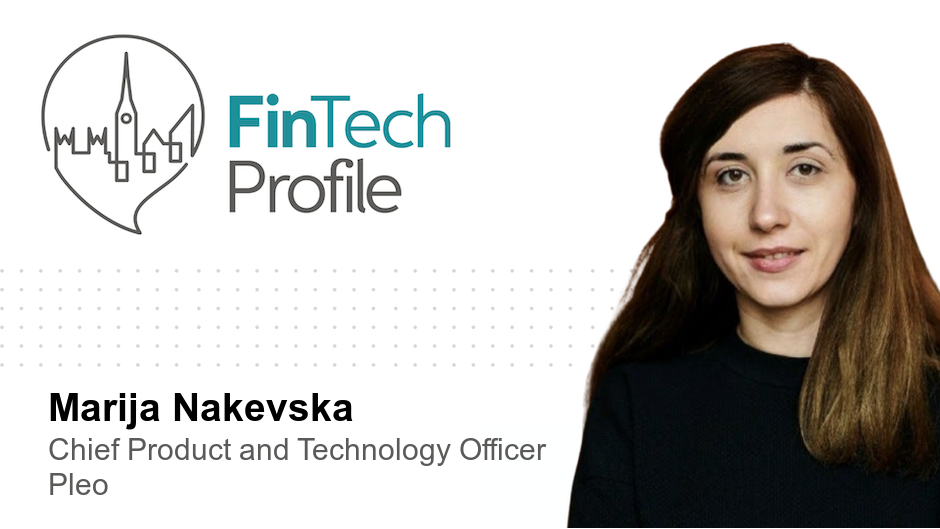
Today we're delighted to speak with Marija, Chief Product and Technology Officer at Pleo, about building products that eliminate friction in business spending. With a background in fintech and a passion for world-class user experiences, Marija shares her vision for AI that acts rather than responds, and why the best financial tools are the ones you barely notice.
My questions are in bold - over to you Marija:
Who are you and what's your background?
I'm Marija Nakevska. My background is in Fintech and building products that put customers first and deliver world-class user experiences.
What is your job title and what are your general responsibilities?
I'm Chief Product and Technology Officer at Pleo. In short, I'm responsible for making sure we build the right things, build them well, and get them into customers' hands in a way that actually makes a difference.
That covers a few distinct areas. Product engineering is where we design and evolve the products our customers use every day. Platform engineering focuses on the underlying infrastructure that keeps everything running reliably and lets our teams move fast without breaking things. We also have an enterprise engineering function that works closely with GTM, Finance, and People, making sure the business itself has the internal systems it needs to operate well.
On top of that, I lead our security and fraud engineering teams. Keeping the platform safe and staying ahead of fraud is non-negotiable. It's the foundation everything else depends on.
Can you give us an overview of your business?
Pleo gives companies the tools to take control of how money moves through their organisation, smart cards, automated expense reporting, and real-time spend visibility, all in one platform.
The result: less time chasing receipts, less operational drag, and finance teams that can actually see what's happening as it happens.
When spending stops being a headache, businesses can get back to what matters – building, growing, and moving forward.
Tell us how you are funded?
Since 2017, Pleo has raised around roughly EUR 370M in venture funding. That backing has given us the runway to build seriously, expand thoughtfully, and scale at a pace the market demands.
It's also allowed us to think bigger. We started out solving expense management, which felt like a clear and obvious problem. But the vision has grown considerably — today we're building a platform for full financial intelligence, bringing card payments, subscriptions, invoices and transfers together in one place. That kind of ambition takes real investment, and we've been fortunate to have backers who share that long-term view.
What's the origin story? Why did you start the company? To solve what problems?
Pleo was founded by Jeppe Rindom with a clear ambition: to eliminate the friction and inefficiency of traditional expense management. Recognising how much time businesses were losing to manual processes, he set out to create a smarter, more automated way for companies to manage spend.
The result is a platform that removes much of the administrative burden from finance operations — from capturing receipts to categorising expenses automatically. For employees, it creates a far more intuitive and autonomous spending experience. For finance teams, it delivers the control, visibility and operational efficiency they have long needed.
Today's finance leaders are expected to operate as strategic partners to the business, yet many are still constrained by disconnected systems and limited visibility. To make informed decisions and lead effectively, they need integrated tools, connected data and real-time insight.
Pleo solves this by bringing every payment, account and financial workflow into one connected platform. It enables finance teams — from CFOs to executives — to streamline accounting, strengthen compliance, navigate uncertainty, maintain real-time visibility across entities and adopt AI-driven processes with confidence.
Ultimately, Pleo is about enabling a healthier way of working – one that supports autonomy, encourages innovation and gives organisations the tools to move faster and focus on what actually drives impact.
Who are your target customers? What's your revenue model?
Our sweet spot is SMBs through to mid-market companies. Businesses that have outgrown spreadsheets and manual processes but don't want the complexity of enterprise-grade finance systems.
We operate on a subscription model that scales with team size and usage. It's deliberately straightforward. As customers grow, the platform grows with them, and the pricing reflects that.
If you had a magic wand, what one thing would you change in the banking and/or FinTech sector?
I'd remove the unnecessary friction that still makes everyday financial experiences harder than they need to be.
Most people don't want to think about which payment rail is running in the background, or which bank is processing their transaction. They just want it to work quickly, clearly, without having to jump through hoops. Yet somehow, money management is still spread across too many tools, wrapped in jargon, and slowed down by processes that feel like they were designed to frustrate rather than help.
The biggest opportunity in fintech isn't adding more features — it's making money feel simple, reliable, and genuinely human. That is what we're doing at Pleo.
What is your message for the larger players in the Financial Services marketplace?
Of course we're seeing a huge amount of chat about AI. Yes, it can drive efficiencies, but if you only view it through the lens of reducing headcount or cutting costs, you're missing the bigger opportunity. The real potential is in how it enables teams to work differently – more productively, more creatively, and ultimately in ways that can unlock new growth.
What I find genuinely exciting isn't the companies shouting loudest about AI, it's the ones where you almost don't notice it's there. The best examples I've seen recently are using it to get ahead of problems: proactively surfacing anomalies, flagging inefficiencies before they compound, turning data that used to sit in a report nobody read, into something that actually prompts action. That's intentional AI.
Embedding AI into a product is meaningless on its own. What matters is intentional, customer-obsessed application – a deep understanding of user needs and whether AI genuinely makes experiences faster, simpler, smarter and more contextual.
AI should push you to rethink processes, evolve how your organisation operates, and challenge assumptions about what your teams spend their time on. If you approach it as an enabler of productivity and innovation rather than just a lever for savings, you're going to get a fundamentally different – and far more meaningful outcome.
Where do you get your Financial Services/FinTech industry news from?
My LinkedIn feed is full of FinTech industry news, nowadays also many AI related news. I read TechCrunch and Wired regularly. Both are good for keeping a pulse on the broader tech landscape, not just fintech. I find a lot of great reading material on Medium, and Medium is where I do a lot of my own writing too.
Can you list 3 people you rate from the FinTech and/or Financial Services sector that we should be following on LinkedIn, and why?
- Marcel Van Oost
Marcel is sharing a personal newsletter on www.connectingthedotsinfin.tech and always comes first with the latest news in Fintech. His posts are very informative and well researched. - Patrick Collison
Patrick, the founder of Stripe, is one of the most influential global payment platforms powering businesses of all sizes. His posts and thought leadership cover the future of payments infrastructure, fintech scale-ups, and real-world trends shaping digital commerce. - Lenny Rachitsky
While not exclusively focused on FinTech, Lenny shares some of the most relevant thinking on product leadership, emerging technology, AI-native product development, and scaling modern software companies, making him particularly valuable for product leaders interested in how AI is reshaping how products are built and teams operate.
What FinTech services (and/or apps) do you personally use?
I travel quite a lot and work internationally so seamless digital banking and payments are essential. Of course Pleo is naturally part of my daily workflow for managing company spending.
What's the best new FinTech product or service you've seen recently?
I look for FinTech products that do one thing above all else: get out of the way. The best ones feel invisible, they handle complexity in the background so you're never really thinking about the tool, just getting on with what you need to do.
Usability and transparency are non-negotiable for me. I want to know exactly what something costs, what's happening with my money, and why, without having to dig through small print. That clarity is still rarer than it should be.
I'm also drawn to services that are genuinely built for how people actually live and work. Some of the best examples I've come across are UK-based products that handle local payment methods like Faster Payments natively, while still working seamlessly the moment you cross a border, that combination is harder to pull off than it sounds, and when it works well, it's a real differentiator.
More broadly, the bar I hold FinTech products to is the same one I apply at Pleo: does this make something meaningfully faster, clearer, and less stressful? If a product saves me time, removes a decision I didn't want to make, or just quietly does what I expected, that's the standard. It's deceptively simple and still, surprisingly, not universal.
Finally, let's talk predictions. What trends do you think are going to define the next few years in the FinTech sector?
The novelty phase of AI is ending, and that's a good thing. We're moving from companies experimenting with AI to companies either genuinely deploying it or quietly pretending they are. The gap between those two groups is going to become very obvious, very quickly.
The shift I'm most focused on is from AI that responds to AI that acts. Agentic AI, systems that can reason, plan, and execute autonomously across workflows, is where the real competitive differentiation will happen. The question stops being "can AI answer this?" and becomes "can AI own this end-to-end, on behalf of the customer, without them having to ask twice?"
The companies that get this right will build AI that earns autonomy, grounded in genuine customer understanding, not retrofitted onto existing products as an afterthought.
Many thanks to Marija for taking the time to share her insights with FinTech Profile. You can learn more about Pleo on their website.