Manuel Dueñas, Senior Fraud Lawyer, Crypto Legal
Manuel Dueñas discusses cryptocurrency fraud investigations, blockchain forensics, and the convergence of traditional finance with digital assets at award-winning firm Crypto Legal.
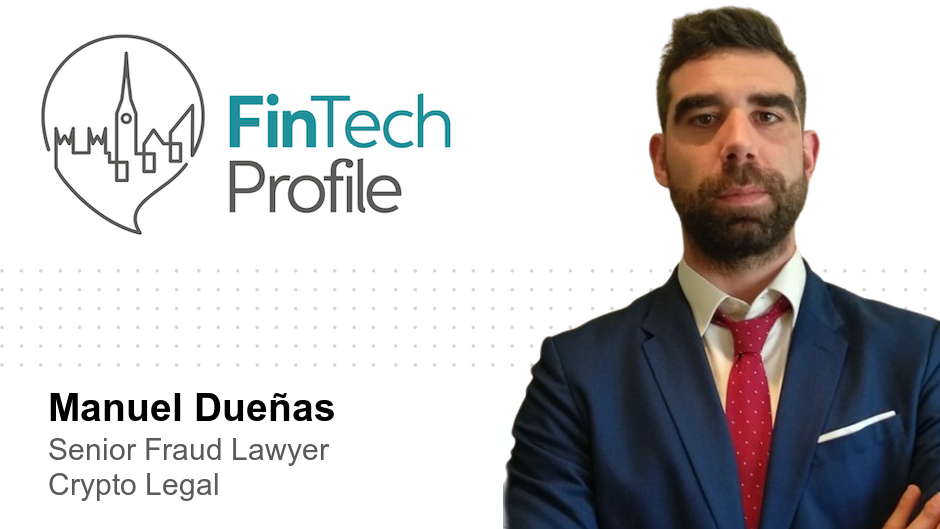
Today we're delighted to speak with Manuel, Senior Fraud Lawyer at Crypto Legal, an award-winning blockchain legal and forensic firm. With cryptocurrency fraud and asset tracing becoming increasingly complex, Manuel shares insights on bridging the gap between traditional legal expertise and blockchain technology, and why institutional collaboration will define the future of financial services.
My questions are in bold - over to you Manuel:
Who are you and what's your background?
I am a Senior Fraud Lawyer at Crypto Legal. My professional background combines law, technology, blockchain investigations, compliance, and digital asset advisory services. Over the past decade, I have worked extensively within the cryptocurrency sector, helping individuals, businesses, exchanges, and institutions navigate the increasingly complex intersection between blockchain technology, regulation, fraud prevention, and asset recovery.
From the earliest stages of blockchain adoption, it became clear that cryptocurrencies would fundamentally reshape the financial services landscape. At the same time, the industry faced significant challenges relating to fraud, scams, regulatory uncertainty, compliance obligations, and the practical difficulties of tracing digital assets across multiple jurisdictions.
My work has focused on building practical solutions to these challenges. Through Crypto Legal, we have assembled a multidisciplinary team of lawyers, blockchain forensic specialists, compliance professionals, and investigators capable of supporting clients across a broad range of matters involving cryptocurrencies and digital assets.
Today, we work with clients globally and have established Crypto Legal as one of the most recognised firms operating within the digital asset legal and forensic sector.
What is your job title and what are your general responsibilities?
As a Senior Fraud Lawyer at Crypto Legal, my role combines legal oversight, strategic leadership, and specialist advisory work within the digital asset sector. I work closely with clients, exchanges, financial institutions, and industry stakeholders on matters involving cryptocurrency fraud, blockchain investigations, asset tracing, compliance, and regulatory risk.
My day-to-day responsibilities include supervising complex investigations, overseeing legal and forensic strategies, monitoring regulatory developments, and ensuring that our clients receive clear, commercially practical guidance in an industry that continues to evolve at a rapid pace. I also collaborate with blockchain analysts, compliance professionals, and legal teams to deliver multidisciplinary solutions to increasingly sophisticated digital asset challenges.
A key aspect of my role is staying at the forefront of emerging trends in cryptocurrency crime, blockchain technology, and financial regulation. This enables us to continuously adapt our services, strengthen our investigative capabilities, and help clients navigate the opportunities and risks presented by the evolving digital asset ecosystem.
Can you give us an overview of your business?
Crypto Legal is a specialist blockchain legal and forensic firm focused exclusively on cryptocurrency and digital asset matters.
We provide blockchain forensic investigations, cryptocurrency tracing, fraud analysis, compliance advisory services, AML support, exchange engagement, dispute support, wallet attribution analysis, and digital asset intelligence services.
Our clients range from private individuals through to corporate entities, financial institutions, blockchain projects, exchanges, and professional service firms.
One of the factors that differentiates Crypto Legal is our combination of legal knowledge and technical blockchain expertise. Cryptocurrency matters frequently require both disciplines. Understanding the law is important, but understanding how assets move across blockchains, mixers, decentralised protocols, bridges, exchanges, and wallets is equally critical.
Over the years, our work has been recognised extensively throughout the industry. Crypto Legal has received 72 awards and industry recognitions across legal, blockchain, cybersecurity, compliance, and digital asset sectors. These recognitions reflect both the quality of our work and our commitment to advancing professional standards within the cryptocurrency industry.
As digital assets become increasingly integrated into mainstream finance, we believe specialised expertise will become more important than ever.
Tell us how you are funded?
Crypto Legal has been built through a disciplined and sustainable growth strategy.
We have focused on developing the business through client demand, service quality, and operational efficiency rather than pursuing rapid expansion for its own sake. This approach has allowed us to remain independent while continuously investing in specialist expertise, technology, research, and investigative capabilities.
We believe that maintaining independence allows us to prioritise long-term client outcomes and strategic development over short-term growth targets.
What's the origin story? Why did you start the company? To solve what problems?
Crypto Legal was established in response to a significant gap in the market.
As cryptocurrency adoption accelerated, there was a growing number of individuals and businesses facing highly specialised challenges involving blockchain transactions, digital asset disputes, fraud, compliance obligations, and asset tracing. Traditional legal providers often lacked the technical expertise necessary to understand blockchain technology, while many technical firms lacked legal and regulatory understanding.
We recognised that clients needed a specialist firm capable of bridging both worlds.
Our objective was to create a business that could combine legal expertise, forensic investigation, blockchain intelligence, and compliance knowledge within a single organisation. By bringing these disciplines together, we are able to provide practical solutions to problems that frequently span multiple jurisdictions, technologies, and regulatory frameworks.
Who are your target customers? What's your revenue model?
Our clients include private investors, cryptocurrency holders, blockchain businesses, exchanges, financial institutions, fintech companies, legal professionals, insolvency practitioners, and corporate organisations.
We generate revenue through the provision of specialist professional services, including forensic investigations, blockchain analysis, compliance advisory work, intelligence reports, due diligence services, dispute support, and digital asset consultancy.
Many of our engagements involve complex matters requiring significant technical and legal expertise. As the digital asset ecosystem continues to mature, we have seen growing demand from institutional clients seeking specialist support in areas such as AML compliance, blockchain intelligence, and risk management.
If you had a magic wand, what one thing would you change in the banking and/or FinTech sector?
I would encourage greater cooperation between traditional financial institutions and the digital asset sector.
There is often a perception that these industries operate in opposition to one another, when in reality they share many common objectives, including financial security, compliance, transparency, innovation, and consumer protection.
Improved collaboration would help accelerate innovation while simultaneously strengthening safeguards against financial crime. Ultimately, the most effective financial ecosystem will be one that combines the strengths of traditional finance with the efficiency and transparency offered by blockchain technology.
What is your message for the larger players in the Financial Services marketplace?
Digital assets are no longer a niche technology.
The sector has evolved significantly over the past decade and now represents an increasingly important component of the global financial ecosystem. Institutions that invest time in understanding blockchain technology today will be significantly better positioned for the future.
The key is not simply adopting new technology but developing the expertise, governance structures, compliance frameworks, and risk management systems required to use it responsibly.
Those organisations that successfully balance innovation with robust controls are likely to be the most successful over the coming years.
Where do you get your Financial Services/FinTech industry news from?
I follow a combination of specialist fintech, regulatory, legal, cybersecurity, and blockchain publications.
I also monitor updates from regulators, financial authorities, blockchain analytics providers, industry associations, and major financial institutions. Given the speed at which the sector evolves, it is important to obtain information from multiple sources and perspectives.
Can you list 3 people you rate from the FinTech and/or Financial Services sector that we should be following on LinkedIn, and why?
- Michael Saylor: Michael has played a significant role in advancing institutional conversations around digital assets and long-term technology adoption.
- Caitlin Long: Caitlin provides thoughtful commentary on financial regulation, banking innovation, and the integration of digital assets into traditional finance.
- Brad Garlinghouse: Brad has been one of the most prominent voices discussing blockchain adoption, regulatory engagement, and the future of cross-border financial infrastructure.
What FinTech services (and/or apps) do you personally use?
I regularly use a range of fintech and digital asset platforms for payments, banking, compliance monitoring, and blockchain analytics.
I am particularly interested in products that improve transparency, security, efficiency, and accessibility within financial services. The most valuable fintech products are often those that remove friction while maintaining strong compliance and security standards.
What's the best new FinTech product or service you've seen recently?
One of the most interesting developments has been the continued evolution of blockchain intelligence and compliance technologies.
The sophistication of modern transaction monitoring, wallet attribution, risk scoring, and blockchain analytics platforms has improved dramatically. These technologies are helping organisations better understand digital asset risks while simultaneously improving transparency and regulatory compliance across the sector.
Finally, let's talk predictions. What trends do you think are going to define the next few years in the FinTech sector?
Several trends will shape the future of financial services.
First, the continued convergence of traditional finance and digital assets will accelerate. We are already seeing increased institutional participation, greater regulatory clarity, and wider adoption of blockchain-based infrastructure.
Second, compliance technology and financial crime prevention tools will become increasingly important. As financial systems become more digital, organisations will require more advanced methods of identifying and managing risk.
Third, artificial intelligence will significantly enhance operational efficiency, compliance monitoring, fraud detection, customer service, and financial decision-making.
Finally, blockchain technology will continue to mature beyond speculation and become increasingly integrated into practical financial applications, including payments, settlements, identity solutions, tokenisation, and asset management.
The organisations that successfully combine innovation, compliance, and trust will be the ones that define the next generation of financial services.
We'd like to thank Manuel for taking the time to share his insights with us. You can learn more about Crypto Legal and their blockchain forensic and legal services on their website.