Liam Leahy, CEO, UST FinX
Liam Leahy discusses progressive banking modernisation, the need for banks and fintechs to better understand each other, and why adaptability beats transformation.
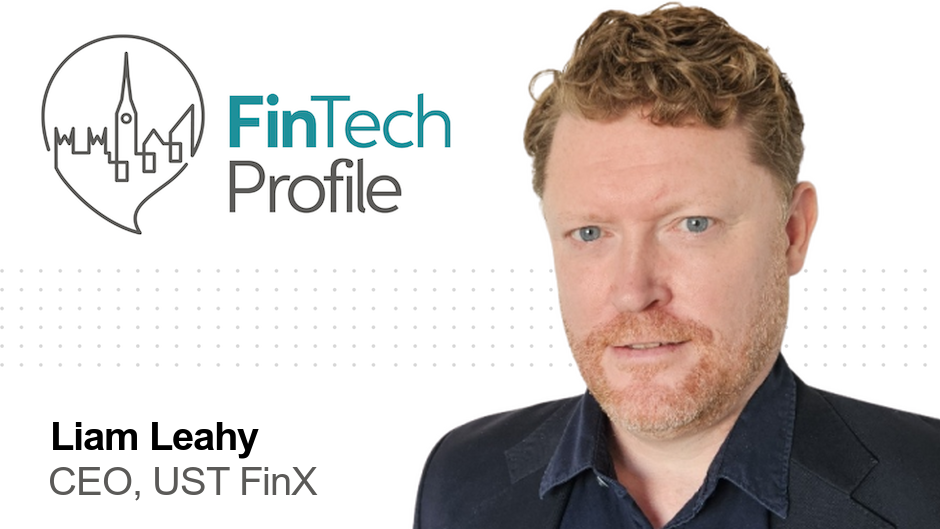
Today we're meeting Liam Leahy, CEO of UST FinX. They provide a standards-based, composable banking platform that enables financial institutions to progressively modernise at their own pace, delivering business value at every stage with a single accountable partner throughout the journey.
Over to you Liam - my questions are in bold:
Who are you and what's your background?
Technology has always been at the core of what I do. I started out as a software engineer and have spent the past 20 years working in financial services technology. After beginning in hands-on engineering, I moved into product development at Dovetail, where I subsequently transitioned into commercial leadership, ultimately becoming Head of Enterprise Payment Solutions. I then joined Thought Machine, where I progressed to Chief Revenue Officer, before taking on my current role as CEO of UST FinX.
One of the biggest lessons I've learned along the way is that businesses aren't looking for technology for its own sake. They're trying to solve problems, create value or enter new markets. Understanding their objectives, the constraints they face and collaborating to overcome those challenges is what builds trust and delivers meaningful outcomes, rather than simply selling technology as the answer to everything.
What is your job title and what are your general responsibilities?
I'm CEO of UST FinX, responsible for the strategy, direction and growth of the business. We're at an exciting stage in our development, and my role is very hands-on. I work closely with our leadership, product and engineering teams to shape our platform strategy and roadmap, while also engaging with our customer, partners and the wider market to understand the challenges and opportunities shaping the industry. An important part of my role is bringing together the strengths of UST FinX and the broader UST organisation so I can deliver meaningful outcomes for our clients.
I enjoy being close to both the technology and the market, ensuring that what we're building is aligned with what customers need and that we're creating a sustainable, successful business.
Can you give us an overview of your business?
UST FinX helps financial institutions modernise their technology and operations in a practical, progressive way. We believe modernisation shouldn't require high-risk, multi-year transformation programmes before delivering meaningful value. Our standards-based, composable banking platform allows banks to modernise at their own pace, introducing new capabilities, improving customer experiences and delivering business value at every stage. Importantly, we're core banking agnostic, working with both legacy and modern systems to give institutions the capabilities of a modern bank without remaining constrained by legacy technology. Replacing the core doesn't have to be the starting point, or even a necessary step. Banks should have the flexibility to choose their own modernisation journey based on their business priorities.
Backed by UST's global scale and expertise, we combine technology, banking domain knowledge and delivery capabilities to provide a single accountable partner throughout that journey.
Tell us how you are funded?
UST FinX is a wholly owned subsidiary of UST, a global technology and digital transformation company. UST has provided the growth investment to develop our platform, build our team and expand our presence in the financial services market.
This backing allows us to take a long-term view of the business, investing in our technology and capabilities while leveraging the financial strength, reach and expertise of the wider UST organisation.
What's the origin story? Why did you start the company? To solve what problems?
FinX existed before I joined, and initially focused on providing technology implementation services to financial institutions. I'd previously worked with the team on a shared customer and was familiar with the organisation and its capabilities. I was later approached by UST leadership about leading FinX and building on that foundation.
Having spent years working with banks on modernisation, I'd seen firsthand how difficult it can be to translate ambition into practical, achievable programmes, particularly for mid-tier institutions facing significant cost, complexity and risk constraints. What attracted me was the opportunity to tackle that challenge differently, combining a standards-based banking platform with deep banking expertise and delivery capabilities. Our ambition is to help banks modernise progressively, delivering real business value along the way, with a single accountable partner supporting them throughout their journey.
Who are your target customers? What's your revenue model?
We are addressing the needs of banks, credit unions and other financial institutions looking to modernise their technology, improve operational efficiency and bring new products and services to market. We have a particular focus on mid-tier financial institutions, where the ambition to innovate is often constrained by legacy technology, limited resources and the perceived risk of large-scale transformation. We also work with fintechs and organisations launching new banking propositions.
Our commercial model combines platform subscription fees with implementation and ongoing support services, allowing customers to adopt capabilities progressively and align investment with their business priorities. Ultimately, we're looking to build long-term partnerships, supporting customers as their businesses evolve rather than simply delivering a technology project and moving on.
If you had a magic wand, what one thing would you change in the banking and/or FinTech sector?
I'd like to see banks and FinTechs get better at understanding each other. Too often, they speak different languages. FinTechs focus on innovation and technology, while banks are focused on business outcomes, managing risk, regulatory obligations and the realities of running complex organisations. Banks often want to embrace innovation, yet their procurement processes are designed primarily to minimise risk rather than enable change, creating significant barriers for smaller, innovative companies. Equally, FinTechs need to better understand the constraints and challenges banks face. If I could change one thing, it would be to make it easier for both sides to engage, understand each other's priorities and work collaboratively. I think we'd see considerably more innovation and better outcomes for everyone.
What is your message for the larger players in the Financial Services marketplace?
My message would be to stop thinking about modernisation as a one-off transformation programme with a defined endpoint. Today's modern technology will inevitably become tomorrow's legacy, as customer expectations, business priorities and technology evolve. Modernisation needs to be an ongoing business strategy, focused on continually improving capabilities, responding to changing market demands and delivering measurable value along the way. Equally important is building deep, trusted partnerships with technology providers who understand your business, share your objectives and are committed to the journey, rather than simply delivering a product or a project. The banks that succeed will be those that embrace continuous change as part of how they operate, rather than a once-a-decade exercise.
Where do you get your Financial Services/FinTech industry news from?
I'm a voracious consumer of news and industry commentary. I subscribe to the Financial Times and The Economist, which are my go-to sources for broader economic, geopolitical and business developments. For financial services technology, I regularly follow FinTech Futures and Finextra for developments across the UK and Europe, while American Banker and Banking Dive provide valuable perspectives on the US market. I think it's important to look beyond FinTech itself and understand the wider economic, regulatory and competitive forces shaping the industry.
Can you list 3 people you rate from the FinTech and/or Financial Services sector that we should be following on LinkedIn, and why?
Dave Wallace and Dharmesh Mistry (Dave and Dharm DeMystify): I enjoy their podcast, which combines industry knowledge with humour and engaging discussions on banking, technology and the future of financial services. They're good at making complex subjects accessible.
James Barker: James offers a practical perspective on the commercial realities of FinTech, particularly around bringing technology to market and engaging with financial institutions. His commentary is insightful, direct and often entertaining.
Ron Shevlin: Ron brings a sharp, independent perspective on the US banking industry. I like his willingness to challenge industry hype; question established thinking and focus on the realities of banking rather than vendor narratives.
What FinTech services (and/or apps) do you personally use?
I use Revolut and Wise frequently for payments, foreign exchange and moving money internationally. I was also an early and enthusiastic user of Curve, which I thought was a genuinely innovative proposition, although I've since migrated entirely to Google Wallet for everyday payments and no longer carry a physical wallet. On the investment side, I've been moving more of my activity to Interactive Brokers. I also use Barclays and Chase banking apps, and I've been impressed by how far Barclays has come, continually improving its digital offering. What's interesting is how FinTech innovation has raised expectations across the industry, encouraging established banks to continually improve their own customer experiences. Ultimately, the best financial technology is often the technology you barely notice because it just works.
What's the best new FinTech product or service you've seen recently?
I'm particularly interested in the emergence of stablecoin-based payment infrastructure, with companies like BVNK developing solutions that have the potential to transform cross-border payments. Moving money internationally remains unnecessarily complex, slow and expensive, and stablecoins offer the opportunity to simplify settlement, reduce costs and enable money to move around the clock. What interests me most is how these companies are bridging traditional financial infrastructure with new payment networks, making the underlying technology largely invisible to customers. We're still relatively early in the adoption journey, but I think this is one area where we're beginning to see genuinely practical applications of emerging technology with the potential to deliver significant business value.
Finally, let's talk predictions. What trends do you think are going to define the next few years in the FinTech sector?
In 2027, I expect AI to move from experimentation to execution, becoming embedded across both customer engagement and operations to deliver more personalised experiences and improve efficiencies. Boards and executive teams want to see tangible outcomes, not further proof-of-concept exercises. Most importantly, AI will fundamentally change how technology is built and deployed, accelerating software development, testing, integration and migration activities, and enabling organisations to deliver change faster with smaller teams.
I believe stablecoins and digital assets will continue moving into the mainstream as banks seek faster, more efficient ways to move value and connect traditional and digital financial ecosystems.
Finally, banks will prioritise adaptability over large-scale transformations, adopting composable architectures that allow them to introduce new capabilities quickly and evolve as market demands change.
In 2027, the financial institutions that succeed will be those that can continuously evolve, giving mid-tier banks access to a level of agility and innovation that was once the preserve of Tier 1 players.
Many thanks to Liam for taking the time to share his insights with FinTech Profile. You can learn more about UST FinX on their website.