Adam Barbera, Co-founder and CEO, Dost
Adam Barbera discusses building Dost's native-AI platform that automates the full financial cycle, the future of autonomous finance, and why finance teams deserve better tools.
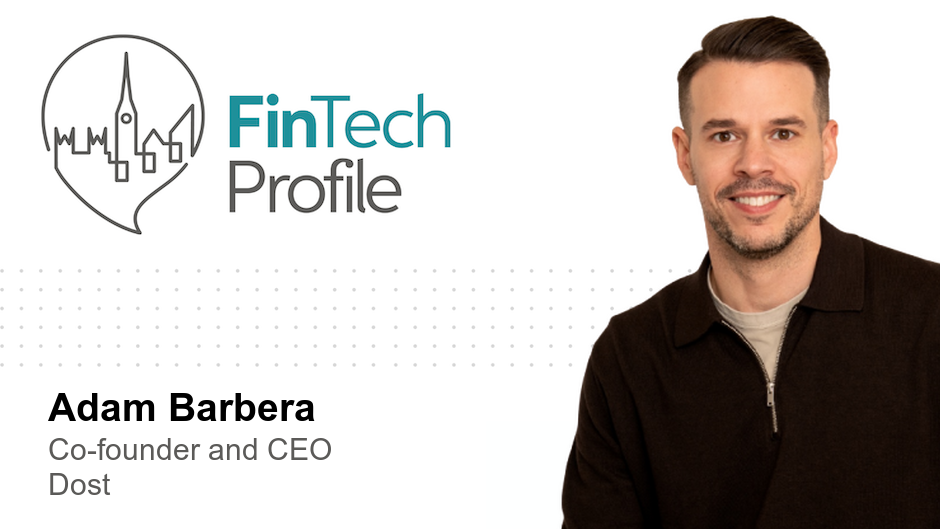
Today we're delighted to speak with Adam Barbera, Co-founder and CEO of Dost, a native-AI platform automating the full financial cycle for finance teams. From his early days selling ERPs at SAP to co-founding Dost after identifying critical gaps in accounts payable automation, Adam shares insights on building enterprise fintech, the shift to autonomous finance, and why the finance function is poised for radical transformation.
My questions are in bold - over to you Adam:
Who are you and what's your background?
I'm Adam Barbera, Co-founder and CEO of Dost. My route into finance and enterprise software started in sales. I spent my first years selling ERPs at SAP as an Account Executive, which is where I was introduced to how large finance functions actually operate underneath the software they run on. From there I moved to Tech Data based in Barcelona (now TD SYNNEX), where I joined the European team focused on new technologies. It covered artificial intelligence, analytics, cloud and everything the market was starting to move into.
That team is where I first met Fernando Martín and Naqqash Abbassi, who would later become my co-founders at Dost. It was also where I saw the first serious opportunity in accounts payable automation.
Tech Data had an Innovation Committee, an internal initiative where people could bring problems from their day to day and try to build solutions around them. I was part of it, and one of the pain points that kept coming back to us was accounts payable. Tech Data was implementing another tool at the time and it wasn't working. I went to Naqqash, who was Lead AI and Computer Vision, and asked whether we could build what would today be called an AI agent, an autonomous digital worker for that process. He said yes, we could build it.
We proposed it inside Tech Data, sponsored the idea internally and asked for resources but ultimately our offer to build it was declined. That was the moment I knew Naqqash wanted to build something himself. I knew Fernando had already founded a company before and could bring valuable experience. I spoke to both of them, convinced them, and here we are. I lead the business whilst Naqqash is our Chief Product and Technology Officer and Fernando acts as our Co-Founder and Chief Evangelist meaning he is the voice that connects what we build with the market that needs it, educating finance leaders and representing Dost's vision externally.
We started shaping the idea in 2020. In June 2021 I left my job at Tech Data completely and we officially set out. We went into a small accelerator, closed a Friends, Family and Fools round of €40,000, built the MVP, and started closing our first customers. Before we wrote a line of code, we interviewed over 100 companies to validate whether the product should exist. The resounding answer was yes.
What is your job title and what are your general responsibilities?
I'm the Co-founder and CEO of Dost. My role covers three main areas: leading Dost's international expansion, setting the company's overall strategy, and managing investor relations and fundraising.
On a daily basis my time is split between customers and the business itself. I still spend a lot of time in front of finance leaders, running sales conversations directly. Anyone who has founded a B2B company knows the CEO stays close to sales long after it stops being their formal responsibility. On top of that, I work with our leadership team on strategy and product direction, and stay in constant contact with our investors and board.
Can you give us an overview of your business?
Dost is a native-AI platform that automates the full financial cycle for finance teams, covering both accounts payable and accounts receivable as one autonomous process.
On the accounts payable side, we handle everything from supplier onboarding and vendor management through to invoice capture, validation, three-way matching across invoice, orders and delivery notes, approval workflows, and payment execution. On the accounts receivable side, we cover the process from order intake and invoice generation through to invoice distribution, collections, and cash reconciliation. There's a customer portal, a supplier portal, and native bank reconciliation for both incoming and outgoing payments.
On top of that operational layer, we have an analytics layer that reads what's happening across the finance cycle and turns it into insight the CFO can act on. That's what makes Dost different from most finance automation platforms in the market: we're not just automating invoice capture or payments. We're running the full cycle end-to-end with AI at the core.
Since launching, we've delivered 95% accuracy in data extraction from the very first document, an 80% reduction in processing costs, and 90% time saved on manual processes. We've processed over five million accounting transactions.
Tell us how you are funded?
We're VC-backed and have raised three rounds so far: Pre-seed, Seed and Series A.
On the cap table we have Octopus Ventures, one of the UK's leading VCs, which led our Series A. On the European side we have Draper B1 out of Spain, and on the US side we have Born Capital. We also have a group of Business Angels who have been particularly meaningful for us, including Karl Joseph Seilern from Angel Invest Ventures and others from the enterprise software and finance space.
What's the origin story? Why did you start the company? To solve what problems?
The origin of Dost sits in a very specific insight I had at Tech Data.
I was working with the European new technologies team, and part of my role was through the Innovation Committee I mentioned earlier. What we kept seeing was the same problem across companies: finance functions running critical operations on broken foundations. Manual invoice processing, approvals chased over email, reconciliation done in spreadsheets, and systems that were never designed to talk to each other. All of this was happening within businesses using modern ERPs that on paper should have solved the problem.
The Innovation Committee gave us a chance to interview more than 100 companies to test whether the pain we were seeing was really universal. It was. Finance teams weren't complaining about their ERP or their bank. They were complaining about the layer between their operational reality and their system of record, the layer where nothing was working properly.
Once we understood that, the idea for Dost started to take shape: build a native-AI platform that handles that missing layer end-to-end. Not another OCR tool. Not another workflow product. A platform that treats accounts payable and accounts receivable as one autonomous process, connected to the ERP the finance team already uses.
The reason we exist is because finance teams deserve tools that actually work with how finance operates. Not tools built for a system of record, but tools built for the operational reality of finance.
Who are your target customers? What's your revenue model?
Our target customers are mid-sized to large companies with annual revenues between $70 million and $500-$600 million. They typically sit in traditional sectors like manufacturing, distribution, industry, retail, and hospitality. What they have in common is enough complexity in their finance operations that automation actually moves the needle commercially, not just cosmetically.
Our revenue model is B2B SaaS, with a subscription based on volume and modules activated.
Some of the companies we work with include Synergym, Cardoner, Housfy, Vicio, IASO, and Eco-equip, across industries like fitness, real estate, hospitality, healthcare and manufacturing. We have a growing customer base in the UK as well as across Europe.
If you had a magic wand, what one thing would you change in the banking and/or FinTech sector?
If I could change one thing, it would be the fragmentation of finance infrastructure across countries.
Right now, doing business across borders means dealing with completely different standards for supplier onboarding, invoice certification, payment systems, and e-invoicing mandates. Each country has its own rules, its own timelines and its own validation logic. This is a barrier not only for software vendors trying to build cross-border solutions, but also for the finance teams inside every company that operates in more than one region.
I'd standardise supplier onboarding and payment methods globally as well as the certification and validation process for invoices. That single change would remove a huge amount of unnecessary friction from international business and free up finance teams to focus on the parts of their work that actually adds value.
What is your message for the larger players in the Financial Services marketplace?
Build their platforms to work with AI, not around it.
Most software that finance teams still use every day was designed for a world where a person sat between every step. Data entry, approval routing, reconciliation, reporting. Now that AI can handle those steps end to end, the software that assumes a human in the middle is starting to feel like scaffolding that doesn't need to be there anymore.
The temptation for larger players is to add a chatbot on top of what they already have and call it AI. That is not the same as being built for AI. Native AI is an architecture, not a feature and it changes how data flows through the platform, how decisions get made, and what the finance team actually spends its time on.
The other thing I would say is that most finance teams are ready. Every finance leader I speak to knows their current tooling is holding them back but they are waiting for someone to give them a real alternative. Whoever moves fast enough to be that alternative will define the category and others will risk becoming a case study in how quickly enterprise software can be replaced.
Where do you get your Financial Services/FinTech industry news from?
For daily perspective on where AI is taking the CFO function, I read AI CFO Office by Wouter Born. It's one of the sharpest reads out there for anyone thinking seriously about how finance leadership is changing.
Beyond that, the Financial Times is a constant, and now that I'm based in London, the BBC has become part of my daily reading too.
Can you list 3 people you rate from the FinTech and/or Financial Services sector that we should be following on LinkedIn, and why?
Wouter Born: General Partner at Born Capital and author of the AI CFO OFFICE newsletter. One of the sharpest voices right now on where AI is taking the CFO function. He writes with real depth about what modern finance leadership actually looks like.
Hristo Borisov: Co-founder and CEO of Payhawk. Built one of the most impressive finance software companies out of Europe. His posts on product, culture and building for finance teams are consistently worth reading.
Eric Glyman: Co-founder and Co-CEO of Ramp. Redefined what a finance automation platform can look like in the US market. His thinking on how AI reshapes finance operations is a reference point for anyone building in this space.
What FinTech services (and/or apps) do you personally use?
Between running a company across two countries and travelling regularly, seamless digital banking and cross-border payments are non-negotiable for me. Revolut has been a constant, both for personal spending and for the flexibility it gives me when I'm moving between London and mainland Europe.
Beyond that, Dost is naturally part of my daily workflow. Not because I built it, but because it's genuinely how I keep visibility over what's happening in our finance operations without having to interrupt anyone.
What's the best new FinTech product or service you've seen recently?
Rather than name one product, I'll share the standard I use for the ones that really impress me. The best fintech I have seen recently share three attributes.
They earn trust before they ask for attention. In a space where money moves and mistakes have consequences, the products I keep coming back to are the ones that are radically clear about what they do, how they charge, and where the risks sit. Clarity is still surprisingly rare.
They respect the existing stack. Finance teams already work with an ERP, a bank, a set of controls, a set of habits. The products that stand apart fit inside that reality without forcing everyone to rebuild around them. Everything that requires a full replatform to prove its value struggles, no matter how good the technology.
They treat AI as infrastructure, not marketing. There's a big difference between adding a chatbot on top of an existing product and rebuilding the product to actually run on AI.
At Dost, that's the bar we hold ourselves to as well. If a product makes something meaningfully faster, clearer, or less stressful for a finance team, and it does it without asking them to change how they work, that's the standard worth aiming for.
Finally, let's talk predictions. What trends do you think are going to define the next few years in the FinTech sector?
The dominant trend of the next decade in enterprise finance software will be autonomous finance.
Functions that today still require human intervention will be fully automated. Invoice entry is the obvious one, but even the traditional bookkeeper role, the person who codes transactions and closes the books, will become obsolete in its current form as the tools mature. Finance teams inside complex companies, which today run with large teams in accounts payable and accounts receivable, will get significantly smaller.
The finance role of the next decade will be about interpretation and decision-making. Understanding why the numbers say what they say and turning data into action will help finance become a much higher-value function.
Two trends will accelerate this shift. The first is hyper-personalisation of software: platforms that adapt to each customer's context out of the box, without months of implementation. The second is agent-based architecture: finance platforms will stop being tools you log into and start being infrastructure that AI agents can query, act on and orchestrate. At Dost we're already building for both. Our platform is architected to onboard customers in minutes rather than weeks, and we've just launched our first MCP server so that finance teams can interact with Dost through Claude and any other AI assistant they use. There is a huge opportunity for finance teams willing to take this as an opportunity.
Many thanks to Adam Barbera for taking the time to share his insights with FinTech Profile. You can learn more about Dost on their website.