Rohini Gupta, CEO & Co-Founder, FinregE
Rohini Gupta on building an end-to-end regulatory operating system at FinregE, why compliance is becoming a competitive advantage, and what MCP means for embedded regulatory intelligence.
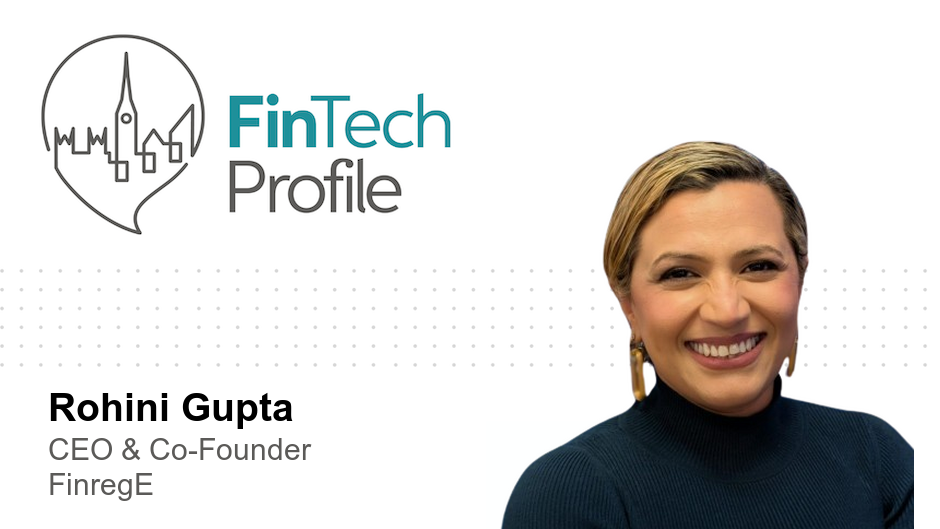
Today we're delighted to speak with Rohini Gupta, CEO and Co-Founder of FinregE. After more than 20 years spanning supervisory roles at the Bank of England and the Financial Conduct Authority and senior positions at Credit Suisse and RBS, Rohini co-founded FinregE to replace what she calls the "spreadsheet and prayer" era of compliance. In this interview she discusses building an end-to-end regulatory operating system, securing strategic investment from Moody's, and why she believes compliance is about to become a competitive advantage rather than a cost centre.
My questions are in bold - over to you Rohini:
Who are you and what's your background?
I've worn many hats in my career and describe myself to friends and family as part regulatory strategist, part tech visionary but full-time disruptor of the "status quo" in compliance. My journey wasn't a straight line; it was more of an informative and highly enlightening tour, with multiple vantage points, through the corridors of global finance.
I've spent more than 20 years in the trenches of financial regulation, central banking, and investment banking. I've held supervisory roles at the Bank of England and the Financial Conduct Authority (FCA) and led major initiatives at Credit Suisse and RBS (now known as NatWest Markets), so I've experienced financial markets from both sides.
Notably, like many, I've lived through structural market reforms and periods of intense regulatory scrutiny where the stakes couldn't be higher. I saw firsthand that while the world was moving toward digital transformation, the way we managed regulatory obligations was still stuck in the "spreadsheet and prayer" era. That gap, between the speed of regulation and the speed of operational execution, is exactly what led me to dive headfirst into the FinTech arena. I didn't just want to build another tool, I wanted to build the foundation for regulatory intelligence.
What is your job title and what are your general responsibilities?
I am the CEO and Co-Founder of FinregE. On paper, my job is to steer the ship. In reality, like many Founder CEOs, I spend my days oscillating between the "big picture" and the "deep dive."
One hour I'm strategising with our CTO and AI engineers to push the boundaries of what AI RIG (our Regulatory Insights Generator) can do, and the next, I'm talking to C-suite executives at global and highly regulated firms about how to start mastering their data.
My mission is, however, always the same. And that is to ensure that we aren't just selling software but providing the critical infrastructure and service that provides highly regulated institutions with clarity, control and confidence. We provide clients with the right operating model for navigating regulatory complexity with software and AI.
Can you give us an overview of your business?
Imagine if you could take the chaos of global regulation, millions of data points, thousands of sources, hundreds of jurisdictions and distil it into a single, living, breathing operating system. That is FinregE.
We've built the End-to-End Regulatory Operating System (FinregE ROS). Most RegTech companies focus on a tiny slice of the pie, such as a specific report for a specific regulator. We've gone bigger. We provide the infrastructure. Powered by insights and tools via AI RIG (our Regulatory Insights Generator), FinregE ROS offers a complete suite of capabilities: Horizon, Library, Map, Governance, Assurance, Action and Workflows. This allows firms to see exactly what they are obligated to do, where they stand and how to fix gaps in real-time.
The market reaction has been fantastic. Word of mouth about measurable impact means our clients are recommending us to others and we are gaining significant independent industry recognition of our leading market position. We were, for example, named RegTech Company of the Year 2026 at the FinTech Awards London and secured a spot in the RegTech100. We aren't just a "nice to have", we are the engine room for compliance.
Tell us how you are funded?
We started with a clear vision and, if I'm honest, a lot of grit in 2018, recognised by Innovate UK through an innovation grant to fuel our vision into the FinregE. The journey evolved from conviction from me and Amit Madahar, Co-Founder and Chief Technology Officer, to strategic validation.
Since then, a major milestone for us was securing strategic investment from Moody's Corporation in 2026. Likewise, having regulators themselves utilise our solution speaks volumes about the advanced AI native tech that we offer the market.
What's the origin story? Why did you start the company? To solve what problems?
The "aha!" moment came from a place of shared frustration, for myself and Amit. Throughout my career at the Bank of England and in investment banking, I kept seeing the same professional "tragedy", for want of a better description. And that was brilliant compliance officers spending 80% of their time manually hunting for data in fragmented silos and only 20% actually managing risk.
The problem wasn't a lack of effort; it was a lack of infrastructure. Compliance failure is rarely caused by a lack of will. Instead, it's caused by fragmented data. I started FinregE, with expert tech guidance from Amit who shared my frustration, to kill the spreadsheet.
I wanted to shift the conversation from "AI as a fancy tool" to "AI as the essential plumbing" of a financial institution. We solve the "fragmentation crisis" by unifying regulatory intelligence and operational action with the assistance of explainable AI to validate human actions in one place. And it's important to note that we are AI-native. We don't just add on AI for effect.
Who are your target customers? What's your revenue model?
Our global customer base is, quite simply, the "highly regulated". And these are all exceptional institutions who take their regulatory obligations seriously. We work with global financial services firms, multinational corporates with complex footprints and even the regulators themselves. On the FS side we serve everyone from Tier 1 banking clients to regional banks, asset and wealth managers, insurers and leading payment firms.
We provide FinregE ROS as a solution that grows with the institution. For example, we help a global bank move from "we think we are compliant in Singapore" to "we know we are compliant in Singapore, here is the traceability map to prove it, and here is the workflow showing the action taken."
If you had a magic wand, what one thing would you change in the banking and/or FinTech sector?
Like so many peers, I would vanish the "Silo Mentality." In too many banks, the Risk team doesn't talk to the Compliance team, who doesn't talk to the IT team, who is using a legacy system from 20 years ago. It's absolute chaos.
If I could wave a wand and create a culture of unified data transparency across the entire sector, we would see a massive drop in systemic risk and a huge spike in innovation.
What is your message for the larger players in the Financial Services marketplace?
To the CEOs and CIOs of the Tier 1 banks, asset managers and insurers I have a very clear message: Stop treating compliance as a cost centre or a "tick-box" exercise and, instead, view it as a competitive advantage.
In the age of AI and instant regulatory updates, "adequate" is the new "dangerous." If your compliance is still manual, you aren't just risking a fine; you are potentially hindering your organisation's agility.
I would encourage them all to move from fragmented tools to an integrated Operating System. Clarity and control aren't just regulatory requirements, they are competitive advantages. And they provide firms with the necessary confidence to navigate regulatory complexity.
Where do you get your Financial Services/FinTech industry news from?
I'm a bit of a news hound and I read the headlines as soon as I wake and throughout the day at regular check-ins.
I lean heavily on The Financial Times for the global macro view. And Finextra, FinTech Finance News, FinTech Futures and IBS Intelligence are my go-to news services to keep a pulse on the specific shifts in the FinTech ecosystem.
I'm also a huge fan of The Banker, published by The FT. It is incredible that the publication is celebrating 100 years and still as relevant as ever, going to show that when you become essential to an industry, longevity follows.
Can you list 3 people you rate from the FinTech and/or Financial Services sector that we should be following on LinkedIn, and why?
I follow far too many these days as there is such good content out there. But if I had to choose just three, in no particular order:
Jamie Dimon: Dimon's leadership journey is a masterclass in steering complex organizations through uncertainty. What I admire is his hands-on operational approach – he deeply understands the business down to the details, yet communicates vision clearly to regulators, shareholders, and 290,000+ employees.
2. Jane Fraser: First female CEO role model of a major Wall Street bank, leading one of the most complex global financial institutions. She's driving Citi's transformation with sharp focus on simplifying operations, strengthening risk management and modernising compliance infrastructure.
Sallie Krawcheck: She's a powerful voice on financial inclusion, regulatory fairness, and innovation within guardrails. Her dual perspective, having operated at the highest levels of regulated banking and now building a compliant FinTech, mirrors FinregE's position at the intersection of regulation and technology. She also demonstrates how to build trust with regulators while disrupting established models.
What FinTech services (and/or apps) do you personally use?
QuickBooks for accounting. Their UI/UX sets the standard for making complex financial workflows intuitive. It's a reminder that good design in financial tools isn't just nice-to-have, it drives adoption and accuracy.
Stripe – from app to website design- everyday frictionless payments remind me what we're fighting for in compliance: security without sacrificing user experience.
What's the best new FinTech product or service you've seen recently?
I've been closely watching Open Source AI tools like BrowserOS and Open Code. These embody the speed at which technology is evolving and the power of AI to accelerate innovation. They're not FinTech per se, but they're the tools building the next generation of FinTech. From providing best in class on how agentic workflows can actually be seamlessly applied to MCPs in action.
Finally, let's talk predictions. What trends do you think are going to define the next few years in the FinTech sector?
Ah. The dreaded prediction question! There are three areas worthy of focus I think.
1: AI moves from Chatbot to Agent – and Compliance Leads the Way: Everyone's talking about AI, but most implementations are still glorified search. The real shift is agents that take action, not just answer questions. Compliance is actually the perfect use case – high stakes, structured data, clear rules. I predict we'll see AI agents handling regulatory monitoring, control testing, and audit prep autonomously within 2-3 years.
This is why we started FinregE with AI in 2018. We weren't chasing hype. Instead, we saw that compliance was information-intensive, rule-based, and underserved by technology. The market is finally catching up to where we've been.
2: Regulation becomes a competitive advantage, not a cost centre: Historically, compliance was a tax on doing business. That's flipping. As AI makes compliance scalable, firms that invest early will move faster than competitors, not slower. They'll launch products in new markets quicker, adapt to regulatory changes in real-time, and use compliance data as strategic intelligence.
Think of it like security: companies that treated security as strategic won the cloud era. Companies that treat compliance as strategic will win the AI era. FinregE's position is to make that possible.
3: Embedded compliance + MCP: The integration layer wins: Just as payments became embedded compliance will embed into financial infrastructure. GRC platforms, core banking systems, payment processors – they'll all have compliance intelligence built in. The question is: who provides that intelligence layer?
This is where MCP (Model Context Protocol) becomes critical. MCP solves the integration problem – it's a standard protocol for connecting AI agents to data sources and tools without custom builds for every client. Think of it as the 'USB-C of AI.'
For FinTech, this means:
- AI compliance agents can plug into any GRC system, document repository, or ticketing tool
- Deployment goes from months to days
- Clients keep their existing stack – we make it smarter.
The winners won't be the companies that try to replace every system. They'll be the ones that connect intelligence to what already exists. That's the MCP playbook, and it's central to how we're building FinregE.
Many thanks to Rohini Gupta for taking the time to share her insights with FinTech Profile. You can learn more about FinregE on their website.