Raouf Mhenni, Chief Commercial & Operating Officer, SBS
Raouf Mhenni on modernising banks without breaking what works, powering Wero across European banks, and why buying AI as a checklist item is the most expensive mistake in banking right now.
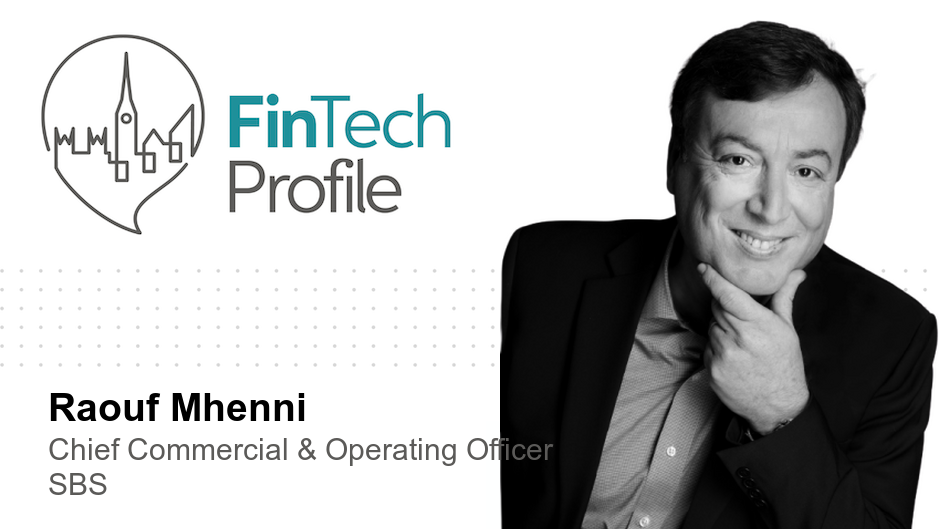
Today we're delighted to speak with Raouf Mhenni, Chief Commercial and Operating Officer at SBS, the financial technology company that around 1,500 banks and lenders across 80 countries run on. Raouf started out in pre-sales and was made a closer six months in when his employer restructured; twenty-five years later he leads commercial and operations for a business modernising core banking, lending and payments without ripping out what already works. In this interview he discusses powering Wero for European banks, life under the 74Software group after the Axway combination, and why the most expensive mistake in banking right now is treating AI as a checklist item.
My questions are in bold - over to you Raouf:
Who are you and what's your background?
Today I'm Chief Commercial and Operating Officer at SBS, but I have a twenty-five-year career that consists mostly of customer-facing work in technology, the last several in financial services.
The path to getting here was less plotted than that makes it sound. I started in pre-sales, the job where you give demos all day and hand the prospect off to someone else when it's time to actually close. Six months in, my company restructured and made me a closer. I think I was too inexperienced to know I should be nervous about it at the time, but I haven't done a job that wasn't customer-facing since.
What is your job title and what are your general responsibilities?
I'm Chief Commercial and Operating Officer at SBS, which means my mandate is to drive top-line growth while optimizing the operational engine behind it. With 1,500 financial institutions across 80 countries using our software, my job is to ensure our clients have the technology solutions they need to solve their biggest pain points — and that the promise we make them is one we can actually execute on, wherever they operate.
I spend my time on two things. One is figuring out how to improve customer relationships. Unlike in many other industries, partnerships between banks and fintechs often span decades, so meeting our customers' expectations throughout the relationship is what separates a signed contract from a high-value relationship built to last. The other part of my job is coaching. I get more satisfaction now from helping a younger commercial leader figure out how to read a customer than from closing a deal myself, because sales done right is one of the more rewarding jobs in business.
Can you give us an overview of SBS and the work you do for clients?
SBS is a financial technology company that roughly 1,500 banks and lenders in 80 countries run on. The work we do is helping institutions modernize the technology behind their business without abandoning what they already have. A bank can't shut down lending or payments for a year while it rebuilds and integrates new systems. So our job is to swap out pieces of what they're running, one at a time, so they fit next to the rest.
For example, several European banks we work with are using our software to launch Wero, the new pan-European payments app. An auto lender in the U.S. is swapping paper-and-clipboard floor-plan inspections for digital ones we run through their mobile app, and we'll process over 100,000 of those this year.
Even though it might sound like banks and specialized finance providers operate in two different industries, the challenge they share is how to move away from legacy technologies without breaking what works today.
How are you helping clients adopt new technologies like AI?
AI is where I see the most expensive mistakes being made in banking right now. The mistake is treating it as a checklist item. Someone goes to multiple vendors and asks, "Does your platform do AI?", sees "yes," and ticks the box. That's a fine way to buy a feature, but it's a terrible way to adopt a technology that regulators will eventually ask a bank to explain.
Banks need to be asking questions like: How was the model trained? Who's accountable for what it does? Can your vendor walk you through, in plain language, how it makes the calls it makes? If the answer is no, there is a real risk in trusting systems the bank doesn't understand, and that gets expensive fast in this industry.
At SBS, we support our clients' AI ambitions by building all our products on a single centralized data platform. That means whether a client is using us for their banking core, lending, or payments, all data across those systems is stored in that platform in the same format. The data platform makes it easy for AI to plug and play across their entire operations, rather than being manually configured for each system. We also provide our clients with the AI layer itself and work alongside them to ensure they understand it, so they can explain it to regulators when the time comes.
SBS and Axway recently came together to form 74Software – how has that impacted how you serve your clients?
The deal closed in September 2024, and SBS and Axway now both sit under a parent group called 74Software. Day-to-day for clients, less has changed than people assumed, because SBS still runs as SBS with the same team and leadership.
The real upside has been on the integration side. Axway is one of the best in the world at the software that wires different systems together. APIs, data flows, and AI agents, the layer underneath everything that no one sees, but everything depends on. We've integrated that capability into our open banking platform, which helps banks and fintechs share data more easily.
Who are some of the key customers you work with, and what market segments do they represent?
It's a wide spectrum, and that's one of the things I like about the job. Across Europe, we work with some of the world's biggest banks, like Santander and Société Générale, to provide the infrastructure they need to best serve their customers. U.K. mortgage operators like Nottingham and Scottish building societies also rely on us to power their mortgage and savings offerings.
In Africa, we work with major financial institutions like Attijariwafa Bank or Cris Group as well as a range of microfinance providers.
In the U.S., we work with the captive finance arms of carmakers like Mercedes-Benz and Toyota FS, helping them digitize the financing operations behind car sales and leasing. We also work with companies like NextGear Capital, the country's biggest independent inventory finance company, to manage the millions of cars sitting on dealership lots.
When you list it out like that, it might sound like a random group of names, but that's far from reality. All these organizations are wrestling with the same problem: trying to modernize the technology behind a complicated, regulated business without ripping out the systems they already depend on, all while deploying AI on top.
If you had a magic wand, what one thing would you change in the banking and/or FinTech sector?
I would love to change how banks evaluate and ultimately select fintech partners. The standard process often consists of a feature grid, a scorecard, a procurement committee, and a sequence of demos. By the end, the institution has convinced itself that choosing the right platform will define the next five years.
But that is almost never the case, since most platforms do what they are supposed to. What determines whether a modernization succeeds is what the partner does when something no one foresaw lands on the table. For example, if in a few years the bank discovers that data, they relied on turns out to have been stored inaccurately, will the vendor willingly help them, or will the bank be left to fend for itself? That's the moment that defines whether a partnership earns its name.
What is your message for the world's largest banks?
Your modernization and AI transformation will outlast the technology choice you make. It's important to pick the partner who'll still be useful in year three, when a complex problem happens that nobody saw coming.
There are a few ways banks can scope this out early in their vendor selection process. The partner willing to tell a bank where their product is going, and where it isn't, is offering foresight, whereas the one who guards their roadmap like a classified file is asking for blind trust. AI governance is another factor. If a vendor can't walk you through how their models were trained and how the decisions get made, eventually the bank will face compliance challenges when regulators start asking questions.
The most useful signal of all is the sales cycle itself. A vendor that treats every reasonable ask as an exception during the bid won't loosen up after they win. On the other hand, a vendor who pushes back and is honest about what they won't commit to is the one who'll still be there in year five.
Where do you get your Financial Services/FinTech industry news from?
I run a Claude prompt every day that goes to check the news across several websites and news platforms such as Finextra and The Banker
Can you list 3 people you rate from the FinTech and/or Financial Services sector that we should be following on LinkedIn, and why?
1- I follow Juliana Rotich because she is inspiring, she turns technology into practical solutions that connect underserved communities to essential services and greater economic opportunity.
2- I follow Pål Krogdahl because the conviction he sets out in his book Rip Out the Core—that core banking modernization should be progressive, pragmatic and value-driven—strongly aligns with SBS's own approach.
3-I follow Jamie Dimon because his candid, long-term perspective on banking, technology, risk and leadership offers a rare combination of strategic depth and real-world experience at global scale.
What FinTech services (and/or apps) do you personally use?
I Have 7 Banking and Financial Apps installed on my devices : Revolut, Wise, Société Générale, BIAT, Amundi and AMEX.
What's the best new FinTech product or service you've seen recently?
I consider M-KOPA one of most impactful fintech products because it turns an affordable smartphone into a gateway to financial inclusion. Through flexible digital financing, it gives underserved customers access not only to connectivity, but also to credit, insurance and wider economic opportunities. Its strength lies in solving a real everyday need first, then progressively bringing millions of people in Africa into the formal financial ecosystem.
Finally, let's talk predictions. What trends do you think are going to define the next few years in the FinTech sector?
Almost every trend worth watching over the next few years comes back to AI in some way.
For example, AI has made modernization both more urgent and less forgiving, because banks can't simply bolt AI onto fragmented systems, inconsistent data and unclear accountability. The institutions that benefit from AI will be the ones whose modernization partners help them lay the foundations with clean data, explainability, auditability, cybersecurity and built-in human oversight.
Explainability is also becoming more important in these engagements. Regulators aren't going to keep accepting "the model said so," and as a result, banks will be expected to demonstrate how AI-driven decisions are governed, monitored, audited and updated. The vendors that win will be those who help banks lay solid foundations today, rather than just slapping shiny new technology on top of aging systems. Down the line, as AI improves and regulators ask harder questions, only those with the groundwork in place will succeed.
Many thanks to Raouf Mhenni for taking the time to share his insights with FinTech Profile. You can learn more about SBS on their website.