Paul Williams, Founder, DoorID
Paul Williams discusses how DoorID is tackling address and asset fraud with patent-pending technology that provides live evidence of physical presence.
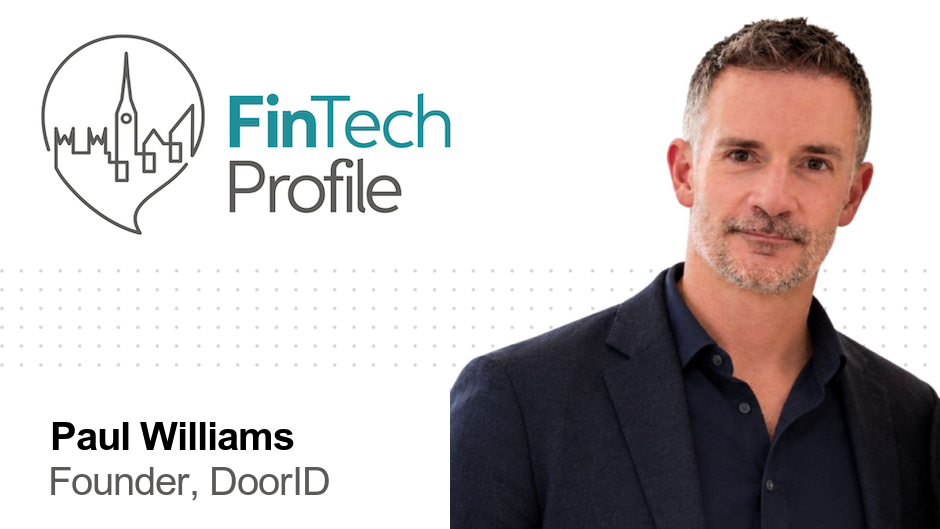
Today we're delighted to speak with Paul Williams, Founder and Director of DoorID. With a background spanning the British Army and over 15 years in regulated consumer finance, Paul has developed patent-pending technology to help businesses prevent address and asset fraud through evidence captured live during guided checks. In this interview, Paul shares the origin story of DoorID, how it's addressing gaps in traditional verification methods, and why intelligent friction may be the future of fraud prevention.
My questions are in bold - over to you Paul:
Who are you and what's your background?
I'm Paul Williams, founder and director of DoorID and the inventor of its underlying technology, which is patent pending.
My background spans service in the British Army and more than 15 years in regulated consumer finance, building businesses in the UK and the US. That experience has brought together financial services, technology and customer experience.
I drew on this experience in consumer credit to design and develop DoorID's underlying method, product and technology.
What is your job title and what are your general responsibilities?
I'm the founder and director of DoorID. As the inventor of its underlying technology, most of my time day-to-day is spent on product and technology development, taking the method I created and developing it into a working product.
Can you give us an overview of your business?
DoorID helps businesses prevent address and asset fraud through evidence captured live during a guided check. Our address check takes applicants through a short journey on their phone, providing evidence that they can physically access the address they have supplied. This gives businesses an additional check before approving an application, releasing funds or handing over goods.
Our platform is built on patent-pending technology that links people, places and assets and we're building on that foundation with additional capabilities and products.
Alongside our address and vehicle collection checks, we are developing further products for future release, applying the underlying technology and methodology to verification challenges across other industries.
Tell us how you are funded?
DoorID is currently self-funded.
What's the origin story?
DoorID grew out of the fraud challenges we encountered in our car finance business. We were seeing manipulated identity documents and AI-generated images that raised a question: what evidence could we actually rely on?
In our experience and testing, convincing fabrications could escape document checks. I began looking for a different way to establish that an applicant was physically at the address they had provided and could access the property.
That led me to invent and develop DoorID's underlying technology: gathering evidence captured live during a guided check, with an actionable signal and a tamper-evident evidence pack. What began as a problem in our own business became the foundation of a solution and a standalone company.
Why was the company started?
I founded DoorID as a standalone business to address a problem I had encountered at Quick Car Finance after a genuine customer of our car finance business sent an AI-generated image of her open front door while on holiday. I developed the technology separately from the brokerage, recognising that the need extended far beyond just motor finance.
My experience in the UK and research into the Australian market highlighted potential applications across lending, mortgages, conveyancing, insurance, digital onboarding and government services. I also saw an opportunity to help organisations assess customers who struggle to provide conventional proof-of-address documents.
The ambition was to build a dedicated technology business serving that wider need, wherever evidence linking a person, place or asset can support a better decision.
What problems was it created to solve?
DoorID was created to address the gap between a document passing a check and having reliable evidence about the person presenting it.
In our own experience and testing, we have seen manipulated identity documents escape detection, so a successful document check is not proof enough that there is no fraud risk.
I developed DoorID to gather evidence captured live during a guided check, linking the person to the address and their ability to access it. Clients receive an actionable signal, with optional API integration into their existing systems, without needing to wait for the supporting evidence pack. That tamper-evident pack provides a record they can retain and review.
The same principle extends to assets: gathering evidence that a vehicle or other asset is physically present where it is claimed to be. In our brokerage, we rely on this evidence rather than treating a successful document check as sufficient reassurance.
Who are your target customers?
Our immediate priority is motor finance lenders and brokers. It is the industry we come from, and we have experienced first-hand the pressure that increasingly convincing fraudulent applications place on businesses making lending and payout decisions.
But the need extends well beyond motor finance. We see potential across mortgages, conveyancing, insurance, crypto, gambling, gaming and dating platforms, as well as government services. We also see opportunities for onboarding teams assessing customers who struggle to provide conventional proof-of-address documents.
Our research into the UK and Australian markets has reinforced the international potential. The common requirement is evidence linking a person, place or asset when a decision depends on physical presence. Motor finance is our starting point; our ambition is to serve that wider need across industries and markets.
What's your revenue model?
We charge per customer. For that single charge, a business can use as many verifications from our suite as it needs for that customer.
If you had a magic wand, what one thing would you change in the banking and/or FinTech sector?
I'd change the assumption that every extra step in a customer journey is a bad thing. We've spent years chasing faster onboarding and instant transactions, but sometimes the risk justifies a brief pause to establish what's real.
Fraud prevention protects more than a business's margins. Behind a stolen identity is a real person who may be left dealing with debts they never took on and the distress of putting things right.
We call it intelligent friction: a small, purposeful effort for genuine customers that raises the barrier for fraudsters and helps protect the people whose identities they exploit. Frictionless shouldn't mean defenceless.
What is your message for the larger players in the Financial Services marketplace?
Be willing to question the status quo and look beyond the usual suppliers. An established approach should still be tested against the risks businesses face today.
DoorID was born out of necessity. In our own business, the checks we had tried did not give us the confidence we needed, so I developed a different approach. That experience showed me why innovation can come from businesses living with the problem every day.
Smaller teams can test and adapt quickly; larger institutions can help bring effective solutions to scale. Give new entrants a practical route to a pilot, assess their evidence and judge the technology by what it demonstrates, not simply the size or familiarity of the supplier.
Where do you get your Financial Services/FinTech industry news from?
I follow a mix of industry publications, newsletters, LinkedIn and updates from industry bodies, alongside conversations with lenders and brokers. I'm also a member of FinTech Australia and the Sunshine Coast Tech Industry Alliance, which help me stay connected to the Australian technology community.
Those different perspectives help put the headlines into context and keep me close to the challenges businesses are experiencing.
What FinTech services (and/or apps) do you personally use?
I use a mix of banking, payments, money transfer and investment apps.
Finally, let's talk predictions. What trends do you think are going to define the next few years in the FinTech sector?
David Birch's book Identity Is the New Money offers a useful starting point. I think trusted identity will become increasingly important to how we transact, and protecting the people behind those identities will matter just as much.
AI will shape both sides of that challenge: helping businesses serve customers and assess risk, while giving criminals new ways to fabricate convincing identities and documents.
I expect greater demand for verification grounded in evidence of what is happening at the point of a decision, rather than relying on how convincing a document looks. That will need to work within existing customer journeys and give businesses signals they can act on.
The opportunity is to combine convenience with intelligent friction: straightforward checks that provide meaningful reassurance when the value or risk warrants it.
Many thanks to Paul for taking the time to share his insights with FinTech Profile. You can learn more about DoorID on their website.