My Advice to Banks on AI: Darren Guccione of Keeper Security
Darren Guccione of Keeper Security explains why banks must govern AI agents and non-human identities with zero standing privileges, and close security gaps before accelerating AI deployment.
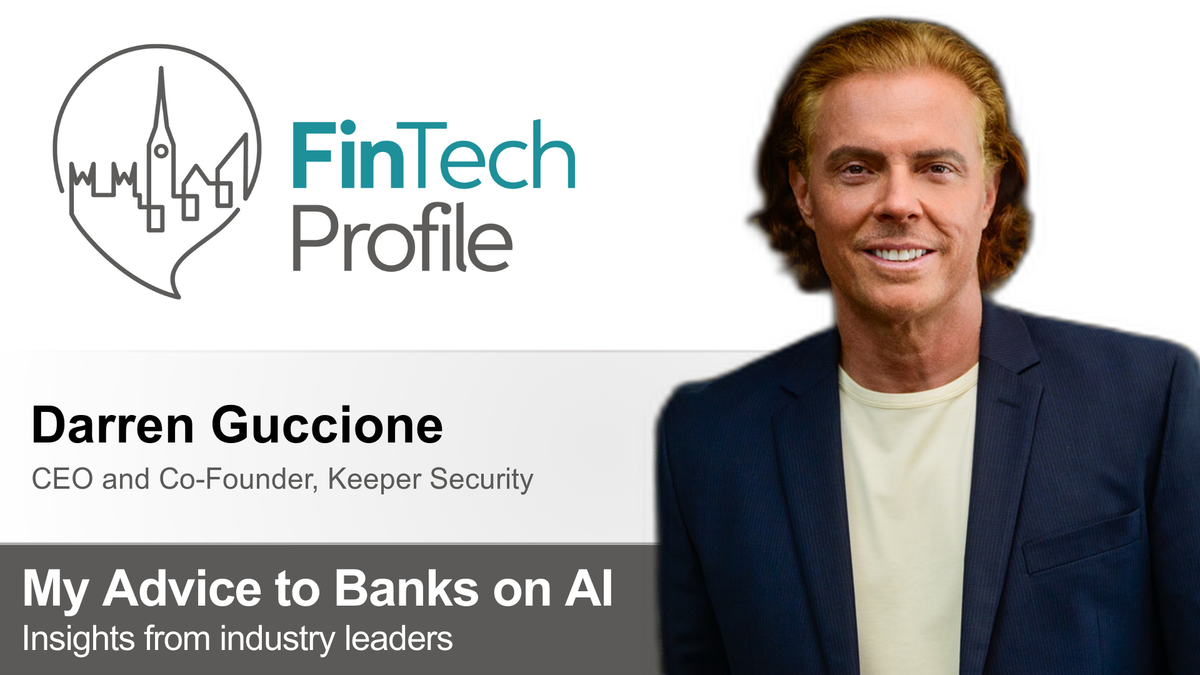
I spoke with Darren Guccione, CEO and Co-Founder of Keeper Security, a zero-trust, zero-knowledge security provider protecting more than 100,000 organisations across 150 countries. Darren shares his practical advice for bank executives on governing data, AI agents and non-human identities as automation expands.
My questions are in bold - over to you Darren:
Can you give us an introduction to you and an overview of your organization?
I’m Darren Guccione, CEO and Co-founder of Keeper Security. Keeper is a zero-trust, zero-knowledge security provider protecting more than 100,000 organizations across 150 countries.
Our core platform, KeeperPAM, is a cloud-native privileged access management solution designed for the modern enterprise. Historically, managing privileged credentials, infrastructure secrets, remote connections and endpoints required deploying multiple, disparate legacy tools. This complexity created security silos and exploitable gaps. We solved this problem by unifying these critical capabilities into a single, cohesive architecture.
As enterprise environments automate, security must protect more than just human employees. Today, Keeper secures all identities across the organization, including humans, machines, non-human identities and AI agents. By combining credential management, secrets management and privileged access controls under one platform, we provide organizations with the complete visibility, compliance and governance they need to secure their critical infrastructure.
If you were advising a bank CEO today, what would you say is the single biggest mistake they’re making with data and AI?
Most banks have a data and AI protection strategy but far less have adequate visibility, security and governance over these critical assets. Additionally, most organizations use antiquated or disparate database management tools that are outside of a cybersecurity control plane.
This lack of oversight extends to human employees. Keeper’s 2026 research found 54% of finance sector respondents see employees sharing sensitive information through AI tools as a security gap, and 45% cite a lack of governance over AI-driven access and automation. Another 31% are concerned about sensitive data being exposed to third-party AI models. No bank would give a new contractor unrestricted access to its core banking platform on day one. Yet that is effectively what happens when an AI tool is connected to customer data without proper definitions and guardrails. Financial institutions must explicitly define what each system can see, for how long and who is ultimately accountable. Only then should they deploy.
What’s one AI or data capability banks should prioritise in the next 12–18 months, and why?
Governing Non-Human Identities (NHIs), and AI agents in particular, is an immediate requirement. AI agents should operate with zero standing privileges – every agent should have its own identity, tightly limited permissions, access that is granted just-in-time and a full record of what it did. Secrets such as API keys and tokens need centralised control and regular rotation, because machines use them to access systems in the same way staff use passwords.
The need shows up in the data. Keeper’s 2026 research found 42% of finance sector respondents see AI-related NHI management as an AI security gap, and 27% say the growth in non-human identities has added to their security pressure over the past year. The investment picture is uneven, with 44% prioritising AI security tools over the next 12 months, against just 29% prioritising Privileged Access Management (PAM). Monitoring what AI does is useful, but limiting what it can do is what stops a problem from becoming a serious incident.
The other key area banks should prioritise in 2027 is AI-led detection and response for privileged activity. Controlling access is no longer enough. The real danger lies in failing to spot misuse once access is granted. Our research found 48% of finance sector respondents say it typically takes hours to detect credential misuse or unauthorised privileged access, and a further 16% say days or weeks. Session data is sensitive, so the analysis must stay under the bank’s control, with records encrypted using keys only the bank holds. Done correctly, it also leaves behind the auditable evidence regulators expect under the Digital Operational Resilience Act (DORA).
Where do you see banks overestimating AI, and where are they underestimating it?
Banks overestimate how far AI output can be trusted and how much of a process can safely be handed over without human oversight. Autonomous agents raise the stakes because they act as well as advise. An agent that can move data or trigger payments is a principal actor. It needs a defined scope, a named person accountable for it and an immutable record of everything it did. Governance should arrive with the agent.
Where banks tend to underestimate is how much invisible access AI gains inside the network. When assistants and agents are given credentials and API keys, they become non-human identities with privileged access. While banks have decades of practice governing human access, governing machines that act on their own is newer ground.
What does “good” actually look like when AI and data are working well inside a bank?
Every person, machine and AI agent has a known identity. Access is granted for a task and removed when it ends, so nobody holds privileges they do not need. Sensitive data is encrypted and reachable only by those who need it, so one compromised account cannot expose everything. Security teams see privileged activity in one place rather than across many disconnected tools.
Banks are moving in that direction; our research found 44% of finance sector respondents improved monitoring and detection of identity-based threats over the past 12 to 18 months, compared with 38% globally. When something goes wrong, a bank should be able to instantly identify what was accessed, by whom or what, and what happened next.
This speed is no longer optional. Under DORA and similar frameworks, a bank must notify its regulator within 24 hours of becoming aware of a major incident. If an autonomous agent makes a critical error, regulators won't accept “the AI did it” as an excuse. Only a bank that can answer those questions and provide an immutable audit trail in minutes can meet that deadline.
What’s the hardest AI or data decision bank executives are avoiding right now, and why?
There’s commercial pressure driving AI deployment that isn’t matched by a corresponding effort to close the security gaps it creates. Boards want visible progress and competitors are announcing pilots. But if a bank cannot say which data an agent can reach, who is accountable for its actions and how its access is withdrawn, they are scaling vulnerability rather than capability.
The bigger issue is that AI ambitions cannot be separated from the state of a bank's underlying security infrastructure. Legacy access, excessive privileges and poorly understood dependencies are not simply technical debt. They are business risks that become harder to contain as automation expands. Executives need to resolve those weaknesses before accelerating deployments, rather than assuming they can retrofit governance once the technology is embedded.
Many thanks to Darren for taking the time to share his insights with FinTech Profile. You can learn more about Keeper Security on their website.