My Advice to Banks on AI: Bharath Gaddam of Data Poem
DATA POEM's CEO shares why banks' AI disappointments stem from fragmented decision architecture, not data quality, and what to prioritise instead.
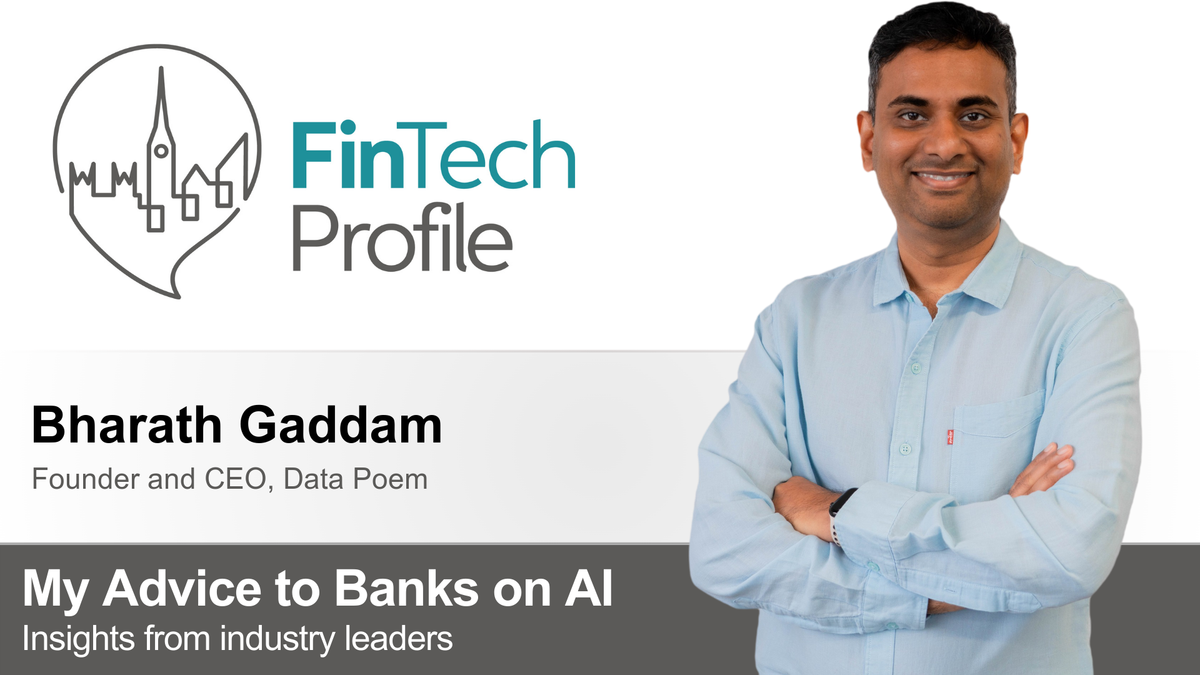
Bharath Gaddam is the Founder and CEO of DATA POEM, an Enterprise Decision AI company whose platform gives enterprise leaders one unified causal model of what drives growth across the business. Before founding DATA POEM in 2019, Bharath worked in the Omnicom and IPG agency groups on brands including McDonald's, Puma, Nike, Domino's, Dove and Volkswagen. In this interview, he shares practical advice for bank executives on where AI is failing, what to prioritise, and the hard decisions leaders are avoiding.
My questions are in bold - over to you Bharath:
If you were advising a bank CEO today, what would you say is the single biggest mistake they're making with data and AI?
Bank CEOs are treating disappointing AI as a data problem or a model problem, when AI failing is really a decision architecture problem. The usual response is another data cleanup program and another, better model. The results barely move, because both fixes miss the real fault.
That fault sits one level up. Every function runs its own model for its own purpose: risk has one view of a customer, finance has another, and the commercial teams have a third. Each was built for a sound reason, often a regulatory requirement or one business line's needs, and each is defensible on its own terms.
The trouble starts when the CEO asks a question that cuts across all of them, such as whether to grow lending to small businesses next year. Three models give three answers, and nobody in the room can say which one reflects what will actually happen.
BCG's "The CFO's AI Agenda," published May 12, 2026, found a version of this problem in corporate finance functions. It names semantic fragmentation, where the same financial terms mean different things in different parts of one organization, as one of the most common reasons AI in finance disappoints. As BCG puts it, "AI amplifies every inconsistency."
Layering AI on fragmented models produces the same disagreement, faster and with more confidence. Across the enterprises we work with, the gains come only after leaders decide which consequential questions need one shared answer. Then they rebuild the architecture underneath, so every function works from the same understanding of cause and effect.
What's one AI or data capability banks should prioritise in the next 12–18 months, and why?
Build an explainable decision layer: one shared model of cause and effect that sits above the existing systems, and that an accountable executive can stand behind. When the board asks why a lending target moved or why a price change was approved, the answer should name the measurable causes behind it.
Most AI roadmaps carry a different priority. The default plan is a better model, with more data, more parameters, or a newer vendor. BCG's research on AI in corporate finance functions, published May 12, 2026, puts the model at the bottom of the list.
BCG attributes about 70% of AI success to organization, workforce, and skills, about 20% to the technology platform, and only about 10% to the models themselves. I read that as an architecture point as much as a people point. Inside a bank, I'd expect most of that 70% to sit in who owns a decision, which definitions everyone uses, and how a recommendation reaches a credit committee or a pricing meeting.
The same research warns that "automating a fragmented process scales fragmentation rather than eliminating it." That's exactly what happens when a bank buys a smarter model and plugs it into the same divided structure.
A decision layer forces those questions early. You have to agree on what revenue, risk, and margin mean across functions before one model can explain all three, and that agreement is most of the value. From then on, every answer the model gives traces back to definitions finance and risk already share, so a regulator can follow it.
Where do you see banks overestimating AI, and where are they underestimating it?
Too many banks treat adoption as proof of value. A long list of AI pilots and use cases feels like progress, and it's easy to report to a board. Impact is a different measure, and the gap between the two is wide well beyond banking.
A Gartner survey of 183 CFOs, published June 8, 2026, found that 84% of corporate finance organizations had implemented AI or planned to, yet only 7% reported a high or very high impact. McKinsey's "The State of AI in 2025," published in November 2025, found that only 39% of respondents said AI had added anything to their organization's operating profit. Most of those said AI accounted for less than 5% of it.
Both figures cover companies across industries, and most bank leaders will recognize the pattern.
Where banks underestimate AI is in what it takes to let it near a consequential decision. Most of the value sits in the big calls: credit appetite, pricing, capital allocation, and where to grow. Those are exactly the decisions a bank has to explain, to a regulator, to its board, and sometimes to a customer.
So the binding constraint isn't model accuracy. It's whether an accountable executive can see what drove a recommendation and defend it under model risk review. Prediction-only systems can be highly accurate and still fail that test, because they tell you what's likely to happen without telling you why.
An AI program that can't explain itself stays in the low-stakes corners of the bank. That's a big part of why adoption runs so far ahead of impact.
What does "good" actually look like when AI and data are working well inside a bank?
Picture the CFO and the CRO walking into the same meeting with the same number. In most large enterprises I see, leaders bring forecasts from different models and spend the meeting reconciling them, so the decision slips to the next one.
A bank in good shape runs its consequential decisions off one shared model of cause and effect. Finance, risk, and the business lines can each ask their own questions of it. The answers add up, because they come from the same understanding of what drives deposits, lending, losses, and margin.
Every consequential decision is also traceable. If the bank tightens credit in one segment or reprices a product, an accountable executive can name the causes the decision rested on. They can also say what the model expected to happen, and what it expected had the bank done nothing.
That last comparison, the counterfactual, is what turns a model output into something a model risk team can validate and a board can challenge.
Gartner made the wider point on March 17, 2026, in a prediction about governments using AI agents: "regulated industries and governments cannot rely on opaque 'black box' systems for consequential decisions." Inside a bank, that is a model risk question for the accountable executive: when a decision goes wrong, a supervisor, an auditor, or a board member asks who owned it and on what basis.
In a bank that gets this right, every decision carries its own explanation from the start, so the evidence exists long before anyone asks for it.
What's the hardest AI or data decision bank executives are avoiding right now, and why?
Who answers for a decision an AI agent makes is the question bank executives keep deferring. As agents move from advising people to acting for them, each one makes small decisions faster than any committee could review. From what I see across enterprises, few leadership teams have settled who owns those decisions when the outcome is bad.
The question is uncomfortable because the honest answer exposes the architecture. If each agent runs on a different prediction-only model, nobody can explain why it acted. Accountability then lands on whoever signed off the deployment, with no way to defend the call.
Underneath sits a second decision that's even easier to avoid: whether to keep funding the fragmented models a bank already has, or rebuild the decision architecture beneath them. Continuing feels safer. Each model has an owner, a budget, and a validation history, and replacing any of them looks like risk.
AI budgets look secure. In BCG's AI Radar 2026, published January 15, 2026, 94% of CEOs say they will keep investing in AI at current or higher levels even if it does not pay off in the next year. What bank leaders still have to choose is whether that spending buys more disconnected predictions or one architecture that can explain them.
My advice is to make that call deliberately, and soon. Name the accountable executive for every agent before it goes live, require every consequential decision to trace back to its causes, and stop funding models that can't meet that standard. The first year runs slower, and in return the bank can trust AI with the credit, pricing, and capital calls where most of its value sits.
Many thanks to Bharath for taking the time to share his insights with FinTech Profile. You can learn more about DATA POEM on their website.