My Advice to Banks on AI: Cindy Griffin of Smart Communications
Cindy Griffin shares why banks should treat fraud as a communication problem, prioritise contextual intelligence, and overcome hesitation about AI-generated customer communications.
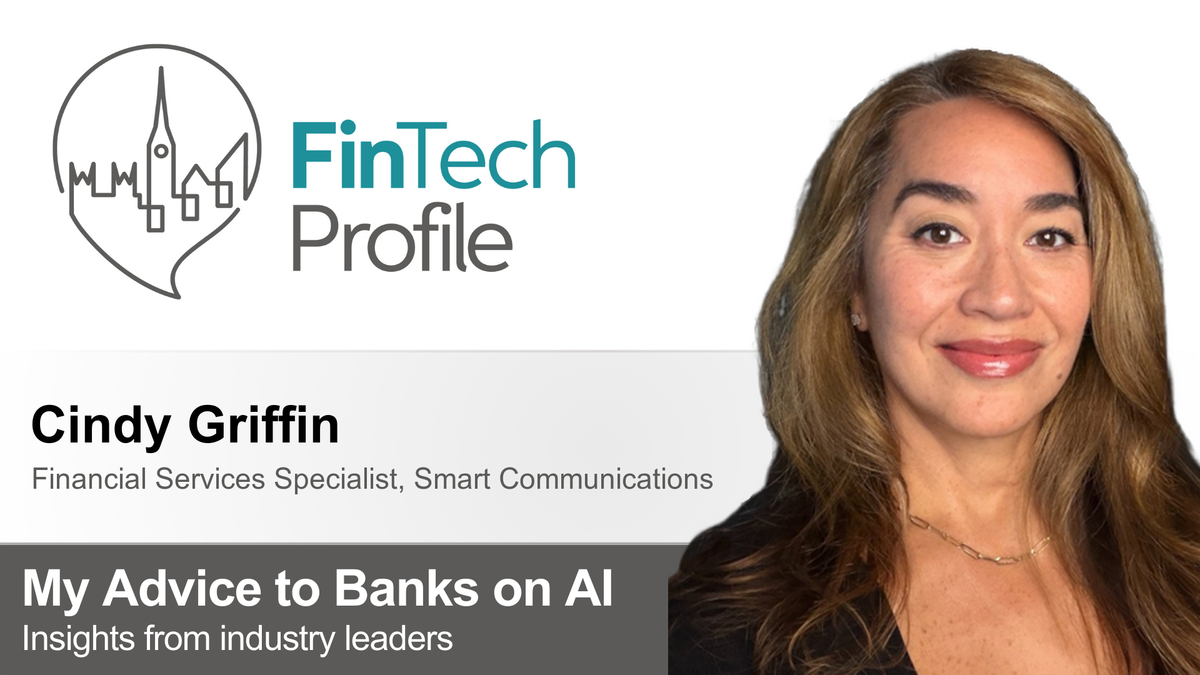
I spoke with Cindy Griffin, Financial Services Vertical Marketing Specialist at Smart Communications, where she focuses on helping banks and regulated financial services organisations improve customer communications in high-stakes moments. Cindy shares practical advice on how banks can better leverage AI to prevent fraud, personalise customer experiences, and bridge the gap between detection and prevention.
Over to you Cindy - my questions are in bold:
Can you give us an introduction to you and an overview of your organisation?
I'm Cindy Griffin, Financial Services Vertical Marketing Specialist at Smart Communications, where I focus on helping banks and other regulated financial services organisations improve how they communicate with customers in high-stakes moments.
Smart Communications provides a cloud-native customer conversations management platform that enables enterprises to deliver personalised, two-way interactions across the entire customer lifecycle. We help organisations scale customer communications, simplify complex processes and drive better outcomes by ensuring every interaction is timely and easy to act on.
If you were advising a bank CEO today, what would you say is the single biggest mistake they're making with data and AI?
Treating fraud as a detection problem rather than a communication problem. Banks have invested heavily in systems that identify suspicious activity after the fact. By the time a flag is raised, the malicious activity has already happened. Meanwhile, fraud itself has evolved. Attacks are coordinated across email, SMS and voice, often timed around payroll runs or financial deadlines, and designed to create urgency and bypass rational decision-making.
The real gap is before that moment: the communication that reaches a customer or staff member right when they're about to make a decision they'll regret. The financial institution's warnings or prompts - if they have them - are rather generic and arrive too late. That's the mistake.
With this in mind, a bank CEO should be thinking less about "Where can we deploy more AI?" and more about "Where does AI improve decisioning, and how do we wrap those decisions in trusted, orchestrated communications?"
What's one AI or data capability banks should prioritise in the next 12-18 months, and why?
Contextual intelligence. The ability to read a transaction, grasp the risk it carries and generate a warning tailored to that particular moment. For example, a change to payment details shortly before a major scheduled payment is a very different risk from a routine profile update. AI should be able to tell the difference and communicate it in plain language, making somebody pause.
This is especially important as fraudsters become more sophisticated in how they mimic legitimate behaviour. Generic alerts are easy to ignore, particularly in high-pressure environments. But a message that reflects the specific context, timing and risk of a transaction is far more likely to interrupt that moment of action. That's where AI can make a measurable difference with contextual intelligence.
And contextual intelligence derived from AI cannot exist in isolation. It needs to be connected to a governed communications layer that can deliver secure alerts, verifications, and next-best actions consistently across channels. In the next 12 to 18 months, this is what will separate banks that merely identify fraud from those that are proactively preventing losses and preserving customer trust.
Where do you see banks overestimating AI, and where are they underestimating it?
They're overestimating the idea that AI can replace human judgement and governance in high-stakes decisions. AI can draft, summarise, and recommend, but it still needs guardrails, clear operating boundaries, and a human in-the-loop. The danger here is thinking that AI can be layered onto messy data, fragmented workflows, and inconsistent outreach and still expect a clean result.
Even considering where banks overestimate AI, it can still play an important role in how the warning is written and delivered and this is where banks are underestimating AI. The language of a fraud warning or suspicious activity prompt is doing the real work and needs to defuse urgency and give somebody a clear next step. AI is well suited to generating and adapting that kind of communication in real time, but most banks aren't using it that way.
Banks also underestimate the power of AI for hyper personalisation. It can help banks understand which journeys drive customer action and which create confusion or abandonment. Ideally, seamless customer data collection drives AI-assisted customer insight and creates a personalised experience for each customer, improving trust.
What does "good" actually look like when AI and data are working well inside a bank?
"Good" looks deceptively simple - it's seamlessness from a customer perspective and boring from an employee perspective. A customer or employee gets a clear, relevant message at the exact moment they need it, right before a potentially risky action is taken. Not a block of terms and conditions, not a generic pop-up, but a timely intervention embedded directly into the workflow.
It might be a prompt that flags an unusual payment request in plain language, or a reminder to verify a change in bank details using a trusted source. The key is that it feels specific and easy to follow. Getting there requires the right communication architecture, the ability to act at the right moment and, most importantly, a commitment to clarity. In many cases, it's the language that lets banks down.
What's the hardest AI or data decision bank executives are avoiding right now, and why?
Whether to let AI touch customer-facing communications at all. There's real hesitation here and, granted, some of it's justified. Regulated industries, of course, need to be careful about automated messaging, especially if it's AI-generated.
But the hesitation has grown into a bottleneck. Banks are sitting on data that could dramatically improve the timing, relevance and effectiveness of fraud warnings. At the same time, fraudsters are moving faster, using increasingly convincing tactics to manipulate behaviour. Yet communications are still often produced at the speed of committee approval, not at the speed of risk.
Bridging that gap doesn't mean removing human oversight. It means using AI to support it, generating timely, contextual prompts that encourage verification and slow down decision-making at exactly the right moment. Because when fraud detection comes too late, communication becomes the first line of defence.
Thank you Cindy! You can connect with Cindy on her LinkedIn Profile and find out more about the company at smartcommunications.com.