Madhu Nadig, Co-founder & CTO, Flagright
Madhu Nadig discusses building AI-native financial crime infrastructure, the industry's fragmentation problem, and why real-time payments demand real-time compliance.
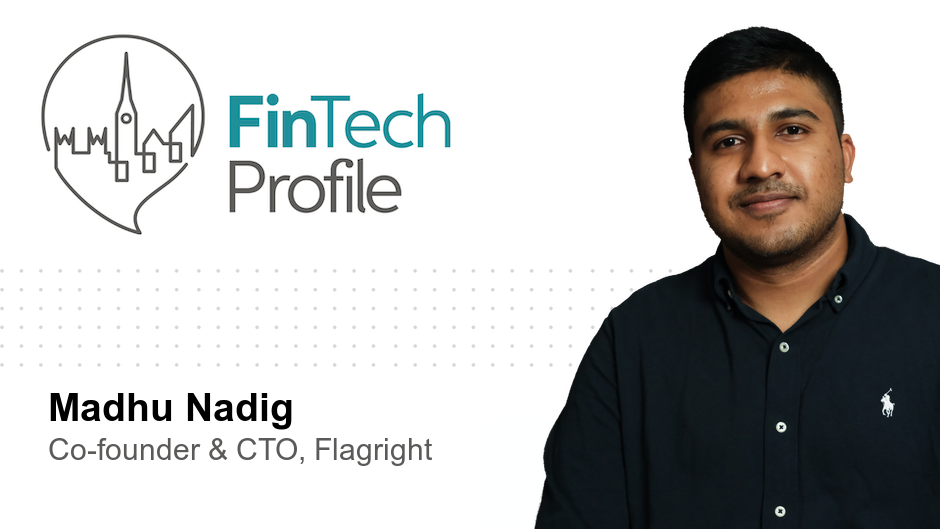
Today we're delighted to speak with Madhu, Co-founder and CTO of Flagright, a company building AI-native financial crime infrastructure for banks, payment companies and fintechs. With a background spanning Palantir, AWS and Forto, Madhu brings a unique systems-thinking perspective to compliance infrastructure, treating financial crime detection as a scalable engineering challenge rather than a box-ticking exercise.
My questions are in bold - over to you Madhu:
Who are you and what's your background?
I'm Madhu Nadig, Co-founder and CTO of Flagright. My background is in building scalable, data intensive systems across roles at Palantir, AWS and Forto. That route into fintech felt very natural to me because financial crime compliance is ultimately a systems problem involving high-stakes decisions, real-time data, complex workflows and very little room for failure. What drew me in was the gap between how important compliance is operationally and how poor the tooling often was in practice.
What is your job title and what are your general responsibilities?
I'm Co-founder and CTO. In practice, that means I spend my time across product architecture, engineering, platform reliability, AI roadmap and staying very close to clients so the product reflects how compliance teams actually work. A big part of the role is making sure whatever we automate remains explainable, testable and audit-ready, because in regulated environments, speed only matters if you can defend the decision afterward.
Can you give us an overview of your business?
At Flagright, we build financial crime infrastructure for regulated institutions across a wide range of operating models, from digital-first payment companies to established banks and enterprise financial institutions. Our platform brings together real-time and post-transaction monitoring, watchlist screening, dynamic risk scoring, case management and AI capabilities across screening, monitoring, governance and quality assurance. What differentiates us is not just feature breadth, but control, with configurable workflows, simulation and backtesting before release, explainable AI inside investigations and audit-ready operations. That is resonating with institutions replacing fragmented compliance stacks with a more unified operating layer.
Another thing that makes us different is that we focus not only on detecting risk, but on making investigations and decisions operationally usable with configurable controls, fast deployment, human oversight, simulation before rollout and a clear audit trail throughout. We have the fastest integration time in the world, deployable in as little as two weeks, with more than 100 financial institutions across 30+ countries using Flagright across industries such as payments, banking, remittances, brokerages and crypto/stablecoin businesses.
On market reaction, the strongest signal has been that teams want fewer fragmented tools and less service-heavy implementation.
Tell us how you are funded?
Flagright is venture-backed. Our pre-seed round was led by Moonfire Ventures with participation from Pioneer Fund and Y Combinator, and our seed round was led by Frontline Ventures with continued backing from Y Combinator, Pioneer Fund and Moonfire. The way I would frame that journey is that we have been deliberate about pairing strong institutional capital with investors and operators who understand infrastructure software, fintech and regulated markets.
What's the origin story? Why did you start the company? To solve what problems?
The company started from a very practical frustration. Baran Ozkan, my co-founder & CEO had spent roughly a year and a half looking for a real-time, risk-based transaction monitoring solution and kept finding the same pattern: the market overpromised, underdelivered and forced compliance teams into slow, fragmented workflows. We decided to build the product we would have wanted to buy ourselves.
My part of that story was bringing the engineering lens from building large-scale, data-intensive systems. The original wedge was real-time transaction monitoring, but once we got deeper into client workflows, it became obvious that the real bottleneck in compliance was not just alert generation. It was everything that happened after the alert, including investigation, evidence gathering, decisioning, documentation and governance. That is why Flagright evolved into a broader financial crime platform and why we have invested heavily in AI capabilities that has become such an important part of our roadmap, not as a branding layer, but as a way to make investigations, quality assurance and policy operations faster, more consistent, explainable and more auditable.
Who are your target customers? What's your revenue model?
Our target customers are regulated financial institutions that need modern financial crime infrastructure, including payment processors, digital banks, banks, brokerages and trusts, remittance companies and crypto/stablecoin businesses. The common thread is not company age; it is operational complexity, regulatory exposure and the need for real-time, auditable controls. In commercial terms, our model is software plus usage-based pricing, because that maps better to how compliance load actually grows.
On customer examples, HitPay is a good one because the public case study is concrete. They reported 83.8% fewer false positives and 50% faster investigations after implementing Flagright. Betterment is another strong example because the story there is less about a headline metric and more about control architecture involving centralised case management, integrated frontline signals, dynamic risk scoring and safer testing of risk changes before production. We also have public references across names like UniCredit, Intuit, GoCardless, B4B Payments, Betterment and others listed on our customer pages.
If you had a magic wand, what one thing would you change in the banking and/or FinTech sector?
I would eliminate the industry's tolerance for fragmented compliance stacks. Too many institutions still accept a world where onboarding, transaction monitoring, sanctions screening, case management and reporting all live in separate systems with separate logic and separate owners. That fragmentation creates blind spots, slows teams down and makes governance harder than it needs to be. If I could change one thing, it would be moving the sector from periodic, box-ticking compliance to real-time, evidence-based control systems.
What is your message for the larger players in the Financial Services marketplace?
My message to larger institutions is simple - treat financial crime infrastructure as core enterprise architecture, not as a compliance sidecar. If your payments stack, customer operations and risk controls evolve faster than your detection and investigation layer, you create hidden operational fragility. The next winners in financial services will not just move money faster; they will investigate faster, tune controls faster and prove governance faster.
Where do you get your Financial Services/FinTech industry news from?
I tend to split my reading between signal and plumbing. For signal, I read the Financial Times fintech coverage and Simon Taylor's Fintech Brainfood. For the day-to-day plumbing of the industry, I still find Finextra useful. And beyond media, I spend a lot of time with primary sources, regulator releases, enforcement updates and technical documentation.
Can you list 3 people you rate from the FinTech and/or Financial Services sector that we should be following on LinkedIn, and why?
- Simon Taylor, one of the clearest thinkers on the intersection of fintech, payments, stablecoins, market structure and AI. He is consistently good at separating signal from noise.
- Nik Milanović, strong on startup formation, fintech infrastructure and where the market is actually moving rather than where people say it is moving.
- David Birch, one of the best people to follow if you care about digital money, identity, payments and the long-term shape of financial infrastructure.
What FinTech services (and/or apps) do you personally use?
A few I genuinely appreciate from a product point of view are Wise and Revolut. Wise is excellent for cross-border money movement and transparency on fees. Revolut is a strong example of how product design, FX convenience and card controls can come together in one interface.
What's the best new FinTech product or service you've seen recently?
One that caught my attention recently is Modern Treasury Payments. What I like about it is that it reflects where infrastructure is heading, with fewer stitched-together abstractions and more unified control across rails. Their launch positions it as a single PSP across ACH, RTP, FedNow, wires and stablecoins, backed by real-time reporting and ledger infrastructure. That kind of simplification, if done well, is valuable because the next phase of fintech is not just more rails, it is about having fewer operational seams between them.
Finally, let's talk predictions. What trends do you think are going to define the next few years in the FinTech sector?
I think five things will define the next phase of fintech. First, AI will move from "copilot" to governed operator: less novelty, more bounded automation inside real workflows. Second, real-time payments will force real-time compliance; the batch-era separation between payments operations and financial crime operations will not hold. Third, fraud, AML, sanctions, onboarding risk and case management will converge into a single risk operating layer because criminals do not respect internal org charts. Fourth, stablecoins will increasingly be treated as payments infrastructure rather than as a niche crypto topic. And fifth, buyers will become much more demanding about governance. They will want simulation, version control, audit trails and clear human override points before they trust AI at scale.
At Flagright, that is exactly why we are investing in AI capabilities across screening, monitoring, governance and quality assurance. The industry does not need more AI for the sake of AI. It needs AI that improves decision speed, reduces operational drag and still stands up under audit. That is the bar I think the sector will increasingly adopt.
We'd like to thank Madhu for taking the time to share his insights with us. You can learn more about Flagright on their website.