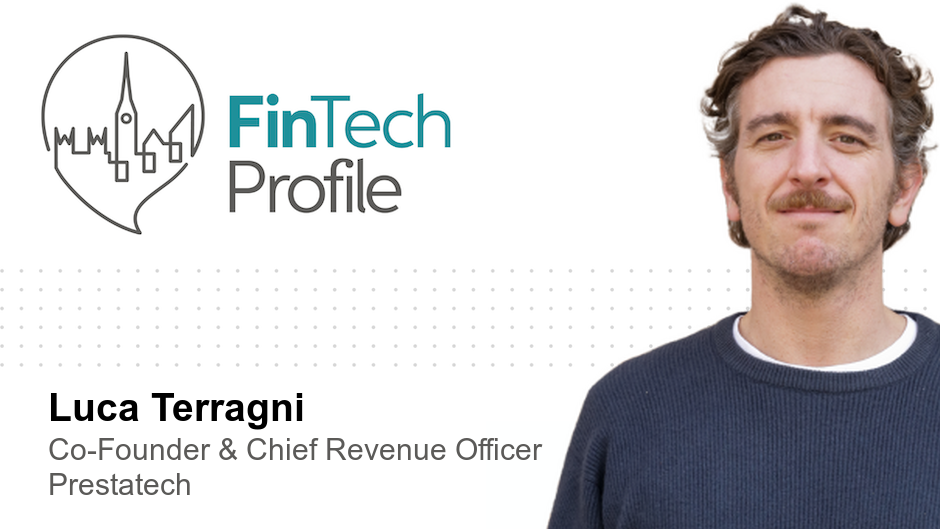
Luca Terragni, Co-Founder & Chief Revenue Officer, Prestatech
Luca Terragni shares how Prestatech uses AI-powered bank account analytics to transform credit decisioning for banks across Europe and the US.
Today we're delighted to speak with Luca, Co-Founder and Chief Revenue Officer at Prestatech, a credit intelligence platform serving banks and lenders across Europe and the US. Having founded and operated a digital lender before pivoting to build the technology layer that powers lending for banks, Luca brings a rare operational perspective to the fintech space. In this interview, he discusses the journey from running Prestacap through a pandemic acquisition and management buyout, the evolution of cash-flow based credit intelligence, and why AI-native infrastructure layers represent the future of banking technology.
My questions are in bold - over to you Luca:
Who are you and what's your background?
I'm Luca Terragni, Co-Founder and Chief Revenue Officer at Prestatech, a credit intelligence platform based in Berlin, serving banks and lenders across Italy, Germany, the UK, and now expanding into the US.
I studied finance at Bocconi in Milan and later did my Master's at ESADE in Barcelona, which is where I met my co-founder, Christian Nothacker. We were university mates at both institutions, so we've known each other for a long time and have been through a lot together.
My early career was in asset management and hedge fund sales between New York and London, which gave me direct exposure to private credit markets and a very practical understanding of how institutional money flows and how credit decisions are really made behind the scenes.
The pivot to fintech came around 2015-2016. At the time, we were in a prolonged low interest rate environment. Banks across Europe were pulling back from SME lending because the margins didn't justify the operational cost. That created a huge gap, and two worlds converged to fill it: private credit funds (the world I was living in) and fintechs (Christian's world, having come from SumUp and the payments space). We saw the opportunity and founded Prestacap, a pan-European digital SME lender operating across Italy and Germany. We built the technology, raised equity from family offices, secured debt facilities from private banks, originated loans, and scaled the business.
In January 2020, Prestacap was acquired by DEPObank, an Italian custodian bank. The timing was brutal, and three months later, COVID hit. The PE sponsor behind DEPObank halted the industrial plan we had been acquired to execute, and everything stalled. So we did what felt natural. We executed a management buyout, bought back the technology with our own capital and the support of family offices and close allies, and relaunched as Prestatech. This time, instead of being a lender, we became the intelligent layer that powers lending for banks.
I've lived and worked across five countries: Italy, the US, the UK, Germany, and Spain. That cross-cultural experience is genuinely useful in European enterprise fintech, where every market has its own banking culture, regulatory DNA, and commercial rhythm.
What is your job title and what are your general responsibilities?
My title is Co-Founder and Chief Revenue Officer. But in a company of about 30 people, what's on the business card only tells part of the story. I have significant exposure to operations, project management, and product as well.
On a typical day, I might start with a call to an Italian bank walking their credit risk team through a proof-of-concept we're running on their SME portfolio, then shift to a product review with our engineering leads on a new cash-flow scoring module, and finish the afternoon on a strategy session for our US market entry, refining our ideal customer profile and coaching our business development team on outreach.
I also spend meaningful time on partnerships with core banking technology platforms, where we're integrating our credit intelligence layer into their ecosystems. And because we're building a structured go-to-market function for the first time, transitioning out of purely founder-led sales, I'm hands-on with hiring, process design, pipeline management, and coaching our growth team.
Essentially, if it touches revenue, product-market fit, or how we show up to clients, it's on my desk.
Can you give us an overview of your business?
Prestatech is an intelligent credit layer that uses bank account data and document automation to help lenders lend more and risk less.
We sit between the raw data that banks already have and the credit decisions they need to make. Our platform has three core capabilities. First, document automation. We ingest, parse, and structure unstructured financial documents like bank statements, tax returns, balance sheets, and payslips, turning them into clean, machine-readable data in seconds. This alone eliminates a massive bottleneck in credit workflows. Second, bank data enrichment. We take raw transaction data from bank accounts and enrich it with categorisation, pattern recognition, and behavioural signals that reveal the real financial story behind the numbers. Third, cash-flow analytics and scoring. We generate real-time, granular cash-flow credit scores based on actual income and expenditure patterns. This is fundamentally different from traditional bureau scores because it reflects what's happening in a borrower's financial life right now, not what happened six months ago.
What ties it all together is that we built this technology while running a real lending operation at Prestacap. That's not a marketing line. We originated loans, managed a portfolio, dealt with defaults, and understood first-hand what data actually matters when you're putting capital at risk. The technology we use today evolved from the tools we built for ourselves, refined significantly since then, but rooted in real operational experience.
We operate on a B2B SaaS model: recurring platform fees combined with volume-based API usage pricing. Our clients include Intesa Sanpaolo and Banca Aidexa in Italy, and we were recognised among CNBC's World's Top FinTech Companies 2025.
The market timing is strong. Banks are under real pressure to digitise credit processes, comply with evolving regulations like the EBA's affordability guidelines, and improve their SME lending economics. We sit right at that intersection.
Tell us how you are funded?
We raised a Series A round led by CDP Venture Capital, the venture arm of Italy's national development bank Cassa Depositi e Prestiti, with participation from Alchimia Investments, and a couple of family offices that have been supporting us since day 0.
But the story before that is important context. When we executed the management buyout to reacquire the technology from DEPObank after the COVID disruption, that was funded with our own money plus support from family offices and family and friends who believed in what we were building. We didn't go to VCs for the MBO. We used our own capital and our personal network.
And going further back, Prestacap itself was funded with equity from family offices and debt from private banks. We never took traditional VC money for the lending business.
So our journey has been quite capital-efficient and relationship-driven throughout. Having CDP Venture Capital as our institutional backer has been particularly valuable in the Italian market, where it carries significant credibility with the large banks we sell into. But we've always been disciplined about raising only what we need and proving the model with real enterprise clients before thinking about scaling capital.
What's the origin story? Why did you start the company? To solve what problems?
The origin story goes back to Prestacap. Christian and I founded it because we saw a structural gap in European SME lending. It was 2015-2016, interest rates were at or near zero, and banks were retreating from SME credit because the economics didn't work for them at those margins. Meanwhile, millions of viable businesses couldn't get funded. Two worlds converged to fill that gap — I came from asset management and hedge fund sales, with direct exposure to private credit, while Christian came from fintech and payments. Together, we built a digital lending platform that operated across Italy and Germany.
Running Prestacap taught us everything. We built technology in-house to handle the operational complexity of lending: parsing documents, analysing bank account data, scoring borrowers, automating decisions. It was embryonic compared to what we have now, but the DNA was there. We lived the credit value chain end to end, from application to default management.
When DEPObank acquired us in 2020, it validated the approach. But COVID hit three months later and the industrial plan was shelved. After the MBO, we had a choice: go back to lending, or take the technology we'd built and make it available to every bank and lender struggling with the same problems we'd solved for ourselves. We chose the latter, and Prestatech was born.
The problems we solve are specific. First, document chaos. Credit teams at banks still spend hours manually reviewing financial documents. Our automation eliminates that. Second, the cash-flow blind spot. Traditional credit scoring misses the real-time signals that actually predict repayment behaviour. Our analytics surface those signals from raw bank data. Third, the speed gap. Borrowers expect instant answers, but banks still take days or weeks to make decisions. We compress that timeline dramatically.
What makes us credible is that we're not theorising about these problems. We lived them. We lost money on bad loans and turned away good borrowers because we didn't have the tools we needed. That experience is embedded in how we build.
Who are your target customers? What's your revenue model?
Our primary customers are banks, lending institutions, and financial intermediaries that originate credit to consumers and SMEs. But the range is broader than that.
In Italy, our anchor clients include Intesa Sanpaolo and Banca Aidexa. We also work with Banca CF+ and serve the broader Italian banking market. In Germany, we count clients like Sennder Technologies and Vermieterwelt, a real estate platform. In the US, we work with alternative lenders like Aqeel Finance. And in Italy, we also serve digital brokers like Facile.it.
So the client base spans traditional banks, challenger banks, alternative lenders, digital brokers, and real estate platforms. The common thread is that they all need to make credit decisions, and they all benefit from better data intelligence.
For our US expansion, we've defined a clear target: community and regional banks with $10 billion to $150 billion in assets, particularly those with strong SME lending operations in the Heartland states and the South. These banks are large enough to need sophisticated credit tooling but often don't have the internal tech resources to build it.
Our revenue model is B2B SaaS with two components: a recurring annual platform licence fee that gives clients access to the core capabilities, and volume-based API usage fees tied to the number of documents processed, credit analyses performed, or scores generated. For larger enterprise deployments, there may also be an initial integration component. This creates a natural land-and-expand dynamic where revenue scales as clients push more volume through the platform.
If you had a magic wand, what one thing would you change in the banking and/or FinTech sector?
I'd collapse the time it takes for proven fintech solutions to actually go live inside a bank.
The biggest friction I encounter every day is not technological. It's procedural. Banks have the customers, the balance sheets, the regulatory licences, and the trust. Fintechs have the speed, the modern architecture, and the product thinking. But the procurement cycles, compliance reviews, and vendor onboarding processes at most banks are so protracted that genuinely useful technology can take 12 to 18 months to reach production, by which point the market and the borrowers have moved on.
If I had a magic wand, I'd create a standardised fast-track framework for banks to adopt proven fintech capabilities. Something that satisfies regulators, respects the bank's risk appetite, but compresses the integration timeline from a year to a quarter. Regulators are moving in the right direction with open banking frameworks and updated outsourcing guidelines, but the gap between regulatory intent and institutional practice is still enormous.
In credit specifically, this matters a lot. Every day a bank spends in a slow procurement cycle is another day of suboptimal decisions: good borrowers rejected, risky ones approved, and operational costs piling up. The cost of inaction is real and measurable.
What is your message for the larger players in the Financial Services marketplace?
Start small, start now, and let the data do the talking.
I understand the hesitation. Large banks have been burned by big IT projects that over-promised and under-delivered. There's genuine vendor fatigue out there, and I respect that. Building trust takes time, especially with institutions that have been around for decades or centuries.
But what I'd say to a CTO or Chief Lending Officer at a major bank is this: you don't need to rip and replace anything. The most effective way to evaluate a new capability is a focused proof of concept on a specific portfolio or workflow. Give us a defined scope, a clear success metric, and a few weeks. If the data doesn't speak for itself, walk away. No hard feelings.
That's how we've built every meaningful client relationship we have. Not through pitch decks or procurement beauty contests, but through showing measurable results on real data. We ran a POC with a major Italian bank across roughly 40,000 SME positions, and the outcomes made the commercial case far more convincingly than any presentation could.
The lending market is evolving fast. Borrowers expect speed. Regulators expect transparency. And the competitive landscape is shifting. The banks that will thrive are the ones willing to test, learn, and iterate with partners who understand credit from the inside.
Where do you get your Financial Services/FinTech industry news from?
Honestly, everywhere. FT daily, plain vanilla but reliable. The Economist when I have the patience for it. TechCrunch, The Information, Sifted for the tech and Europe-specific stuff. But the real gems come from the less obvious places.
Beyond the obvious, I follow a mix of fintech blogs and specialist voices, namely Mint Studios, Fintech OS, Chris Skinner, Alloy Labs. These are people and outlets that actually understand how banking technology works in practice, not just in theory. I also pick up a lot from niche Telegram channels and random deep-dives from practitioners who are in the trenches.
And then there's Litquidity. If you know, you know. It's the best satirical finance account out there, and honestly, sometimes the memes tell you more about market sentiment than any analyst report. I think there's real value in not taking yourself too seriously, especially in an industry that has a tendency to do exactly that.
Can you list 3 people you rate from the FinTech and/or Financial Services sector that we should be following on LinkedIn, and why?
- Conrad Ford — Conrad is Chief Product & Strategy Officer at Allica Bank, which Deloitte named the UK's fastest-growing fintech ever. He's both a sharp thinker and a relentless executor; he founded Funding Options, scaled it, then moved to Allica and helped build one of the most impressive challenger banks in Europe. His posts are always grounded in real operational experience rather than theory. A rare combination of vision and follow-through.
- Michael Jackson — Michael is a Paris-based venture capitalist with one of the largest followings in European tech on LinkedIn. He's candid, rational, and has a genuinely global worldview on technology, policy, and entrepreneurship. I don't always agree with him, but that's precisely the point; he makes you think and challenges the comfortable consensus that too much of the European tech ecosystem falls into.
- Fabio Ciucci — Fabio is a tech entrepreneur and director who's been building and advising in the space since the mid-90s. He's not the most famous name on LinkedIn, but that's part of the appeal. His takes on technology, AI, and fintech are honest and contrarian in a way that most of the usual suspects aren't. He calls out hype when he sees it and isn't afraid to say the emperor has no clothes. If you're tired of echo chamber optimism, Fabio is a good antidote.
What FinTech services (and/or apps) do you personally use?
For day-to-day personal banking, Revolut is my go-to. Multi-currency accounts, instant notifications, seamless cross-border spending. When you live and work across multiple countries, it's genuinely indispensable.
For business banking, I use Qonto. It's clean, fast, and built for the way small companies actually operate. Expense management, invoicing, team cards: it just works without the overhead of a traditional business account.
BBVA deserves a mention as well. They've quietly built one of the best digital banking experiences among the large traditional banks. I use them for everything from savings to everyday transactions, and the app is genuinely excellent. It's proof that incumbent banks can deliver a great digital experience when they commit to it.
And a shout-out to Trade Republic. They've made investing and savings products incredibly accessible across Europe. The simplicity of the UX and the breadth of the product offering are impressive, and they've done it while staying within a regulated banking framework. Worth watching.
What's the best new FinTech product or service you've seen recently?
Fuse. They've built an AI-native loan origination system specifically for US credit unions, and they just raised $25 million to scale it. What catches my attention is the approach. Rather than asking credit unions to bolt AI onto their existing legacy LOS, Fuse built the entire system from scratch around AI. They already have over 100 institutions on the platform, and they've launched a rescue fund to help credit unions stuck in expensive legacy contracts make the switch.
It matters because credit unions serve the American middle class and have deep community relationships, but they've been losing ground to fintech lenders precisely because their technology can't keep up. Fuse is attacking that gap head-on. It's a great example of the broader trend I'm most excited about: AI-native platforms that don't try to replace everything, but fundamentally rethink one specific workflow and do it dramatically better.
Finally, let's talk predictions. What trends do you think are going to define the next few years in the FinTech sector?
Three trends I'm watching closely.
First, the rise of AI infrastructure layers that act as bridges rather than replacements. This is the big one. Banks run on core systems that have been in place for decades, and ripping those out is neither realistic nor desirable. The winning approach is building intelligent layers that sit on top of existing infrastructure and unlock new capabilities without forcing a full re-platforming. That's exactly what we do at Prestatech, and I think this pattern will define the next generation of enterprise fintech: not replacing the core, but making it dramatically smarter. The banks that adopt these bridge layers early will have a meaningful edge.
Second, cash-flow-based credit intelligence is becoming the new standard. Bureau scores were designed for a different era. Regulators, particularly the EBA with its affordability assessment frameworks, are actively pushing lenders toward real-time income and expenditure analysis. Open banking data combined with AI-driven cash-flow scoring will become the default credit assessment methodology within a few years. This is a structural shift, and it favours companies that understand both the data science and the lending economics.
Third, regulatory-driven technology adoption. DORA, CCD2, the increasing scrutiny on AI in credit decisions: banks will have no choice but to adopt technology stacks that are explainable, auditable, and resilient. The fintechs that win will be the ones that treat compliance not as a checkbox exercise but as a product feature. We've built Prestatech with regulatory awareness embedded in the architecture, because in enterprise banking, trust is earned through transparency, not just through clever algorithms.
The common thread is that the winners will be companies that combine deep domain expertise with modern technology and a pragmatic understanding of how banks actually work. The next chapter belongs to those who can move fast while building trust.
Many thanks to Luca for taking the time to share his insights with us. You can learn more about Prestatech on their website.