John Downie, CEO and Founder, SteadyPay
John Downie explains how SteadyPay uses open banking data to lend to the people mainstream credit models turn away, and why credit is becoming a feature rather than a product.
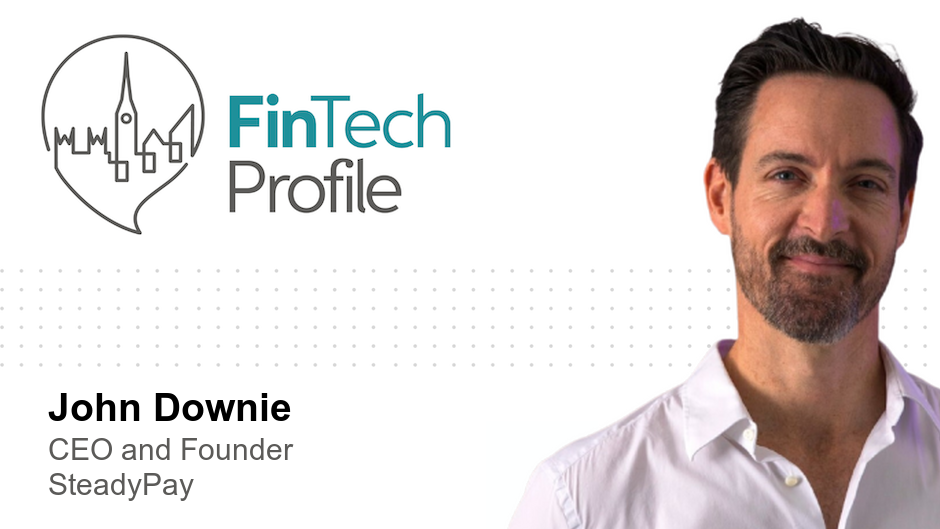
Today we're delighted to speak with John Downie, CEO and Founder of SteadyPay. SteadyPay is a UK, FCA-regulated lending-as-a-service platform that lets fintechs, neobanks and consumer brands offer credit under their own name. In this interview, John explains how open banking data helps SteadyPay lend to the people mainstream credit models turn away, why the funding gap for growing specialist lenders is holding the industry back, and why he thinks credit is becoming a feature rather than a product.
My questions are in bold - over to you John:
Who are you and what's your background?
I studied at the University of Auckland, where I did a BCom in Marketing and Management. I was going to do a master’s in statistics, changed my mind and started a master’s in management instead, which I found far too theoretical, so I switched to postgraduate study in information systems. Statistics and information systems probably tell you most of what you need to know: data and systems are what I enjoy.
I started my career as a consultant at Capgemini over twenty years ago. In 2007 I started Stellar Consulting, a data consultancy in New Zealand that now operates across Australasia, and exited in 2009. From there I went back into banking technology as an architect and technical programme lead at large Australasian banks.
That’s where I kept seeing customers declined for credit. The default response was “computer says no”, even when it was obvious they were creditworthy. Then I moved to the UK and got the same answer myself. With no UK credit history, it didn’t matter what my track record was elsewhere.
At the time I realised that there was a huge and growing population paid by the hour, mainly shift and gig workers, who were underserved by traditional players. That led me to found SteadyPay, to lend to people with irregular incomes using open banking data rather than relying on a credit file alone, serving the individuals and businesses conventional lenders tend to turn away.
What is your job title and what are your general responsibilities?
As CEO and Founder, my job is to set the direction of the business and ensure we have the capital to grow (including the necessary loan book) while bringing in new partners.
The reality of the role is that it’s a juggle between the internal team, making sure that the leaders within the business have the people and the tools that they need, and making sure that everything is aligned. I think of it as a shepherding role, as people can wander off in the wrong direction occasionally, and it’s my role to shepherd them back onto the strategic path of the business.
I like to say when things are going well, it’s the team’s credit, and if things are not going well, it’s generally my responsibility.
On a day-to-day basis, the role can be summarised as three things. So first and foremost, new business. I lead partner development, effectively from the first conversation, or what people call founder-led sales, through to structuring the overall deal and then handing it over to our customer success team.
Secondly, capital, so funding relations, be that equity or debt, and working with all of our investors.
Third, and definitely not the least, risk and regulation. As the lender of record for most of our partners, we carry the permissions, credit and compliance risk, so I stay very close to our credit decisioning, portfolio performance and compliance.
Can you give us an overview of your business?
SteadyPay is a lending-as-a-service platform. Neobanks, fintechs and consumer brands use us to offer credit to their own customers, under their own brand, without having to become a lender themselves. We provide the whole engine: the technology, the FCA permissions, the capital, the credit decisioning, servicing and collections. The partner keeps the customer relationship and we run everything underneath it.
That’s harder than it sounds. Credit is hard, and people underestimate how difficult it is. When a brand sees demand from its customers, the first instinct is usually to build it in-house. For a lot of our partners, the main competitor isn’t another lending platform, it’s DIY. What we offer is the ability to launch fast, with a significant reduction in internal cost and complexity, alongside a team that has already done the work with the regulator.
Partners can offer pretty much any type of credit product they want, from credit cards through to instalment-style lending. We launched in 2020 lending to people with irregular incomes, the freelancers and gig workers mainstream lenders struggled to assess. That’s still the part of the market we know best, and it’s where most of our decisioning was learned.
The flexibility runs through the commercial model too. Around 70% of our customers use the whole lending-as-a-service stack. The other 30% plug and play individual components alongside what they already have. A lot of them choose us precisely because they don’t have to take all of it.
On market reaction, the numbers say more than I can. We’ve originated more than 1 million loans, and our default rate is below 5%, net of recoveries. We approve more than 40% of applicants, against single digits for traditional lenders, and 99% of our decisions are automated, made in under 100 milliseconds. We’ve done that over five years as an FCA-authorised lender with zero compliance breaches. When we tested an income advance product with Pockit, around half of the customers offered it took it up, and it was then rolled out to every eligible Pockit customer.
What that tells me is that a lot of the people the mainstream turns away are perfectly good borrowers. Our job is to prove it. If we do that well, our best customers eventually move on to cheaper credit elsewhere, and I’m comfortable with that. It means the model is working.
Tell us how you are funded?
Funding is a journey, but a necessary one for any business that’s looking to scale fast, or in regulated technology, where you’re getting licences and building out technology before you can get a customer. So you do need some level of investment. We’ve taken multiple rounds of investment, initially from friends, family and angel investors, and then moving on to venture capital as our rounds increased in size and complexity. And then, in parallel to that, lending funded separately through debt facility arrangements as well.
From a friends and family perspective, that’s usually your first source of funds. My main line when talking to those people very early is: will you still talk to me if I lose your money? As you move into angel investors, they’re taking a punt on you to make it work. At that stage I probably spoke to the majority of fintech angel investors in London, and then moved on to VC funding from the likes of Ascension Ventures, Hambro Perks, N1 FinTech Fund, TrueSight and Digital Horizon, amongst many others.
As a lender, equity is only half the story, and it’s tricky to negotiate between those two parties. The loan book itself is funded through debt facilities from institutional lenders, and building out that capital stack has been a very challenging but defining part of the overall journey, because you need to try and get the cost of capital right, but have something that works for the institutions, the customers and the business as well.
What’s the origin story? Why did you start the company? To solve what problems?
So the problem itself we’ve touched on. Mainstream credit models are fundamentally built for salaried people with long UK credit files. Anyone with any variability to their income, or a thin file, fundamentally gets declined, even if they can afford a loan. This applies to both individuals and businesses.
SteadyPay started as a direct-to-consumer lender for exactly those people: freelancers, gig workers, newcomers to the UK, offering interest-free salary top-ups to smooth volatile income. This was a deliberate move on my part to test our approach, which was open banking-based underwriting, and to see what the demand was for this style of product. We learned that underwriting on open banking data works. When we launched in 2020, there were a lot of people who thought it wouldn’t.
What I learned as part of that process, though, is that many fintechs already had these customers and wanted to offer credit. Having built a lender with all of the components in place, the licence, risk, capital and servicing, we can cut out that very slow and expensive process for them. Hence we are a lending-as-a-service platform.
Customers everywhere, ideally, get fairer access to credit inside the apps they already know and trust. And partners get a new revenue line and a very sticky product for their customers without becoming a lender. So far, we've seen very good case studies and improvements of metrics across the board.
Who are your target customers? What’s your revenue model?
Target customers for us are businesses that already have a strong relationship with their consumers or small businesses and want to add credit. This includes neobanks, e-money apps, remittance, cross-border card programmes, consumer brands with big bases, and other platforms. Think of anywhere where seamless and embedded lending would add to the ecosystem.
Embedded payments has come a long way, and embedded lending is behind that curve but is catching up, and that’s where we sit, in that embedded credit piece.
We’ve got many partners live in the UK serving consumers and SMEs, including Pockit, Monese and ANNA Money, and we’re extending into card products and into new markets.
In terms of revenue model, it’s very simple. For those partners that take our full lending-as-a-service stack, we share the loan economics with them. So for those partners, they’re getting a new revenue line without any of the regulatory or balance sheet burden of being a lender. Partners who use individual components pay for the components they use.
But what we’ve also seen from those partners is that the other parts of their business also increase in revenue. So if they’re a neobank, the customers that are using the lending products also use more of their other products, for example.
If you had a magic wand, what one thing would you change in the banking and/or FinTech sector?
From a SteadyPay perspective, it’s access to cost-effective capital for growing specialist lenders.
There’s plenty of senior debt for really big books, but it’s harder to pull together in the sub-£100 million book category, and I know this from talking to other fintech founders. It’s a lot of work to put together senior and mezzanine finance deals, and you’re doing it multiple times, at £10 million, £20 million, £50 million. A lot of people fatigue out during this process, because each of those deals can take anywhere from six to eighteen months to pull together, which obviously slows the business down. So that funding gap is effectively holding back the industry, especially with mainstream lenders pulling back from the space.
Bigger picture, I’d like to see credit files that reflect how people actually earn now. Credit files are very historic and point in time, so people with variable incomes and newcomers get penalised by models that don’t account for their earning profile or their true affordability.
What is your message for the larger players in the Financial Services marketplace?
My message to larger players is to partner with smaller players. By that I mean the reality is they’ve got big customer bases, but innovation is slow, and they’ve got a lot of competition coming from various startups.
If we took a good example, it would be the banking sector. Your risk engines are rejecting good customers. They were built for a world of salaried employment, and I know this because I helped build some of them. I understand how they align to banks’ credit policy, but there are ways of working with partners to reach the good customers they miss.
I think the other thing is, as conditions get tougher, banks and other mainstream lenders are tightening and pulling back from consumer credit, which is creating a real lending gap. And someone, somehow, will serve these customers. A lot of the time it would be better to partner rather than give those customers up and have them leave the business.
Coming back to my original point, which is to partner: you don’t need to build every product in-house. Embedded credit lets you launch in weeks and avoids the headaches of DIY, or, as some might call it, the hubris of DIY. Because once you embark on a DIY journey, it’s very difficult to go to your boss and say, actually, this is going to take longer and cost more money. But by then you’re halfway through, so you keep persevering.
So often DIY is going to cost more or take longer. The reality is you can get going very quickly, and then over time take the components you want back in-house in a very managed fashion, as opposed to trying to eat an elephant in one bite.
The net of what we’re saying is: let specialists run the lending stack, and put your capital where it earns the most. That’s the best way to think about it.
Where do you get your Financial Services/FinTech industry news from?
I’m a member of a WhatsApp group that has about 725 or more fintech founders, and they’re very active, so it’s actually quite a good source of what’s happening. It’s also a very good source of commentary on the latest and greatest things.
But in terms of actual publications, I think we’ll call it the usual sources: everywhere from FinTech Futures, Sifted, the Financial Times, This Week in Fintech, Fintech Business Weekly. So I’m very fintech-focused in terms of what I read!
Can you list 3 people you rate from the FinTech and/or Financial Services sector that we should be following on LinkedIn, and why?
Let’s come at it from a couple of different angles. You can’t go past Nik Storonsky at Revolut. Love or hate the methods, he has created a super successful behemoth against all odds. He’d be the first one to tell you that for the first few years no one wanted to give him any money, and everyone told him his baby was ugly. But look where he’s at now.
If you listen to any of his newer content, it always gives you a few ideas. One of his recent ones was about, in the age of AI, changing team structure from your traditional pod of seven people to a pod of two or three people enabled by AI. So some interesting insights from him.
Then there is Nigel Morris. He’s co-founder of Capital One and QED Investors, and probably one of the most respected out there when it comes to data-driven consumer credit.
To mix it up I’ll go with a journalist next: Jason Mikula, founder of Fintech Business Weekly. He has sharp views on fintech regulation, banking-as-a-service and partner bank risk, particularly in the US.
What FinTech services (and/or apps) do you personally use?
It's tough to beat Wise for simplicity and speed of sending money abroad, and their interest rates on savings aren’t too bad either. I use Apple Pay and Apple Wallet daily. The convenience is hard to beat and I never take a physical wallet with me anymore. In terms of banks, you can’t beat Revolut for breadth of product.
I’ve also been using Prosper, one of the newest kids on the wealthtech block. It’s simple, easy to use and low fee (spoiler: it’s fees that kill long-term wealth building, not failing to pick the hottest stocks).
What’s the best new FinTech product or service you’ve seen recently?
Beyond Prosper, a couple of others have caught my eye:
Pridepay: not launched yet, but a great example of a community-focused strategy, with clean execution and clear benefits.
Defi: it launched its platform at the end of October and the defi ID is a clever idea. You complete KYC once and get a portable onchain identity that you can reuse across platforms, with zero-knowledge proofs so you never hand over your data again. It’s one of the first credible attempts to make crypto-native finance feel as simple and safe as a regular bank app.
Finally, let's talk predictions. What trends do you think are going to define the next few years in the FinTech sector?
First, credit will become a feature, not a product. The most demand we see doesn’t come from lenders. It comes from brands with loyal customers, such as mobility platforms, payment companies and travel brands, who want to offer credit under their own name without becoming a regulated lender. Lending-as-a-service lets them do exactly that. Brands that once saw regulation as a blocker are realising it doesn’t have to be one.
Second, AI will become part of the experience itself, as agents start handling day-to-day financial tasks. Trust in AI, especially with financial data, is already a hot topic, but in some respects it is easier to solve than people think: dedicated spend wallets loaded with a set amount of cash, final approval staying with the user, and proper fraud prevention.
Finally, I see wealthtech having a real moment. Wealth is passing from boomers to their children and grandchildren, and traditional high-fee models are being challenged by digital-first wealth management at lower price points.
Many thanks to John for taking the time to share his insights with FinTech Profile. You can learn more about SteadyPay on their website.