Henrik Landgren, Co-founder and CPTO, Gilion
Gilion co-founder Henrik Landgren, Spotify's first head of analytics, on why risk is just a lack of information, and what banks are getting wrong about the data they feed their LLMs.
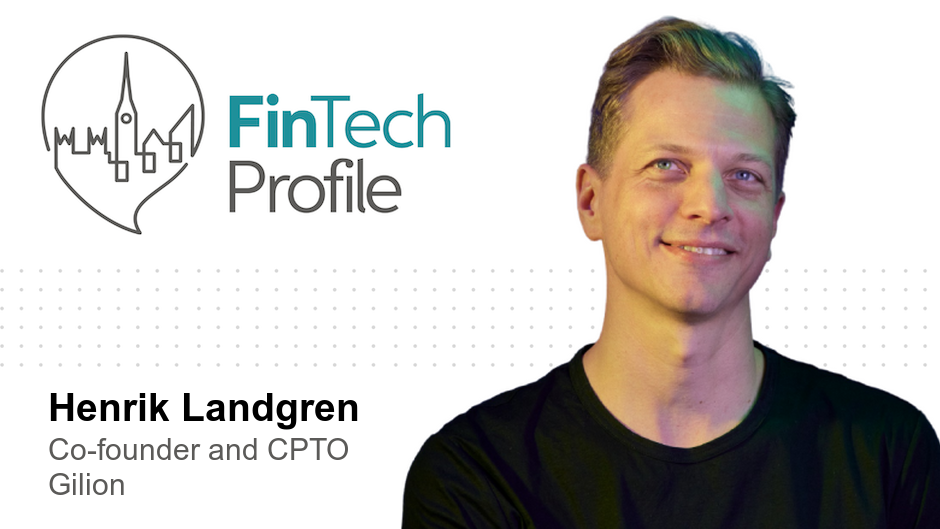
Today we're delighted to speak with Henrik Landgren, Co-founder and CPTO at Gilion, a full-stack AI funding and investment intelligence platform for venture capital, banks and private equity. Henrik was Spotify's first head of analytics from 2010, then built one of Europe's earliest AI-powered deal sourcing tools at EQT Ventures. In this conversation he argues that risk is simply a lack of information, warns banks about the data they are feeding their LLMs, and explains why Europe's growth-funding gap is getting harder to ignore.
My questions are in bold - over to you Henrik:
Who are you and what's your background? What route led you into the FinTech arena?
I am the founder and Chief Product and Technology Officer at Gilion – a full‑stack AI funding and investment platform that lets VCs, banks, and PE firms make better investment decisions.
I moved into finance with a background in engineering and data. I was Spotify's first head of analytics from 2010, working under Daniel Ek during the years the company passed 20 million subscribers. I saw first-hand how an innovative data strategy (palpable today every time you share your Spotify Wrapped or listen to a custom-made playlist) can scale a startup into a recognised global industry leader.
From there, I moved into venture investing with EQT Ventures. That's where I built one of the first AI-powered sourcing tools in Europe, which helped us track promising companies through granular data. We sourced over $100 million in investments, many of which weren't on other people's radars at all, using traditionally overlooked metrics like website hits.
That job exposed a fundamental gap in the investment world: financial institutions, despite their reputation, lack the data infrastructure to properly understand the companies they are pouring millions into. They also miss great companies that don't fit traditional models of what profitability looks like. That's not just on the investor; many businesses still don't know where to start when it comes to tracking metrics that they should care about.
Together with my co-founders, we made it our mission to help investors access and use data faster and more diligently.
Can you give us an overview of your business?
Gilion gives investors, from VCs to banks, a way to assess a company using live operational data rather than a stack of pre-sliced financial statements.
We process over a billion real-time data points per company, turning what would otherwise be an overwhelming amount of data into due diligence that is already two-thirds complete when an investor gets to it.
We've battle-hardened this on our own product. On the founder side, we also lend directly to growth-stage companies through non-dilutive loans, so founders get capital without giving up equity. We started by lending our own money to test whether the model actually worked before we lent anyone else's, and ended up with a track record stronger than any traditional institution.
If you had a magic wand, what one thing would you change in the banking and/or FinTech sector?
I think the sector should understand that risk, by definition, is just a lack of information. Once you understand that, the problem of Europe's lag in innovation becomes fixable, albeit in unexpected ways.
What we consider a 'backable' company often says more about the investor than the company itself. As the industry advances, and AI becomes embedded in physical tech, biotech, and solutions that look different from what we've seen before, assessing what a risky company looks like based purely on gut feel will become impossible.
As we navigate this shift, the time to rethink how we make investment decisions is now.
What is your message for the larger players in the Financial Services marketplace?
Look past the AI headlines and look at the data that you are feeding your LLMs. I cannot stress this one enough! A lot of investors, including large banks, are adding AI tools to speed up the same due diligence process they've always run, without touching the incomplete data feeding into it. That makes decisions faster, but not better.
The banks that win the next decade of growth lending will be the ones that rebuild their risk models around real-time operational data to keep up with the demand in capital – especially in the tech industry.
Finally, let's talk predictions. What trends do you think are going to define the next few years in the FinTech sector?
We will see growth capital extend into companies that no longer look like classic tech businesses.
Think construction firms and industrial recycling companies that run almost entirely on internally built software without a single dedicated engineer. They generate real data and produce real value, but they don't fit a VC model of profitability or a bank's long-term risk criteria. New capital products need to be built specifically for them.
And underneath it all, Europe's $375bn+ funding gap for growth-stage companies becomes harder to ignore: policymakers talk about the AI race and technological sovereignty every day, but there is also financial sovereignty. That involves using our, compared to the US and China, more limited resources smartly. We are a long way away from making the best use of our capital right now. I think and hope that will change as AI proliferates at an investment level.
Many thanks to Henrik for taking the time to share these insights with FinTech Profile. You can learn more about Gilion on their website.