Ben Chisell, Group CEO, Paysend
Paysend Group CEO Ben Chisell on building a £1 billion revenue business with fewer than 500 people, why AI should go to your best performers first, and the stablecoin launching in October.
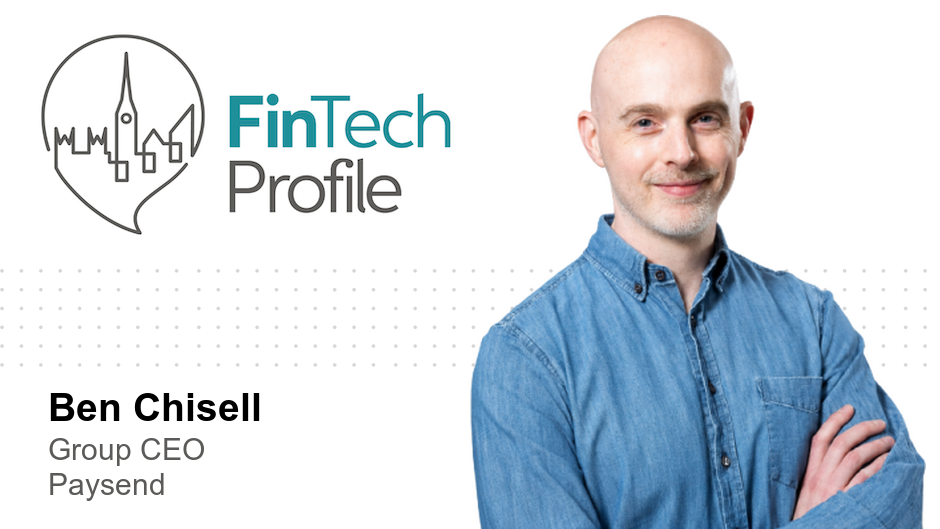
Today we're delighted to speak with Ben Chisell, Group CEO of Paysend, the UK-headquartered technology company building a global payments infrastructure for cross-border money movement. Ben read engineering at Cambridge before leading product and technology at Amazon and eBay, then brought that thinking to UK fintech at Starling Bank and OakNorth. In this conversation he sets out a target of a £1 billion revenue business with fewer than 500 people, explains why he reserves AI for his best performers rather than rolling it out to everyone, and argues that executives who treat regulation as an insurmountable obstacle are the industry's real problem.
My questions are in bold - over to you Ben:
Who are you and what's your background?
I grew up in Liverpool and attended a great school called The Blue Coat, which earned me a place at Churchill College, Cambridge, to read engineering. I specialised in computational fluid dynamics in unstable systems, turbulence modelling and experimentation, atmospheric fluid dynamics, aerodynamics, and solid body mechanics.
My engineering degree taught me the most useful business skill of problem-solving. It requires curiosity to understand the problem, logic to structure it and form hypotheses, and data to solve it, ultimately using those findings to draw conclusions to understand how to apply it in the real world.
Those skills proved fundamental to every stage of my career, especially when I started out leading product and technology at Amazon and eBay. After ten years, I decided I wanted to build successful companies at home in the UK, and finance stood out to me as the ideal industry to innovate in. And so, those same skills I learnt at university and honed in American Big Tech, I applied to my product strategy approach at UK fintechs Starling Bank and OakNorth, which is what ultimately led me to becoming CEO of Paysend today.
What is your job title and what are your general responsibilities?
I'm Group CEO at Paysend, a UK-headquartered technology company building a global payments infrastructure so anyone can move money easily, cheaply and instantly around the world.
The throughline of my career as a product manager has stood me in good stead for my first role as CEO, because the ingredients of problem-solving remain the same, just on a larger scale with greater responsibility. Whereas a product manager's job is to make a product successful, a CEO's job is to make a business successful. Given that a business sells products, if you do a good job of being accountable for business outcomes, the transition is a more natural progression that immediately comes to mind.
My central focus is building a £1 billion revenue business with fewer than 500 people within the next five years. That means being deliberate about our AI strategy, rather than following the hype train and latest fads like indiscriminate spending ('tokenmaxxing') and blanket rollouts of AI tools. My approach has been to reserve AI for the best employees, see what business outcomes they can achieve with it, and once the evidence suggests they have been successful, roll it out to the wider company. Start small, find supporting evidence, expand. We've built successful AI agents that have measurably improved our staff's output by following this blueprint.
On a day-to-day basis, I chat with my department heads and align on which business metrics we're holding ourselves accountable to. It forms part of my leadership philosophy to pick a business metric - whether it be profitability, EBITDA, revenue, or conversion rate - and to use that as a thermometer for how successful I am in that given role. Starting with the end in mind forms the basis of how we work at Paysend because accountability is everything.
Can you give us an overview of your business?
Paysend is a UK-headquartered technology company building a global payments infrastructure to facilitate cross-border payments for enterprise and consumer customers.
We began in 2017 as a consumer remittance app - and we still run one, with more than 12 million customers - to help solve the practical problem of making it easier, cheaper, and safer to send money abroad. After nine years of doing that successfully, we realised that our strongest asset and unique selling proposition was the underlying technology that enabled those cross-border transactions in the first place.
We built our proprietary technology from the ground up to wire the world's card, bank and wallet rails into a single integration, connecting over 25 billion endpoints across more than 170 countries while managing local compliance and operational complexity. The quality of our technology has earned us partnerships with Mastercard, Visa, Western Union, and Deel, enabling us to serve enterprise customers alongside consumers.
Even as our focus shifted, our mission remained unchanged in making money move across borders faster, cheaper, and safer.
Tell us how you are funded?
We are majority founder and management owned, with investment at Series B and further strategic investment.
Given we're now in hyper-growth, EBITDA-positive, with a great team and tech platform, we can grow and innovate sustainably. However, there are many potential partners I have met who share a passion for our business, and appreciate how differentiated our approach is, so if there is an opportunity to grow faster and make more bets, then we would consider moving into a more active fundraising process.
What's the origin story? Why did you start the company? To solve what problems?
Remittances have an outsized impact on the global economy and population, impacting one in eight people worldwide. Every year, 200 million people living abroad send money home, supporting 800 million family members. Those remittances are used for everything from basic necessities like food and shelter to paying for school fees and healthcare. In the best cases, they are instrumental in helping lift entire communities out of poverty and stimulating local economies.
At the same time, the positive impact of remittances is diluted by high costs, slow speed, limited access, and poor transparency. Many of these problems stem from a fragmented global banking system, as banks around the world operate under different data standards, apply regulations differently, and operate on different hours, trapping liquidity in the process. To make matters worse, all those problems run on outdated legacy infrastructure designed for a pre-Internet era.
Our co-founders, Ronald Millar and Abdul Abdulkerimov, saw this problem and decided that remittances needed a technological update. So, they built the technological foundations in the form of payment rails that money runs on to help families look after their loved ones by streamlining cross-border transactions.
Metrics like transaction speed or transfer costs may seem like cold business metrics until you realise that behind every transaction is a family waiting to receive the funds to sustain their livelihoods. That's why delivering a better product is a major source of motivation for the entire team.
Since then, we've expanded our offering thanks to the robustness of our underlying technology, serving enterprise customers who depend on us to manage cross-border complexity and patchwork regulatory requirements. Making money move faster should not be the preserve of a few, but all.
Who are your target customers? What's your revenue model?
We have five distinct customer segments.
One branch focuses on consumers, where our cross-border payments payment app simplifies and streamlines remittances at very competitive rates and low fees.
The second is targeted at enterprises, offering a single API integration to add cross-border payments to their product, which handles all cross-border complexities, licensing, and compliance.
The third offers an instant correspondent banking product to treasury teams. This is underpinned by our instant settlement engine that orchestrates stablecoin-enabled instant settlement flows.
The fourth is offering our embedded remittance product to telcos and retailers who want to offer remittances as a differentiator and additional revenue stream. We are currently in the process of launching with a number of major brands in the Americas.
Lastly, our unique stablecoin is launching in October. More to come on the customer segments and partnerships approach later this year.
If you had a magic wand, what one thing would you change in the banking and/or FinTech sector?
Banking and fintech executives who treat regulation as an insurmountable obstacle. People in our industry often use regulation as a stick to beat the government with, even though we have so many homegrown examples of successful companies like Revolut and Monzo that have achieved banking licenses against all odds.
I'd use my magic wand to instil a mindset shift in which we view the obstacle as the way, treating regulation not as a barrier to growth but as an incentive to build a more robust business. The best way to deal with red tape isn't to focus on where it constrains you but to clearly articulate your goal and chart your path forward. Beginning with the end in mind is the best business advice that so often falls on deaf ears.
What is your message for the larger players in the Financial Services marketplace?
Don't follow the hype cycle with AI. Find your Superstars and let them tell you how to use it.
Where do you get your Financial Services/FinTech industry news from?
My first focus is on our customers. Whatever opportunities we identify with them, I use AI to find the relevant information in the market.
Can you list 3 people you rate from the FinTech and/or Financial Services sector that we should be following on LinkedIn, and why?
I don't tend to get my news from LinkedIn influencers. I honestly learn the most from our customers, our data, our team and our partners.
What FinTech services (and/or apps) do you personally use?
I've used almost every consumer fintech app and have a drawer full of debit cards from fintech apps. However, Fintech is not about the apps; it's about offering a better service and a better product to customers. I think Fintech has shaken up a stale market with better products, but now many of those products have been copied or acquired by bigger players.
Now, if I look at my phone, I still use Starling Bank for my banking, Paysend for sending money around the world, Pensionbee for Pensions, and the app formerly known as Nutmeg for savings.
What's the best new FinTech product or service you've seen recently?
In my capacity as CEO, the best new Fintech Service I've seen recently is Klara, which streamlined the onboarding process for large customers. We've just started working together, and I'm really impressed with the product and founding team.
Finally, let's talk predictions. What trends do you think are going to define the next few years in the FinTech sector?
Stablecoin will become ubiquitous for cross-border settlement; AI hype will disappear and will be replaced by great people becoming superpowered versions of themselves; and Paysend will be a household name.
Many thanks to Ben for taking the time to share these insights with FinTech Profile. You can learn more about Paysend on their website.