Catherine Ann Reid, Founder & CEO, Doqit
Catherine Ann Reid shares how Doqit tackles life admin fragmentation, her journey from media to fintech, and why financial inclusion for people with learning disabilities matters.
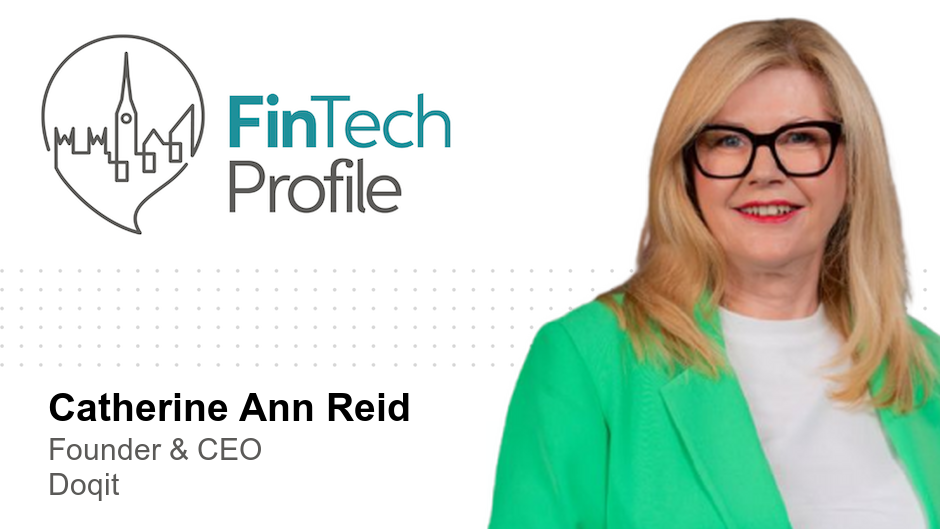
Today we're delighted to speak with Catherine Ann Reid, Founder & CEO of Doqit, a secure life admin system that brings important documents, information, deadlines and reminders together in one place. With nearly 40 years in media before founding Doqit, Catherine Ann brings a unique perspective to solving the universal problem of fragmented personal information - and she's passionate about making financial services truly accessible to people with learning disabilities.
My questions are in bold - over to you Catherine Ann:
Who are you and what's your background?
I left school at 16, with no real idea of what I wanted to do. I just knew that, at that stage in my life, I didn't want to continue in formal education. I've always had a curious mind and that curiosity has stayed with me throughout my career.
I went on to spend almost 40 years working in media, across advertising, typesetting, design and live events, primarily in sales, business development and strategy.
It was a career I absolutely loved. Every client conversation was an opportunity to learn something new, and I was fortunate to work with some fascinating organisations across a broad range of industries.
I remember working with Motorola Semiconductors in East Kilbride back in the 1990s, when mobile phones were still in their infancy. They were talking about all the things we'd eventually be doing on our phones, and I remember thinking, Really? And here we are!
Working with major brands also taught me a great deal about brand experience, customer experience and the importance of communicating effectively with different audiences.
I've always been quite practical, which I think comes from how I was brought up. If something could be done more efficiently, or there was a way to save time, I'd naturally look for it. I wouldn't have considered that particularly entrepreneurial. It was simply how I approached things.
During my career, I had my daughter Chloe, who's now 24 and has a very rare genetic condition, Cohen Syndrom. As a lone parent, I needed greater flexibility, so I moved into freelance work, continuing to use the experience and relationships I'd built over the years.
It was during this period that the idea for Doqit began.
Despite being a very organised person, I managed to file my tax return late three years on the trot, costing myself £100 in penalties each year. Not particularly smart, especially as a lone parent when that £300 could have been spent on much better things!
What frustrated me was that I had the information I needed. I simply couldn't find it when I needed it.
That experience got me thinking about how fragmented our personal information had become, and why there wasn't a better way to manage it all.
So my route into technology, and subsequently the financial services ecosystem, wasn't a conventional one. But those decades spent understanding businesses, customers and how people interact with services have proved incredibly valuable in building Doqit.
What is your job title and what are your general responsibilities?
I'm the Founder and CEO of Doqit, although I sometimes think CEO is a rather grand title when you're running a small startup!
The reality is that you have to get involved in almost every aspect of the business, and you find yourself learning things you never imagined you'd need to know.
I'm fortunate to have a small but absolutely brilliant team. My main responsibilities are around the commercial direction of Doqit, particularly business development, strategic partnerships and identifying opportunities for growth.
I'm also heavily involved in product development. I try to speak to customers every week, and those conversations are invaluable. Their experiences, suggestions and frustrations help us decide what to improve, whether that's considering new features or removing friction from something that already exists.
As a team, we're passionate about making Doqit as simple and intuitive as possible. Life admin is complicated enough without the system you're using to manage it adding to the workload.
I work closely with the team on our marketing and spend time on podcasts, interviews and connecting with other founders, particularly within female founder communities.
And, of course, there's the responsibility of making sure we're moving at a good pace, making sensible decisions about where we invest our time and money, and managing our runway carefully.
No two days are ever quite the same, which is one of the things I enjoy most about it
Can you give us an overview of your business?
I think one of the biggest misconceptions about life admin is that people struggle with it because they're disorganised. Often, they're not. Their information is simply fragmented.
We've got documents in cloud storage, important information buried in emails, dates in calendars, reminders on our phones and yellow sticky notes on the fridge. We might be perfectly organised within each of those places, but nothing is bringing it all together.
And that fragmentation has consequences. People waste time searching for information, lose money when something gets missed, and carry the stress of trying to remember everything.
That's the problem Doqit solves.
Doqit is a secure life admin system that brings important documents, information, deadlines and reminders together in one place, so nothing gets lost or missed.
But there's an important distinction between Doqit and simply storing information digitally.
A digital vault waits for you to open it. Doqit brings the right information back to you when something needs attention.
So whether it's reminding you that your insurance is due for renewal, finding your Government Gateway reference number or securely sharing a document with someone you trust, Doqit is designed to make those everyday responsibilities easier to manage.
And we know from speaking to our customers that this matters.
One customer, Angela, found herself locked out of her pension information. She then remembered she'd saved the details in Doqit and was able to retrieve what she needed.
She told us Doqit had "saved my bacon!"
I love that example because it demonstrates something very simple. You might not need a particular piece of information for months or even years. But when you do, you want to know exactly where to find it.
We're continuing to develop Doqit based on conversations like these, making the system as simple and intuitive as possible.
Because life admin is complicated enough. The system you use to manage it shouldn't be.
I love that example because it demonstrates exactly why we created Doqit. You might not need a particular piece of information for months or even years, but when you do need it, you want to know exactly where to find it.
Tell us how you are funded?
Doqit has been primarily self-funded, alongside investment raised through the Seed Enterprise Investment Scheme (SEIS).
We initially raised SEIS funding to develop our minimum viable product (MVP), and subsequently won £50,000 through the Smart Data Foundry and FinTech Scotland UK FinTech Challenge in 2024. That funding helped us bring Doqit to the app stores.
We raised further SEIS investment in 2026.
Right now, our focus is very much on sales and developing business-to-business partnerships, particularly where Doqit can be offered to employees or customers as a benefit or service.
We'll look at raising further investment in the future, but our priority is to establish those commercial relationships first.
One of the things I've learned is that raising investment is remarkably similar to sales. Unless you've come from, e.g. an investment banking background or you're a second- or third-time founder with an established investor network, it can be incredibly difficult.
You have to build relationships, leverage your network, follow up and understand what matters to the person sitting on the other side of the table.
I've also learned that it's not always about the size of the cheque. A smaller investment from someone with the right experience and network can be enormously valuable. Can they introduce you to other investors? Can they open doors to potential customers or partners?
I think founders sometimes underestimate just how important that can be.
Ultimately, I approach fundraising much as I would a sales strategy. You need to know who you're targeting, why they're a good fit and what you can offer each other beyond the immediate transaction.
What's the origin story? Why did you start the company? To solve what problems?
When I first had the idea for Doqit, I knew I wanted to create something people could use on their phones to manage the important information and responsibilities in their lives.
I could see that life admin was becoming increasingly fragmented, and I was convinced there had to be a simpler way of managing it.
The interesting thing is that the original vision hasn't really changed. What's changed enormously is the technology available to deliver it.
In the early days, what I envisaged would have involved users doing a considerable amount of work themselves, manually entering information and setting reminders.
Today, advances in scanning, Optical Character Recognition (OCR) and artificial intelligence mean we can remove much of that effort. And that's incredibly important because if you're trying to solve a problem involving too much admin, the last thing you want is to give people even more admin to do!
Consumer attitudes towards technology have also changed considerably. People are now much more comfortable managing important aspects of their lives on their phones.
For me, one of the biggest challenges has been taking something that's inherently complicated and making it feel simple.
And that's something we're continually working on. Every customer conversation gives us another opportunity to understand where we can remove friction, improve the experience or make something easier.
Ultimately, the vision I had at the beginning remains the same. I want Doqit to be the system people rely on to manage their life admin, so they don't have to carry all those responsibilities around in their heads.
Who are your target customers? What's your revenue model?
Life admin is a universal problem, although that doesn't necessarily mean Doqit is the right solution for everyone.
Interestingly, many of our customers are already quite organised. They're people who recognise the value of being organised but want a better way to manage everything.
Our core consumer audience is busy working parents and professionals. People who are time-poor, juggling lots of responsibilities and need access to important information wherever they happen to be.
They're not necessarily looking for another app. They're looking for something that will make their lives easier and give them confidence that important things won't get forgotten.
Doqit operates on a subscription model, currently £4.99 per month or £39.99 annually.
One of my favourite App Store reviews came from a customer called Davy Mac, who wrote, "The peace of mind is worth paying double!"
I think that captures something important. People aren't simply paying to store documents. They're paying for the confidence that their important information is organised, accessible and won't get missed.
Alongside our direct-to-consumer offering, we're developing business-to-business partnerships.
Our ideal business partner is an organisation that already has an established relationship with its customers, members or employees and genuinely cares about their experience.
We're particularly interested in businesses that share our values and recognise that offering something genuinely useful beyond their core product or service can strengthen customer relationships and retention.
For us, it's about finding the right partners, where Doqit can become a valuable part of the service they provide to the people they already look after.
If you had a magic wand, what one thing would you change in the banking and/or FinTech sector?
If I had a magic wand, I'd make banking genuinely accessible to people with learning disabilities.
My daughter Chloe has severe learning difficulties and is registered blind. She has no meaningful way of independently accessing or understanding her financial information.
There are products that allow people to make payments using a card, but being able to tap a card doesn't necessarily mean someone understands how much money they have, what they've spent or whether they can afford something.
And that's a significant distinction.
There are some fantastic initiatives, including Project Nemo, which we're very supportive of, working to improve accessibility and inclusion in financial services. But there's still so much more to do.
I'd love to see the banking industry work more closely with people with complex disabilities, their families and carers to develop safe, accessible ways for them to participate in managing their money, with appropriate support and safeguards.
Financial inclusion shouldn't simply mean having access to a bank account or a payment card. It should mean having the opportunity to understand and engage with your own money, as far as your individual abilities allow.
What is your message for the larger players in the Financial Services marketplace?
I'd encourage them to look beyond the products and services they provide and think about the lives their customers are actually living.
Someone's relationship with their bank or insurer doesn't begin and end with opening an account, taking out a policy or making a payment. There's a whole life going on around those transactions, and an enormous amount of life admin that goes with it.
A bank can see what's happening through someone's account, but that doesn't necessarily tell them what's happening in their life, or the responsibilities they're juggling.
And those responsibilities are changing.
People are living longer, which can mean adult children taking on increasing responsibility for their ageing parents. At the same time, younger adults are often living at home for longer because of the cost of housing.
It's increasingly possible for one person to be managing the paperwork, finances, appointments and important information for several generations of a family. That's an enormous responsibility, and often one that goes largely unseen.
I think there's a real opportunity for financial services providers to become more relevant to their customers' everyday lives, rather than focusing solely on individual financial transactions.
By offering practical support that helps people manage those wider responsibilities, providers have an opportunity to build stronger relationships, increase engagement and give customers more reasons to stay with them.
And that's where I believe a system like Doqit could play a valuable role.
My message would be simple: don't just think about the financial products your customers need. Think about the lives they're trying to manage around them.
Where do you get your Financial Services/FinTech industry news from?
I tend to get most of my FinTech news through FinTech North, FinTech Scotland and Finbridge, where I'm an active member of the community, as well as LinkedIn.
I find these communities particularly valuable because it's not just about reading industry news. It's also about hearing directly from people working in the sector, understanding the challenges they're facing and seeing where new opportunities are emerging.
Doqit isn't a FinTech business in the traditional sense. We're a life admin system, but we operate alongside the financial services sector, so understanding what's happening within it is important, particularly as we develop our business partnerships.
Can you list 3 people you rate from the FinTech and/or Financial Services sector that we should be following on LinkedIn, and why?
Barbara Gottardi - Founder and CEO, Finbridge Global
Barbara has an extraordinary depth of experience in financial services, but what I particularly admire is her commitment to making it easier for smaller businesses and financial institutions to connect.
She's a great advocate for founders and someone who genuinely understands the challenges of getting innovation into larger organisations.
Elliot Riley-Walsh - Founder and CEO, Valart
Elliot is another founder who identified a problem through personal experience and decided to do something about it.
As a collector himself, he recognised how difficult it was for people to catalogue, value and properly insure their collections. Valart is bringing technology to a market that has historically been overlooked by financial services.
I admire his determination to challenge an established market, and it's fantastic to see a business built in North Wales making its mark. Valart was recently named FinTech Start-up of the Year at the 2026 FinTech Awards Wales.
Jo Scalpello - Founder and CEO, Retail Checker
Jo has had an impressive career working with some major global brands and is now applying that experience to a problem that affects millions of consumers: online shopping scams.
Having been scammed herself, she founded Retail Checker to help people check whether an online retailer is legitimate before parting with their money.
What I particularly admire is that she's taken her experience, recognised a problem and decided to do something about it. She's also a great example of an experienced female founder bringing a fresh perspective to technology and financial services.
What FinTech services (and/or apps) do you personally use?
I'm probably not the most adventurous FinTech consumer!
I use the digital banking apps from HSBC, Barclays and NatWest, which make managing my everyday finances considerably easier, but beyond that I don't use a particularly large number of financial apps.
I tend to adopt technology when it genuinely makes something simpler or saves me time, rather than because it's new.
And I suspect that's true of a lot of consumers.
What's the best new FinTech product or service you've seen recently?
One that I'm particularly excited about is BankAbility, founded by David Agar and Penny Roberts.
I know David and Penny, and I've had the opportunity to see their minimum viable product (MVP). It's still in development rather than being a generally available consumer app, but I think what they're working on has enormous potential.
Their motivation is personal. Their experiences supporting their son with digital banking prompted them to look more closely at how inaccessible conventional services can be for people with disabilities and additional needs.
They're developing technology that adapts to the individual rather than expecting everyone to navigate the same banking experience.
They've also assembled a fantastic team, including Freddie Quek, who I know well, and people with considerable experience in accessibility, technology and financial services.
As a parent of a young adult with complex needs, financial inclusion is something I care deeply about. I've seen what David and Penny are working towards, and I'm really excited to see how it develops.
Finally, let's talk predictions. What trends do you think are going to define the next few years in the FinTech sector?
I think it would be very easy to say artificial intelligence is going to have the biggest impact on financial services over the next few years. And undoubtedly, it will bring enormous changes.
But I think there's a much bigger opportunity behind that, and it's one I'd really like to see the industry embrace.
We talk constantly about advances in technology, but there are still billions of people around the world who aren't benefiting from the digital services many of us take for granted.
According to the GSMA's 2026 State of Mobile Internet Connectivity report, 4.8 billion people use mobile internet on their own devices, but another 3.4 billion don't. And remarkably, 38% of the world's population lives somewhere with mobile broadband coverage but isn't using it.
So while we're developing increasingly sophisticated technology, we need to think about the people who aren't even at the starting line yet.
That might be because of affordability, accessibility, a lack of digital confidence or simply because the services being developed don't meet their needs.
I think one of the most important opportunities for FinTech over the next few years is to use technology, including AI, to make financial services more accessible, understandable and inclusive.
And this isn't just a challenge in developing economies. Even in countries like the UK, there are people who struggle to access and use the financial services available to them.
I'd love to see the industry measure progress not just by how sophisticated its technology becomes, but by how many more people can actually benefit from it.
Because what good is all this innovation if we're leaving so many people behind?
Many thanks to Catherine Ann for taking the time to share her insights with FinTech Profile. You can learn more about Doqit on their website.