Why Banks Need Agentic AI Now: Insights from Cobus Greyling of Kore.ai
Cobus Greyling explores how agentic AI is transforming banking by resolving fraud faster, improving customer trust, and freeing frontline teams from manual coordination.
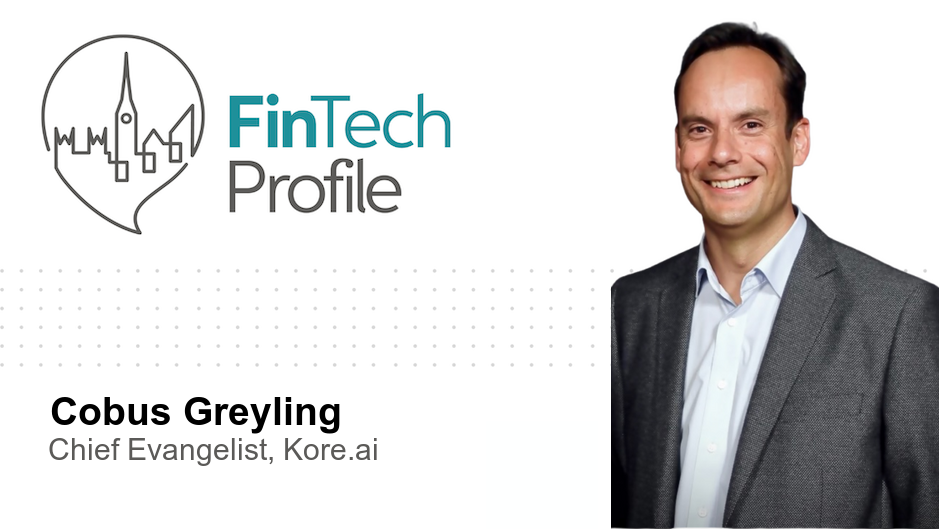
I spoke with Cobus Greyling, Chief Evangelist at Kore.ai, about the rising pressure on banks to respond to fraud and scams with speed and sensitivity. Cobus shares his perspective on why traditional automation falls short and how agentic AI is changing the equation by coordinating complex workflows end-to-end whilst keeping humans firmly in control.
Over to you Cobus - my questions are in bold:
Why do banks need Agentic AI, and why now?
Fraud and scams have become a defining stress test for modern day digital banking. As MoneyWeek recently reported, financial fraud in the UK is continuing to rise significantly, with criminals stealing £629 million in the first half of 2025 and over two million fraud cases were recorded — a 17% increase on the same period in 2024.
While the financial impact of scams is significant, the deeper damage often lies in what happens next. How a bank responds can either stabilise the situation or add to a customer's distress. Banks face a unique pressure to respond quickly and sensitively, under regulatory constraints, while having to ensure a customers' trust remains, as their top priority.
Too often, the customer's experience after an incident is slow, fragmented, and emotionally draining. Customers are passed between teams, asked to repeat information, and left waiting while banks attempt to coordinate responses across disconnected systems. In an era of instant digital service, these moments define trust. And they expose a growing gap between the experiences banks promise versus the outcomes they actually deliver.
Why automation alone can't deliver outcomes
For more than a decade, automation has been positioned as the solution to providing fast, scalable customer service. The banking industry started investing in rules-based tools like RPA and workflow engines, then moved to predictive models that improved scoring and classification, and later to conversational AI that made interactions more intuitive.
Automation has improved efficiency at the margins and reduced manual effort in narrow areas, but cost-to-serve remains stubbornly high and resolution times for complex cases (especially fraud) remain too long. Processes might be quicker, but automation hasn't delivered the seamless resolution customers expect even if their issue is multifaceted and complicated.
At the heart of it, is that most banking problems are not isolated tasks. Fraud resolution, disputes, onboarding exceptions, and payment issues unfold across multiple systems, policies, and teams. Traditional automation speeds up parts of that process, but a customer's experience should be seen as one continuous journey, and that disconnect is why faster steps in some areas don't always mean better outcomes.
How agentic AI changes the equation
Unlike earlier forms of automation or AI assistance, agentic AI systems are designed to perceive context, reason about intent and constraints, plan multi-step actions, and act across workflows. Crucially, they are not limited to responding or recommending and can take ownership of a process coordinating data, decisions, and actions end-to-end while operating within clearly defined governance boundaries.
For example, a global financial institution uses an advanced AI to manage over 300 million annual customer interactions, support 50+ million consumers, and achieves up to 60% self-service containment with 95%+ intent accuracy across 300+ intents. And a major UK bank has integrated AI agents into loan-approval workflows that's reduced loan fraud by 35%.
Clearly, tackling fraud and supporting customers needs in a timely, accurate manner is key for financial institutions, who are using AI to make the difference in their relationships with their customers. The key shift is removing coordination burden from both customers and frontline staff – not just using AI to speed up tasks.
In fraud and scam cases, for example, an agentic AI system can correlate transaction histories, customer communications, risk signals, and policy requirements; assemble evidence; prepare audit-ready documentation; and draft customer updates. Human teams remain in control of high-risk decisions and approvals, but they are no longer burdened with the manual coordination that slows resolution and drives up cost.
The impact is immediate and tangible; fewer handoffs mean fewer delays, better context means fewer repeat contacts, consistent documentation strengthens compliance. All while customer confidence is improved at the moment trust matters the most. Agentic AI works because it aligns context, accountability and action across systems.
The future of banking is autonomous, intelligent, and human-centred
Agentic AI also speaks directly to one of the most pressing realities inside banks today: the pressure on people. Frontline teams are handling more interactions than ever, many of them tied to fraud, financial loss, and anxious customers looking for help. Too much of their time is still spent chasing information, stitching together updates from different systems, and documenting work after the fact.
Freeing up humans
When agentic AI systems can take on that background coordination, employees can spend more time focusing on the areas where humans thrive such as innovation, analysis, and customer growth. For example, Crédit Agricole Bank Polska, using Agentic AI, cut document-processing time by 50%, saved 750+ hours per month, and improved customer satisfaction and team morale.
Regulations
At the same time, agentic AI doesn't mean handing control over to machines. In banking, autonomy has to come with guardrails. Decision rights, escalation points, security protocols and approval thresholds are defined up front, and every action an agentic AI takes can be traced and explained. Human oversight remains central, ensuring speed doesn't come at the expense of accountability or regulatory trust.
In Europe, the EU AI Act and the United Kingdom's Prudential Regulation Authority (PRA) are setting clear expectations for oversight, traceability, and ethical deployment of intelligent systems. This ensures that AI innovation strengthens financial stability and consumer trust.
Ultimately, agentic AI is there to support humans rather than replace – and in banking it is supporting both frontline staff and customers alike. The ultimate test will be how banks utilise their people to build those trusted relationships with customers to ensure they remain happy.
Redesigning banking for better outcomes
The bigger opportunity, though, goes beyond saving time on individual tasks. It's about rethinking how work gets done end-to-end. Banks that simply layer new tools onto already fragmented processes will struggle to see lasting impact. Organisations that can embed agentic AI into core workflows are better positioned to deliver outcomes faster and more consistently, while purposefully improving the experience for customers no matter their issue.
As scams rise and expectations grow, supervised agentic AI offers a practical way to resolve issues faster, build trust, and strengthen operational resilience. The next frontier of AI in banking is not about more automation. It is about achieving intelligence, autonomy, and governance in unison. This is the domain of Agentic AI. Banks that adopt it thoughtfully will help define what customer-centric banking looks like in the years ahead.
Thank you Cobus! You can connect with Cobus on his LinkedIn Profile and find out more about the company at kore.ai.