Susan Cooney, Co-Founder & Co-CEO, MahiMarkets
Susan Cooney shares how MahiMarkets brings institutional-grade trading technology to brokers and prop firms, the power of self-funding, and why AI's real impact will be in trading infrastructure.
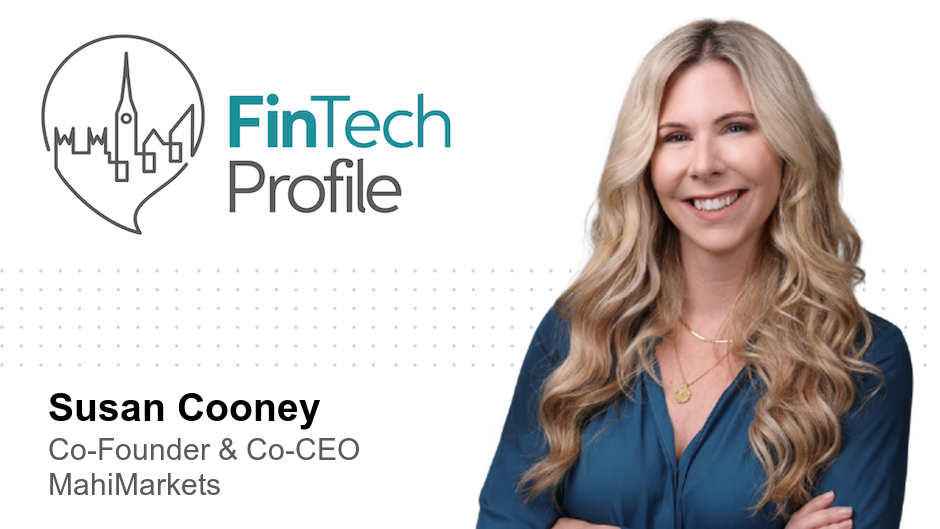
Today we're delighted to speak with Susan Cooney, Co-Founder and Co-CEO of MahiMarkets. With a career spanning the pioneering days of electronic FX trading at institutions like Dresdner Kleinwort and Barclays Capital, Susan has been at the forefront of bringing institutional-grade trading technology to a wider market. In this interview, she discusses building BARX into one of the world's top trading platforms, why MahiMarkets has remained self-funded for over a decade, and her predictions for AI's role in trading infrastructure.
My questions are in bold - over to you Susan:
Who are you and what's your background?
I'm Susan Cooney, Co-Founder and Co-CEO of MahiMarkets. I've spent my whole career in electronic FX. I started at Dresdner Kleinwort Wasserstein, selling Piranha, one of the very first online eFX trading platforms, to institutions across Europe. That was the pioneering era of electronic trading, and we were quite literally convincing traders to come off the dealerboards and trust a screen.
From there I moved to Barclays Capital, where I ran European institutional e-FX clients before being asked to recruit and lead a new global sales team to build out BARX, Barclays' e-FX platform. The way I built that team was quite controversial at the time. Not one of them came from a finance background. I hired pure salespeople, because I believed the ability to sell was the hard part and the rest could be taught, and then I set about teaching them eFX myself. It raised plenty of eyebrows on the trading floor, but the results spoke for themselves: BARX became one of the top single-dealer platforms in the world. My co-founder David was on the other side of that same story. He began as an interbank spot FX broker in his native New Zealand, traded currency options at Chase Manhattan and Credit Suisse, ran currency options for Asia at Dresdner Bank in Singapore, then returned to London as Dresdner's Global Co-Head of Currency Options. He went on to co-head the global options desk at Barclays, where he was instrumental in developing BARX pricing and risk.
So between us we had built, priced, sold and run one of the world's leading e-trading platforms from the inside. In 2010 we left to start our own firm, MahiFX, now MahiMarkets, to take that institutional-grade technology to the rest of the market. We run from three offices in London, Dubai and Christchurch, New Zealand, which conveniently gives us a team that's awake whenever the markets are.
What is your job title and what are your general responsibilities?
I'm Co-Founder and Co-CEO, running the company alongside David. Broadly, he owns the trading and product side and I own the commercial side, a division of labour that goes back to our Barclays days, where he built the pricing and I sold it.
On the commercial side, that means leading our marketing and sales strategy: I also do most of the firm's recruitment, for every position, from developers to analysts. That goes back to the lesson I learned building the BARX team: I believe strongly in hiring for character. Skills can be taught, but character can't, and in a company our size one hire changes the culture in a way it never would at a big bank, so I've never been willing to delegate that judgement. The other half of my role is the day-to-day running of the business itself, covering operations and costs, which I do alongside our brilliant CFO, Nicole. When you're self-funded, in the early days watching the pennies is a survival skill, and it's a big part of why we've been able to build for the long term without outside capital.
Can you give us an overview of your business?
MahiMarkets builds institutional-grade, multi-asset trading technology for brokers and prop firms. The sorts of firms you often see advertised on football shirts and stadiums. We've been crafting e-trading solutions for banks and brokers since 2010.
Our flagship is MFXCompass, an institutional pricing, execution and risk engine that runs on a broker's own flow and optimises how they price and manage their book. The premise is simple. Most brokers run their risk with suboptimal tools leading to pricing and risk losses. Many firms are extremely vulnerable to the type of group trading and arbitrage made famous by gamestop. Our clients typically see 5 to 30 times our fee back in P&L gains, measured on their own production flow rather than on a backtest or a forecast.
Tell us how you are funded?
We're self-funded and proud of it. David and I left Barclays in 2010 and built the company on our own capital, with no angels and no VC. That was a deliberate choice, and one of the best decisions we made. It meant we could build for the long term. We've never had to chase a growth metric to please a board, ship something half-finished to hit a funding milestone, or pivot away from what we know because of trends.
What's the origin story? Why did you start the company?
David and I had spent years inside the banks that built the most sophisticated pricing and risk engines in the world. What struck us both was how narrow the club was. A handful of top-tier banks had this extraordinary technology, and everyone else, from regional banks to brokers and smaller institutions, was pricing and risk-managing with tools that were years behind. The gap wasn't talent or ambition. It was that building this technology properly takes a massive budget and a decade of hard lessons.
We had already paid for those lessons at Barclays and Dresdner. So in 2010 we left to build the engine once, properly, and let the rest of the market run on it. That thesis hasn't changed in fifteen years. What's changed is the surface area. We started with eFX pricing for banks, and today it's multi-asset technology covering FX, gold and crypto for brokers and prop firms. Every product we've shipped answers the same question: what does a firm that can't build pricing and risk in-house need in order to compete as though it had?
Who are your target customers? What's your revenue model?
Our customers are retail FX and CFD brokers and prop firms. In particular we work with multi-jurisdictional brokers regulated across the likes of ASIC, the FCA and CySEC who want institutional-grade pricing and risk without rebuilding their stack.
The revenue model is aligned with the client: typically a base fee plus a share of the value we create, whether that's revenue-share on new flow or performance-linked fees on the P&L uplift our engine captures. Because everything is measured on the client's own production flow, the renewal conversation is easy. The numbers either earn it or they don't. Clients typically see 5 to 30 times our fee back in measurable P&L. Our favourite kind of sales pitch is a live pilot on a slice of a client's book. In a recent one, that slice generated $2.41M of captured value in its first 28 days, at which point the conversation rather runs itself.
If you had a magic wand, what one thing would you change in the banking and/or FinTech sector?
I'd abolish the reflexive "we'll build it in-house" instinct, or at least make every institution honestly cost it first. We still routinely see firms embark on eighteen-month, eight-figure internal builds of systems that already exist, are already battle-tested, and could be live on their flow in a quarter. The build usually ships late, under-featured, and with a permanent maintenance burden nobody budgeted for. Banks wouldn't build their own Bloomberg terminals, so I'm not sure why pricing and risk engines are treated differently. The firms winning right now are the ones that treat technology procurement the way they treat trading: measure the P&L of the decision, on real numbers, and act on the evidence.
What is your message for the larger players in the Financial Services marketplace?
Hold your technology vendors, and your internal builds, to the same standard you hold a trader: realised P&L, measured on your own flow. Not a slide deck or a proof-of-concept in a sandbox. The tooling now exists to run new pricing technology on a controlled slice of your production book and read the results in dollars within weeks. If a vendor won't agree to be measured that way, that tells you something. And if you're sitting on a large book priced with last-generation tools, the gap between what you're capturing and what you could be capturing is a real number. Someone in your organisation should be accountable for knowing what it is.
My second message is that the AI wave in trading will be won by the quiet kind of AI rather than the loud kind. Systems that generate and rigorously test thousands of candidate improvements, promote only proven winners, and keep a human hand on the trigger. Nobody serious is going to let a language model loose on a risk book, but firms that dismiss AI entirely because of the hype will be leaving measurable money on the table.
Where do you get your Financial Services/FinTech industry news from?
The Full FX, because Colin Lambert's coverage of the FX market is always good reading in our world, and Finance Magnates, who have followed our story since the very beginning, for the daily pulse of the brokerage industry. For the wider fintech picture I'll dip into FinTech Futures.
Can you list 3 people you rate from the FinTech and/or Financial Services sector that we should be following on LinkedIn?
Colin Lambert, Editor of The Full FX. We've known Colin since our Barclays days. He knows the market extremely well, has decades of sharp, independent commentary on FX market structure behind him, and a great sense of humour to go with it. Nobody covers our corner of the market better.
Chris Skinner, author of The Finanser. Consistently thought-provoking on where banking and technology are heading.
Leda Glyptis, author of Bankers Like Us. The most honest voice on why financial institutions struggle to actually adopt the technology they buy.
What FinTech services (and/or apps) do you personally use?
Running a company split between London, Dubai and Christchurch makes you a heavy consumer of cross-border fintech. We bank with Revolut and find it extremely useful. I also use Xero, a proud New Zealand export, on the business side.
What's the best new FinTech product or service you've seen recently?
A product I admire is Hyperliquid. It's a trading exchange that launched less than two years ago with a team of about eleven people, and it now handles around 80% of the perpetual futures market. Nearly $3 trillion in volume. They won because existing infrastructure was too slow, so they built their own chain and owned the whole stack, from matching engine to settlement. In trading, flow goes wherever fills are fastest and fairest, and Hyperliquid is proof of that. It's the same principle behind what Mahi does in FX, CFDs etc.
Finally, let's talk predictions. What trends do you think are going to define the next few years in the FinTech sector?
First, AI will move out of the chat window and into the plumbing of trading. The headlines are all about autonomous agents, but the real money will be made where AI works deep in the infrastructure: scanning books for mispricing, flagging toxic flow, and proposing incremental improvements that build an audited track record before anything touches production. Risk committees and regulators will insist on explainability, so the firms that industrialise the unglamorous parts, the testing, the evidence, the sign-off, will pull ahead of the ones chasing demos.
Second, the cross-asset convergence of retail trading and introduction of 24/7 markets beyond crypto. Retail traders increasingly expect a single venue for FX, gold, crypto and beyond, with institutional-quality pricing across all of them. Running one asset class well is hard enough. Running several on the same pricing and risk infrastructure is genuinely hard, and the brokers who get it right will capture flow that currently leaks to specialist venues.
Third, the end of faith-based technology procurement. The tools now exist to measure a vendor's impact in dollars on your own production flow within weeks. As that becomes normal, the vendor-client relationship will shift from licence fees justified by feature lists to commercial models tied to demonstrated P&L. We've built our whole business on that model, so admittedly we would say that. But we think the whole industry ends up there, because once one vendor lets you measure them, it becomes very hard to hire the ones who won't.
Many thanks to Susan Cooney for taking the time to share her insights with FinTech Profile. You can learn more about MahiMarkets on their website.