Rupert Lyle, Investment Director & Fund Principal, Future Planet Capital Regional
Rupert Lyle discusses regional venture capital, founder wellbeing, and why the West Midlands needs more than two VC firms to unlock its startup potential.
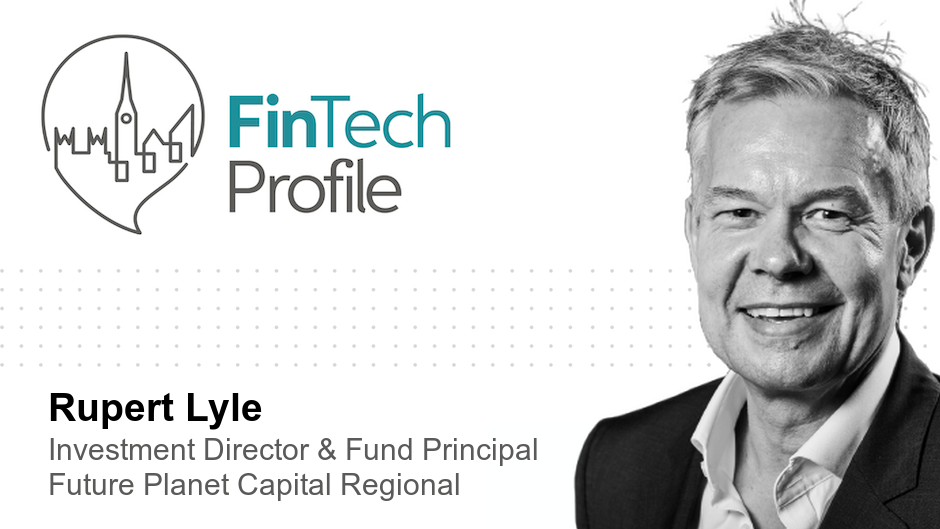
Today we're delighted to speak with Rupert Lyle, Investment Director at Future Planet Capital Regional and Fund Principal of the West Midlands Co-Investment Fund. With over 35 years in venture capital - from a graduate role at 3i to leading a £25 million regional co-investment fund - Rupert shares his perspective on regional funding gaps, founder wellbeing, and why the best investment opportunities often lie outside London.
My questions are in bold - over to you Rupert:
Who are you and what's your background? How has your career path led you to venture capital and regional investment?
I've worked in venture capital since 1989, so it's not really a career path, as much as my whole career really.
I started at a stockbrokers straight out of university and joined about two weeks before Black Friday when the markets collapsed, which was an interesting introduction to finance. Shortly after that I saw an advert in the Financial Times for a graduate role at 3i and joined their venture capital team.
I started in Aberdeen, moved to Birmingham as part of my career development, spent a couple of years in Hamburg, and apart from that I've been in Birmingham since 1993. So I've always come at venture capital from a regional angle, not a London one.
That matters, because once you've spent long enough outside London you can see very clearly where the gaps are, particularly around access to capital.
What is your role at Future Planet Capital Regional, and what are your general responsibilities? How do you balance evaluating new investments with supporting portfolio companies?
I lead the Future Planet Capital Regional's investment activity as Fund Principal of the West Midlands Co-Investment Fund.
The idea for the fund actually germinated when I was on the Advisory Committee of the London Co-Investment Fund. Seeing how effective that co-investment model was, and how it became a key component of the London early stage ecosystem, I suggested to then-Mayor of the West Midlands, Andy Street, that we should create something similar in the region.
The combined authority committed £12.5 million and the West Midlands Pension Fund matched it, creating a £25 million fund. Future Planet Capital Regional won the tender to manage it, and I was asked to become Fund Principal.
In venture capital people talk about pre-investment and post-investment as if they're separate things. In reality, it's a journey with the founder and raising investment is just one stop along the line. The real value add is bringing things other than just money and using experience and networks to help founders build the business and develop as leaders.
Can you give us an overview of Future Planet Capital Regional and the West Midlands Co-Investment Fund? What makes the regional VC model different from London-centric funds?
London is now a fully functioning ecosystem in its own right. There's more capital, more startups, more investors, more advisers, more everything. In sectors like fintech, that creates momentum and the whole system feeds itself.
The regions are very different. There's less capital, fewer venture firms, fewer deals, and more silos. That makes it harder for founders to get backing and harder for ecosystems to mature properly.
For context, Hungary has roughly the same size economy as the West Midlands and has around 37 venture capital firms. The West Midlands has two. That tells you there's a structural funding gap.
Funds like the West Midlands Co-Investment Fund exist to help unlock more capital locally and support founders who might otherwise struggle to access funding.
What's the origin story? Why was the fund created, and what gap in the market does it fill?
The fund was created to address the shortage of venture capital in the region. Having seen how the London Co-Investment Fund helped catalyse London's startup ecosystem, the idea was to create a similar mechanism in the Midlands that could attract private investment and support local founders.
Another gap is the type of businesses that receive funding. Traditional venture capital tends to favour fast-scaling software or fintech businesses that can exit quickly. But many founders are building companies with longer-term ambitions or a strong sense of purpose.
Those businesses often struggle to find capital, and part of our role is supporting founders who don't necessarily fit the classic VC template.
What sectors and stages are you focused on? What does a company need to have for you to get excited about it?
People always want a neat answer on sector, but for me it starts with the founder.
Yes, we see plenty in fintech, software, AI and other highly scalable software related businesses, but I'm much more interested in whether the founder can actually build something than whether they can produce a nice pitch deck.
There's a quote often attributed to Thomas Edison that I use a lot: "A vision without execution is hallucination." We see a lot of founders with vision. Far fewer with a realistic grip on execution.
What gets me interested is a founder who knows what they're brilliant at, knows what they're not so good at, and is prepared to recruit people who challenge them - not just execute. The best founders understand that if they try to do everything themselves, they become the problem.
You've mentioned founder challenges such as emotional readiness and burnout. What are you seeing on the ground with founders and how does that shape your investment approach?
Most founders are nowhere near as prepared for the journey as they think they are. Not legally prepared, not financially prepared, and definitely not psychologically prepared.
They all wear this avatar. You ask how they are, they say "Fine". You ask how the business is going, they say "Great". Usually, that's not the case at all. Not maliciously, but because they think that's what they're supposed to say.
Only around ten percent of startups survive; it's an absolute rollercoaster. Founders are far more likely to suffer from anxiety, depression and burnout than the general population, and at the same time many founders feel they have to present an image that everything is going well, even when it isn't.
That shapes our approach massively. We don't just want to hand over money and sit there like the sword of Damocles waiting to strike. We want to work with founders closely, help them make better decisions, and create an environment where they can actually be honest about what's going on.
Mansion House reforms and pension fund investment into venture capital have been a big talking point. What's your view on whether this will change the funding landscape?
The Mansion House agenda has moved decisively from ambition to execution, marking a meaningful shift in the funding landscape.
Pension Funds that signed up to the accord have now begun to invest into private assets, with schemes starting to allocate to venture capital, growth equity, and other private markets in support of UK innovation and productivity. This reflects the removal of barriers that pension funds previously faced, making private market investment both feasible and defensible for defined contribution pension schemes.
FPC believes the Mansion House reforms represent a once-in-a-generation opportunity.
If you had a magic wand, what one thing would you change in the fintech or startup investment landscape?
I'd change the narrowness of what gets funded.
At the moment the system overwhelmingly favours businesses that are highly scalable, software-led, and can be sold in a relatively short timeframe. In fintech especially, if you've got a bit of traction and a growth story, there's money around.
I'd also get founders to realise much earlier that they can't - and shouldn't - do it on their own.
Most founders start by doing everything themselves. That quickly becomes the default and before long they're the biggest blocker to growth in the business. If founders understood earlier that building a company means building a team, not just building a product or service, we'd see far fewer early-stage failures.
It would also make the journey much less lonely and much less stressful. Founding a business is an emotional rollercoaster at the best of times. Surrounding yourself with the right people makes that journey far less tough and, frankly, far more rewarding in every sense.
What is your message for larger players in financial services when it comes to working with or investing in startups?
Large financial institutions are often criticised for moving slowly, but the reality is they are responsible for huge amounts of customer money and data. They simply cannot take unnecessary risks.
Giving unproven early-stage startups, often run by unregulated individuals, access to internal systems and customers is a significant risk. That's just a fact.
The responsibility sits with startups to demonstrate that the software, operational, customer and people risks can be properly managed. The way to do that is by working closely with carefully chosen financial institutions and building genuine partnerships rather than expecting instant access.
Can you highlight some portfolio companies you're particularly excited about that we should be following?
Inicio.ai is one people should be watching. They're tackling a very real problem in financial advice by using AI to help financial planners deliver more personalised and efficient client outcomes. It's a good example of technology being applied to improve how financial services actually operate rather than simply adding another layer of complexity.
More importantly, it's a founder-led business with a very clear sense of purpose and a strong understanding of the problem they're solving.
For founders keen to talk with you about investment, what's the best way of connecting with you and the team?
LinkedIn or email is usually the easiest route.
But the most important thing isn't how founders get in touch. It's whether they've actually thought clearly about the problem they're solving and why they're the right people to solve it.
Where do you get your FinTech and investment industry news from?
I don't really. We run a sector-agnostic fund, so I'm not trying to position myself as a fintech expert. In fact, I'm often more interested in what founders are doing before it becomes industry news.
As James Goldsmith once said, "If you see a bandwagon, it's already too late." By the time something is all over the press, the real opportunity has usually passed.
What I'm looking for are founders with ideas that haven't yet made the headlines. Businesses with genuine "onlyness", where they are solving a problem in a way that nobody else is.
Can you list someone you rate from the FinTech or investment sector that we should be following on LinkedIn, and why?
Rachel Turner would definitely be one. I think founders should listen to everything she says and writes. She has a very clear understanding of how venture capital actually works and, more importantly, how founders should think about building scalable, investable businesses.
Many thanks to Rupert for taking the time to speak with us.
You can connect with Rupert on LinkedIn and learn more about Future Planet Capital Regional on their website here.