Jovi Overo, Chief Executive Officer, ONE.io
Jovi Overo discusses how ONE.io is building unified financial infrastructure for pioneering businesses in gaming, Web3, and digital assets that traditional banks struggle to serve.
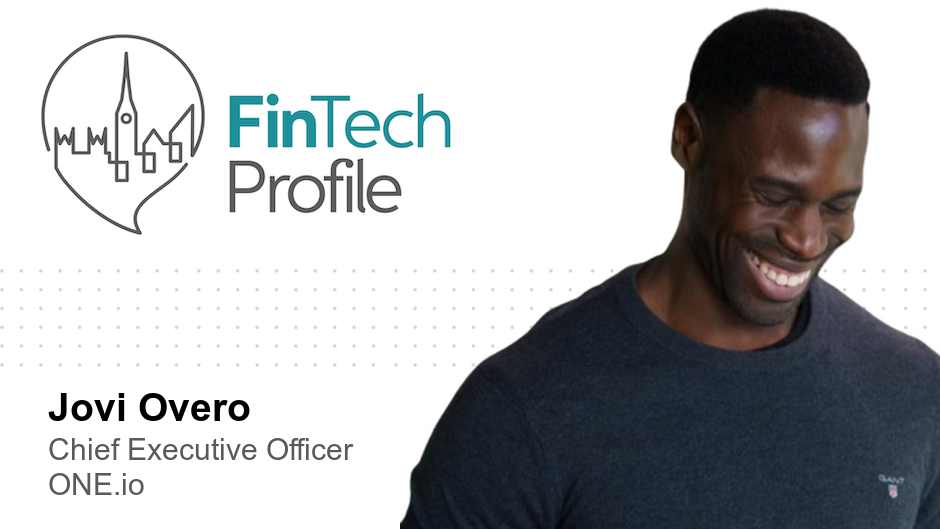
Today we're delighted to speak with Jovi, Chief Executive Officer at ONE.io. With over two decades of experience across fintech, payments, and digital assets, Jovi shares how ONE.io is solving the structural gaps between fiat and digital assets for global businesses that operate where traditional financial infrastructure slows down or walks away.
My questions are in bold - over to you Jovi:
Who are you and what's your background?
I'm Jovi Overo, the Chief Executive Officer at ONE.io. I've spent more than two decades working across fintech, payments, banking, and digital assets, and I'm drawn to the parts of financial services most people find too hard to fix. I started out studying psychology before going on to complete a Diploma in Investment Advice and later a Master of Business Administration. That combination, how people actually behave, how money actually works and how businesses actually win, still shapes how I lead.
Before joining ONE.io, I was MD at Unlimit Banking as a Service, a Global Fintech, and held senior roles at Trade Ledger and Xcina Consulting. I've spent my career with one foot in regulated finance and the other in fintech, moving at full speed. That's the only place the interesting problems live.
What is your job title and what are your general responsibilities?
As CEO of ONE.io, I set the direction and make sure we build the infrastructure our clients actually need and not the one the industry tells them they should settle for. That covers everything from shaping our product vision and regulatory strategy to driving commercial growth and strengthening the partnerships that support our global platform.
I work closely with my team across product, compliance, and operations to make sure we're innovating responsibly and scaling in the right way. A big part of my role is also staying close to the market, which involves understanding where the pressure points are for high‑growth businesses and ensuring ONE.io is positioned to solve those challenges with speed, clarity, and institutional‑grade reliability.
Can you give us an overview of your business?
Think about the businesses the financial system struggles to serve. The ones doing real work in gaming, Web3, commodities, cross-border flows, and trading. The ones who wake up every morning at the edge of the map, running global operations on infrastructure built for a world that doesn't exist any more. Most of them spend more time managing their providers than managing their business. A fiat rail here. A crypto wallet there. An FX provider somewhere else. A treasury function living in a spreadsheet and a prayer.
Businesses need a service where they never have to think about any of that again.
One regulated home for multi-currency accounts, global payments, Real Time FX, and 24/7 digital asset capabilities. The thing we offer is certainty. The quiet confidence that when your counterparty is waiting, your money moves. When a client needs settlement at an unusual hour in an unusual currency, it settles. When the rest of the industry says no, we say send it.
What we are building toward makes that promise bigger, not smaller. Right now, a global business has its bank account in one place, its digital asset wallet in another, its FX provider somewhere else, and its treasury function held together by a spreadsheet. In a few years, that is one screen. One operating system. Fiat, digital assets, yield, payments, reporting, all in one place. That is not a five-year plan for us. It is the direction every decision we make is already pointing.
That is what pioneering businesses have never been given. That is why we like to think we exist.
What's the origin story of ONE.io?
ONE.io started in 2017 as an OTC digital asset trading desk. The team quickly noticed the interesting problem wasn't the trading. It was everything around it. Clients couldn't open accounts. They couldn't settle cleanly. They couldn't find reliable payment rails. Entire sectors were being stepped away from, and the businesses inside them were treated as inconveniences rather than customers. We saw a gap in the market, the size of the market itself.
We realised a real opportunity lay in solving the structural gaps between fiat and digital assets. That led us to acquire our FCA PI licence in 2020 and launch our proprietary payments platform in 2021. Since then, we've continued to build the infrastructure our clients need, including expanding into high‑capacity USD payment rails designed for the speed and scale required by VASPs, Web3 firms and iGaming operators.
Pioneering businesses require a single, unified solution for global payments, FX, and digital asset settlement, all within a regulated environment.
Who are your target customers?
Global businesses operating where the rest of the system slows down or walks away. iGaming. Web3. VASPs. Fintechs. High-net-worth trading entities. They live or die on speed, certainty of settlement, and the ability to move between fiat and digital assets without friction.
A lot of them share the same story. They are too complex for Revolut. Too institutional for Wise. Too exotic for the high street. They are not doing anything wrong. They are doing something new, and new doesn't fit neatly into a risk model written in 2008. When a wire sits in a queue for 72 hours, it isn't a banking inconvenience. It is a trade that dies. A supplier who walks. A window that closes.
These businesses are running serious global operations on a treasury function held together by four providers, two spreadsheets, and somebody's patience. Their fiat lives in one place, their digital assets in another, their FX in a third, and their reporting is reconstructed after the fact. The companies we serve don't need one more provider bolted onto the stack. They need the stack to stop being a stack. That is the work.
Every year, there are more of these businesses, not fewer. Every trend that makes traditional infrastructure harder for pioneering companies makes what we are building more valuable.
What trends will define the next few years in FinTech?
A key shift we can expect to see is the growing role of stablecoins in everyday financial workflows. They're gaining traction because they solve a long‑standing structural gap in how money actually moves. Cross‑border payments still rely on infrastructure built for a pre‑digital world, fragmented rails, multiple intermediaries, and settlement windows that stop outside business hours.
Stablecoins introduce constant liquidity, predictable settlement, and a far more direct way to move value. They're not here to replace the financial system, but they do expose where it's slow or constrained so their role in the modern money movement is only going to grow from here.
We also see regulation becoming more sophisticated across the industry, not just in crypto, but with any business touching financial data or high‑risk onboarding. Consequently, compliance is now a core part of product design. As frameworks like MiCA roll out, companies will need to build clearer playbooks for managing high‑risk users and navigating global rules. Businesses that can translate regulation into something practical and usable for partners will be the ones that stand out.
The third is that treasury, banking, and digital assets are going to collapse into a single operating system. Today, a serious global business runs its treasury across a dozen disconnected tools. Fiat on one side, digital assets on the other, FX in the middle, reporting stitched together after the fact. The next generation of financial infrastructure treats it as one problem, solved on one screen, in one regulated environment. That is the category we are building in, and the 18-to-24-month window to define it is already open. Most fintechs today are features, not companies. The next five years will not be about more of them launching. It will be about fewer, stronger platforms consolidating. We intend to be one of them.
Thank you to Jovi for taking the time to share these insights with us.
To learn more about ONE.io's work, visit ONE.io.