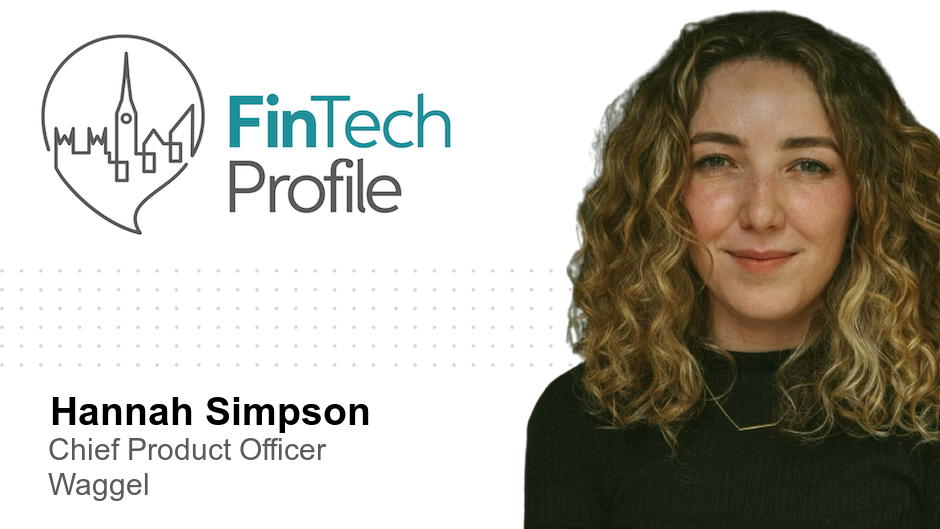
Hannah Simpson, Chief Product Officer, Waggel
Hannah Simpson discusses Waggel's mission to transform pet insurance through transparency, preventative care, and responsible AI adoption in the insurtech space.
Today we're focusing on a very, very important issue for many families across the UK... their pets! Did you know that (apparently) 60% of all British households own at least one pet? That, by the way, translates into something like 36 million pets in the country!
This is why I was keen to connect with Hannah, Chief Product Officer at Waggel, one of the UK's fastest-growing (pet) insurtechs with more than 200,000 customers.
Hannah shares her unconventional journey from travel systems to product leadership, and how Waggel is tackling one of the most complex areas of financial services: making pet insurance transparent, fair, and genuinely customer-focused.
Over to you Hannah - my questions are in bold:
Who are you and what's your background?
FinTech and tech leadership was never on my career bingo card. I studied English Literature and initially thought I'd go into primary teaching, but it didn't take long for me to realise that path wasn't for me.
That journey began in the travel industry, where I landed an office role as a travel agent at Flight Centre. I loved customers but was terrible at making commission, I rarely hit targets. However, I became fascinated by the global distribution system (GDS): constructing flight legs, optimising complex routes, balancing budgets and preferences. It felt like being a bootleg developer before I even knew what product or engineering was.
That curiosity led me to request a move into the business systems (IT) team, which ultimately set the direction for my career. From there, I worked on several large-scale transformation programmes including implementing one of the first NDC solutions in the travel agent sector to help traditional agencies compete with platforms like Skyscanner.
I later moved into the not-for-profit banking sector, where I led multi-million-pound transformation initiatives. Highlights included delivering a £1.5m annual revenue uplift through automated fees reform and implementing automated HMRC Gift Aid reconciliation at scale.
I joined Waggel during its early growth phase and have since been a key part of its transition from start-up to established scale-up. I've led product initiatives that helped triple our live policy count, scale the business to over £1m in premiums written per month, and support the payment of more than £75m in claims. In 2025, my teams launched an industry-first triage vet service that has already helped customers save over £1m in premiums, while reducing claims frequency and severity through preventative care.
Alongside my role at Waggel, I'm also the founder of the Dead Product Society, a UK-wide product leadership community, and I'm currently studying an Executive MBA at the University of Cambridge.
What is your job title and what are your general responsibilities?
I'm Chief Product Officer at Waggel, responsible for product and delivery.
On a day-to-day basis, that means owning the product vision and roadmap, ensuring we're solving the right customer problems while scaling sustainably. I work closely with engineering, data, operations, finance, and customer teams to align priorities and make trade-offs that balance growth, risk, and experience.
A significant part of my role is also leadership and culture. We're a fully remote business with a deliberately flat structure, so I spend a lot of time creating clarity; setting direction, improving communication, and making sure teams feel trusted and empowered to do their best work.
I also oversee Waggel's major AI initiatives, from customer support automation to claims assessment tooling, ensuring we adopt new technology responsibly and in a way that genuinely benefits customers.
Can you give us an overview of your business?
Waggel is a digital-first pet insurance provider focused on reducing stress for pet owners by making insurance clearer, fairer, and easier to understand.
Pet insurance is often complex and filled with jargon or vague policy wording that technically meets regulation but leaves customers confused down the line and likely when they need clarity most. Waggel takes a different approach: we put being human and keeping things simple first, explaining cover transparently and in plain language, keeping customers informed at every step of their policy and claims journey.
We offer one product - lifetime pet insurance - designed around the long-term care of pets rather than short-term cover. This allows us to build lasting relationships with customers and make decisions that support pets throughout their lives, not just at the point of claim.
Alongside this, we are building a more preventative approach to pet insurance. Through services like our vet triage service and partnerships across the pet care ecosystem, including Joii and Biscuit, we help customers access guidance and support for their pet earlier, reducing unnecessary claims.
Market response has been strong. Waggel now supports 200,000+ customers, writes £1m+ in premiums each month, and continues to grow by doing something genuinely different in a complex industry: combining a human, customer-first approach with thoughtful use of technology to deliver long-term care for pets.
Tell us how you are funded?
Waggel is funded by a specialist pet insurance-focused investor, Correlation One Investments (Europe) Limited. It has allowed Waggel to work closely with their underwriting partner, Red Sands, allowing for strong alignment across product, underwriting, and risk that sets us apart from our competition as an insurance broker.
At Waggel, we've always believed in focusing on long-term sustainability rather than chasing short-term growth that might negatively affect our customers. That approach has always sat well with our investors too.
What's the origin story? Why did you start the company? To solve what problems?
Waggel was founded by Andrew Leal and Ross Fretten with a simple belief: pet insurance sucks, so they decided to change it. Andrew was determined to break into insurtech, while Ross brought a strong product and UX background, and together they set out to challenge a market dominated by jargon, legacy brands, and complex policies.
From day one, Waggel focused on building a more transparent, digital-first pet insurance brand that customers could actually trust. They set themselves apart early, being one of the first brands to solely hire trained vet-nurses as personal customer champions; giving customers personal veterinary care experts to support them through their claims process and offering free and unlimited behaviour and nutrition advice for pets to get ahead of preventable claims.
As the business has grown from challenger start-up to established scale-up, my role has been to help translate that original mission into scalable products, systems, and ways of working, focusing on driving growth while protecting what it was that we started with; pet insurance sucks so do it differently.
Who are your target customers? What's your revenue model?
Our customers are pet owners across the UK who want comprehensive lifetime cover for their cat or dog but also value simplicity, transparency, and a human touch in a digital space.
Revenue is generated through monthly insurance premiums. Where we differ is how we manage risk and invest in service teams. By investing in preventative care, automation, and better data, we reduce claims frequency and severity rather than relying on price hikes and by investing in our people we ensure that the customer is always one click away from a human that genuinely cares.
We've seen strong engagement with services like triage vet service, which not only reduces customer premiums at a time where costs are rising, prevents unnecessary claims with proactive care but materially reduces overall claim and services costs, a huge win for both customers and the business.
If you had a magic wand, what one thing would you change in the banking and/or FinTech sector?
I'd remove the false trade-off between customer empathy and operational efficiency.
It's a shame to see the growing trend of technology being deployed to purely optimise metrics while degrading the customer experience. The best FinTech products use technology to enhance trust, clarity and stand out when the teams are clearly asking the right questions internally such as 'is this fair for our customers?'. Rather than ticking the required audit boxes and avoiding the bigger, more moral-driven conversations.
I'd love to see a shift in how regulation is viewed. Regulators shouldn't be treated as the "big bad wolf" for asking us to put customers, especially vulnerable customers, first. Passing an audit shouldn't be the goal or just one requirement when building a product; products where good customer outcomes are designed from day one should be the norm.
If we built systems assuming customers were intelligent, emotional humans that we have to establish trust with rather than edge cases or liabilities, I'm sure the entire industry would look very different, especially insurance. I passionately believe trust and reputation are real growth drivers.
What is your message for the larger players in the Financial Services marketplace?
If you want to move faster, you have to address all forms of debt; not just legacy systems, but legacy thinking and the unresolved problems your organisation has learned to work around rather than solve.
One of the most underrated skills in technology transformation is the ability to clearly articulate the problem. Building the right products quickly and efficiently starts there, I back that solving meaningful problems rather than delivering to predefined numbers delivers significantly more value.
If you build without solving business or customer problems, you'll miss the real multipliers on the table whilst enabling a culture with menial purpose.
Where do you get your Financial Services/FinTech industry news from?
My daily scroll would be The Financial Times. I do also enjoy a podcast, like the Purpose Driven Fintech and I recently have started listening to Breaking Banks
Can you list 3 people you rate from the FinTech and/or Financial Services sector that we should be following on LinkedIn, and why?
- Andrew Leal – I've been lucky enough to work with Andrew for the last 4 years. As a leader he's incredible at setting a vision that's one step ahead of the industry and uniting his teams behind it.
- Anne Boden – I'm obsessed with her book Banking On it, Anne's leadership and journey launching such an epic challenger Starling Bank is inspirational. (I know this one is cliche, but it's true!)
- Monica Millares – Monica's growth at BigPay is astounding and she has a genuinely human, authentic approach that I resonate with. Also, her podcast Purpose Driven Fintech is great.
What FinTech services (and/or apps) do you personally use?
I use a handful of FinTech products that make every money management simpler and more empowering. Despite using a few different banking apps, Monzo remains my go-to for everyday banking and continues to set the standard for transparency. I'm also a big fan of its mortgage tracker, which makes a traditionally opaque part of financial life far easier to understand. Cleo is a great example of AI used with customer experience front and centre, showing how technology can feel supportive. I use SumUp to run low-cost community classes in my local town, which is a great reminder of how FinTech can enable community-led initiatives. Also, I loved using Moneybox so much while saving that I went on to invest during their crowdfunding round.
What's the best new FinTech product or service you've seen recently?
ekko.earth really stands out for me for their approach to sustainable payments. The speed at which they've broken into the market shows how powerful it can be when business purpose and product are genuinely aligned.
I've also been super impressed after reading about SuperFi, particularly for how it supports young adults navigating financial independence for the first time.
Finally, let's talk predictions. What trends do you think are going to define the next few years in the FinTech sector?
There is enormous pressure on FinTechs to adopt AI quickly, and we're entering a cycle of moving fast and learning in public. AI buzzwords are enticing, but value depends on fundamentals: clean and well-governed data, ongoing maintenance, continuous monitoring, and clearly defined health and performance criteria for models.
In the near term, that pressure is likely to lead to uneven experiences as the industry experiments. Things may get worse before they get better as the industry learns how to harness AI to provide value, a great customer experience, optimise operational processes and do this responsibly at scale.
As AI becomes embedded in everyday financial interactions, we'll also see a shift in how customer trust is formed and maintained. Reputation will no longer be shaped solely by human touchpoints, but by how reliable, fair, and intuitive automated systems or experiences feel to customers. With the insurance sector being notably low-trust, reputation and perception is going to be an important challenge to overcome and should be a key consideration within automation strategies. FinTechs that actively measure and manage that perception will be the ones that thrive.
Longer term, however, that trust unlocks the real opportunity: meaningful hyper-personalisation. Sophisticated use of machine learning can enable financial products that genuinely adapt to individual needs and contexts, but only if customers trust the systems behind them.
I'd like to thank Hannah for taking the time to share her insights with us.
You can connect with Hannah on LinkedIn and learn more about Waggel on their website.