2026 FinTech Predictions: Insights from Steve Morgan of Pegasystems
Steve Morgan, Global Banking Industry Lead at Pegasystems, shares his predictions on AI transformation, agentic AI adoption, and the critical change management challenges banks will face in 2026.
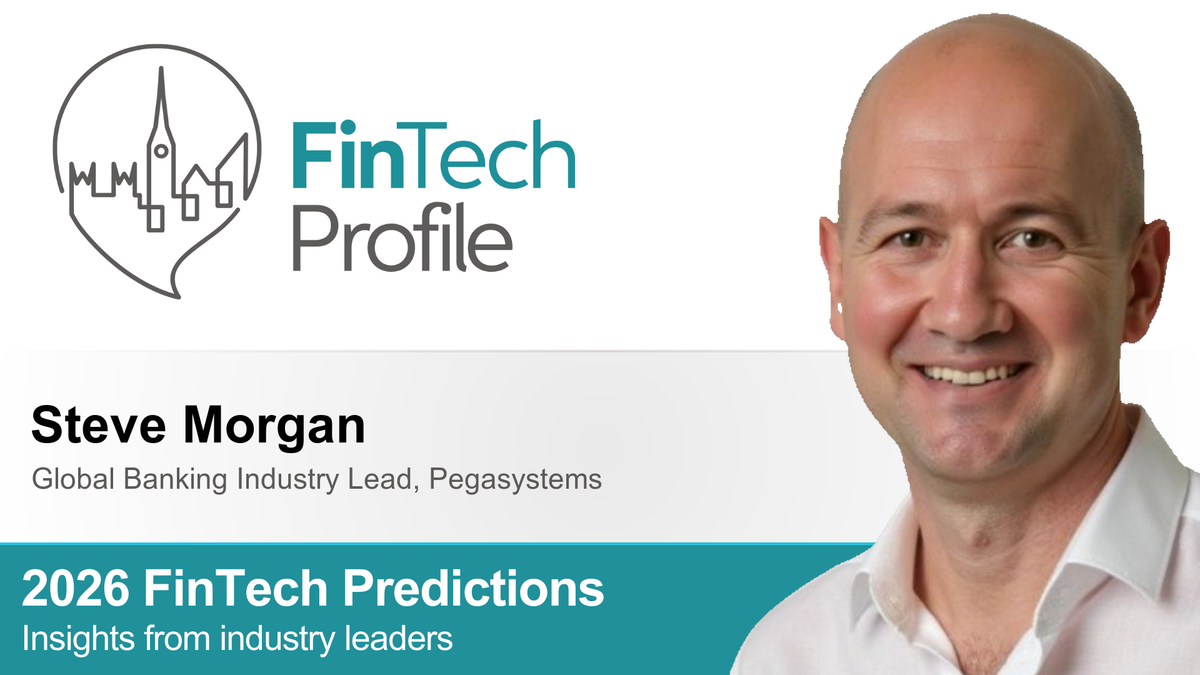
We spoke with Steve Morgan, Global Banking Industry Lead at Pegasystems, about the transformative shifts heading towards financial services in 2026. With banks accelerating their AI and automation initiatives, Steve shares his perspectives on the critical success factors, emerging technologies, and often-overlooked challenges that will define the year ahead.
Over to you Steve - my questions are in bold:
What's the biggest shift you expect across financial services in 2026?
What we're seeing is how banks and others who are modernising their operations with AI and automation are realising this cannot be done without a parallel stream of change management work. This is not about how AI might automate or enhance processes but how the breadth and depth of the impact of these technologies will change jobs and workflows. There is so much more work that needs to be done to map out and analyse processes and understand how they will be transformed, and then work to manage successfully through that change.
For many institutions this work is only just beginning even as different AI and automation projects are being started. The risk in 2026 is that these change management programmes will not be planned and executed properly, and delay the full benefits of any new AI-powered processes. Thinking how change management itself can be enabled by AI tools that map out how processes can be transformed is going to be a key consideration for banks.
Which emerging technology will have the most practical impact on banks and the FinTechs that support them?
I expect to see agentic AI make proper inroads into some areas of banks. Our intelligence on where agentic AI projects are planned is that the priority will be on customer engagement, servicing and operations areas. The hope is that customers are becoming accustomed to elements of AI (mainly GenAI but also agent building for some) in their daily lives and so long as a bank is transparent about its use of agentic AI, has the right governance and delivers the right outcomes for customers, there should be little resistance.
What's going to assure success with these projects is how much banks are confident that they have chosen agentic AI technology that's purpose designed for a regulated industry like financial services. You really need predictable AI and agents.
So, I expect more banks to filter out agentic AI technology that depends solely on prompt-based configuration and incorrectly empowers agents with full freedom to reason and plan at any step of the process, without proper governance or controls. AI creativity is great in some scenarios like brainstorming an advertising campaign or redesigning a process, but will fail when doing financial service tasks like resolving a credit card fraud case. There is going to be a rejection of AI black box technology that cannot adhere to the higher standards of performance and oversight that govern banks.
What customer behaviours or expectations will most challenge banks and financial service providers?
As technology becomes more sophisticated, operations are even more streamlined and efficient than ever before. Customers are therefore expecting convenience and speed to be reflected in their banking journey, whether this is through more personalised products or quicker communication with the bank.
Agentic AI will re-write chat and voice bot capabilities and enable them to be truly autonomous in their engagement with customers, with more personalised and valuable answers. But true agentic AI success will depend on whether organisations have laid the right foundations. This covers both technology and people capabilities, as well as helping the customers shift and adapt to how they interact with their bank.
Of course, customers themselves will use AI to help with their interaction with a bank. I have plenty of personal examples of friends asking genAI tools for advice on investments, products or even to craft letters like a complaint. There's a business opportunity to be gained or missed here in how banks take advantage and adapt to this. This will be as simple as dealing with AI generated complaints or duplicate claims where a stock fake image has been used. It will be as complex as how to ensure genAI tools are recommending customers talk to them or consider their products and services. As much as the technology adapts and customer usage patterns change, then the banks too need to keep up and adapt in turn.
What risks or blind spots do you think the industry is underestimating as we move into 2026?
As more AI and automation projects progress in 2026, there will need to be a much more serious conversation about when and how AI hands over to the human and vice-versa. This is about asking how automated we want to be wherever we apply these technologies. It's about knowing when a customer needs to talk to someone, or the bank would like to intervene and personally help say in a time of need or stress or where there is a complex set of options to consider.
There will need to be human oversight and checking to some degree. So, banks need to understand not just how many people they need but more importantly how the roles will change, how customer interactions change and this is going to be widespread in 2026.
In 2026, banks will explore the limits of what AI can do because it cannot provide all the answers in a way that people will accept. There will remain uncertainty on the customer and the bank side of making errors in high value or customer stressed situations. Not all expertise is digitised (for AI to reference), and certainly empathy is not.
If you were advising a bank's leadership team today, what strategic priority should they focus on to stay competitive in 2026 and beyond?
First and foremost banking is about trust, closely followed by the features and pricing of products and services. Lastly, it's about the service, interaction experiences and options available to customers. I say lastly as customers are still slow to shift banks wholesale. That doesn't mean there aren't valuable opportunities for shifts in customers, especially around times where a contract ends like a mortgage or insurance product. It's also around times of trust building like dealing well with a complaint or dispute. After that is a key time to potentially expand the relationship. I do think I would be focusing on improvements in operations and customer service in 2026. The new technology capabilities suit these areas to hugely improve customer and staff experiences. Any savings or efficiency gains can be put into sales and distribution to better compete on pricing and feature sets, or if not then go towards protecting bank margins.
Thank you Steve! You can connect with Steve on his LinkedIn Profile and find out more about the company at https://www.pega.com.