Theo Wasserberg, Head of UK&I, Embat
Theo Wasserberg discusses democratising AI-powered treasury management for mid-market European enterprises and why real-time financial control is replacing legacy systems.
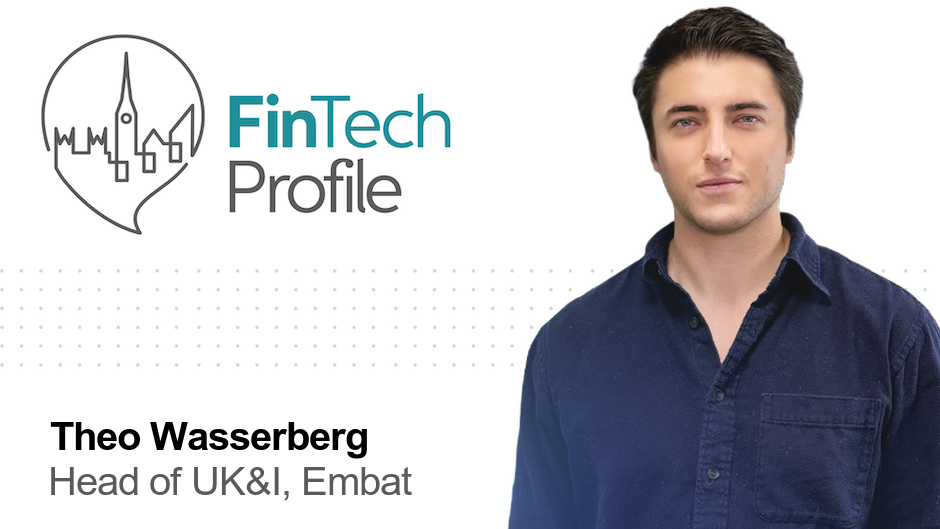
Today we're delighted to speak with Theo, Head of UK&I at Embat, an AI-powered cash and treasury management platform serving over 400 corporate clients across Europe.
With a background spanning SAP, major ERP implementations, and strategy leadership, Theo shares his insights on why mid-market firms have been left behind by traditional treasury systems and how AI is transforming the finance function from a manual cost centre into a strategic partner.
My questions are in bold - over to you Theo:
Who are you and what's your background?
I'm Theo, and I lead Embat's UK and Ireland business. My journey here has been shaped by years of seeing finance and treasury challenges up close and wanting to solve them properly.
I spent over five years at SAP, working deep in the ERP ecosystem with major implementation partners. During that time, I was constantly exposed to the pain points companies face with bank reconciliation, cash management, and treasury operations. After completing my MBA at INSEAD, I spent time leading strategy at a major SAP partner, which gave me an even clearer view of what wasn't working in the market.
One project really crystallised things for me - I looked at what it actually takes to implement traditional treasury systems. We're talking about 12-18 months and massive investment just to build basic capabilities. When I discovered Embat could deliver the same outcomes in a fraction of that time and cost, I knew I had to be part of it.
What also drove me to join was seeing how underserved mid-market firms are. They're stuck in this gap - too sophisticated for basic tools, but not large enough to justify those expensive, complex legacy systems. That's exactly where Embat fits, and the opportunity to genuinely revolutionise treasury management for these companies is what keeps me motivated.
What is your job title and what are your general responsibilities?
I am Embat's Head of UK and Ireland. My core mission is to spearhead our expansion into one of the world's most sophisticated financial hubs, ensuring that treasury teams across the region have the real-time visibility they need to navigate an increasingly complex economic landscape.
On a daily basis, my responsibilities resolve around three key pillars:
Strategic Growth & Market Localisation: I don't just "oversee" a region; I work to ensure Embat's innovative approach to real-time treasury and cash management resonates with the specific needs of UK and Irish businesses. This involves identifying the unique friction points CFOs face here - such as multi-currency complexities and fragmented banking landscapes - and showing how our platform solves them.
Driving Innovation in Corporate Finance: A significant part of my day is spent engaging with forward-thinking finance leaders. We are moving the needle from "static reporting" to "dynamic strategy". I act as a bridge between our clients' needs and our product team, ensuring that Embat remains at the bleeding edge of real-time liquidity monitoring, automated accounting, and sophisticated cash flow forecasting.
Building a High-Impact Ecosystem: As Embat scales, building and growing a world-class team and an increasingly powerful partner ecosystem is central to our success. We are actively expanding our relationships with key banking partners while strengthening cross-functional collaboration across product and technology teams. This growth enables us to move faster, serve larger and more complex customers, and do so while maintaining startup agility alongside the institutional-grade security and reliability that define Embat.
In short, my job is to empower finance teams to stop chasing data and start using it. I'm here to make sure Embat isn't an addition to their stack, but the "financial nervous system" that allows them to make faster, smarter, and more confident decisions.
Can you give us an overview of your business?
CFOs today face challenges that go way beyond the technical. They're leading teams, fostering cross-functional communication, and driving strategy. Technology should be their ally, automating the tedious processes and providing real-time information so they can focus on strategic, data-driven decisions that actually move the business forward. That's what Embat is really about.
Embat is an AI-powered Cash and Treasury Management platform that delivers real-time financial control to mid-to-large European enterprises. Our key achievement is replacing legacy manual processes (like spreadsheets and fragmented systems) with a centralised, intelligent platform underpinned by AI.
Embat centralises global payments, intercompany management, and treasury accounting, alongside automating bank reconciliation (saving finance teams up to 75% of their time) and utilising our proprietary AI, TellMe, for predictive cash flow forecasting, among other things.
By integrating via API with 15,000+ financial institutions and major ERPs, Embat achieves unparalleled data centralisation and integration. This transforms the finance function from a manual cost centre into a strategic partner, enabling data-driven decisions based on an accurate, always-on cash position. This combination of intelligent automation and vast connectivity is the future of corporate treasury.
Tell us how you are funded?
Our growth has been fueled by a total of €21.5 million in funding to date, but for us, it's about more than just the capital - it's about the caliber of the partners standing behind us.
Our most recent Series A round was led by Creandum, an elite venture capital firm known for backing era-defining companies like Spotify, Klarna, and Pleo. Having a partner with that pedigree is a significant endorsement of our vision to redefine corporate treasury. What's perhaps even more telling is that 100% of our previous investors chose to double down and participate in this round again, which speaks volumes about the momentum we've built and the trust they have in our execution.
This funding has been a strategic catalyst for two major areas:
- Product Velocity: It has allowed us to aggressively accelerate our R&D. We aren't just building a "better" platform; we are developing features that address real-time client needs - like AI-driven forecasting and seamless bank connectivity - faster than anyone else in the space.
- International Expansion: The Series A was the "green light" for our European roadmap. It directly supported our entry into the UK&I and DACH markets, including the opening of our new offices in London and Munich.
In the current economic climate, being backed by such sophisticated investors gives our clients a high level of long-term security. They know they are partnering with a platform that has the resources and the institutional backing to lead the market for years to come.
What's the origin story? Why did you start the company? What problems were you solving?
Embat was founded by Antonio Berga and Carlos Serrano, finance professionals who met at JP Morgan. Antonio's from Mallorca, Carlos from the Canary Islands, and they both had solid careers in London. But they'd been itching to do something different for years, and around 2020, everything aligned.
The European PSD2 directive created a major shift because it opened up customer information pipelines in a way that hadn't been possible before; suddenly, you could extract data within seconds rather than days. Antonio and Carlos saw an opportunity that nobody else was taking seriously: mid-market companies that are typically underserved when it came to treasury automation.
These finance teams were still spending hours on tasks that should take seconds - managing collections, processing payments, and reconciling accounts. It was inefficient and frustrating, but the existing solutions were either too basic or too expensive and complex for companies of this size.
So, in the middle of the pandemic, they got to work. They brought on Tomás Gil, who'd been CTO at Fintonic, as a co-founder and partner and by October 2021, Embat officially launched.
Embat's core belief is that business sustainability starts with cash. Treasury isn't just an administrative box to tick - it's the vital pulse of a company, and a real-time reflection of its health.
We're on a mission to democratise professional treasury management, putting a sophisticated platform and financial insight into the hands of all companies, not just the Fortune 500.
Who are your target customers? What's your revenue model?
Embat is unique because it is the first cloud-native solution designed specifically to democratise real-time AI treasury management for the European mid-market and scaling corporate sector. We now support over 400 corporate clients across Europe, including Treatwell, Dojo, and Fever.
At Embat, we've identified a significant gap in the market. Historically, high-end treasury automation was the exclusive playground of the "Fortune 500" due to high costs and implementation hurdles.
Our Target Customers:
- We are specifically designed to democratise real-time AI treasury management for the European mid-market and fast-scaling corporate sector. These are organisations that have moved beyond the startup phase and are dealing with high volumes of transactions, multiple bank accounts, and complex multi-currency requirements.
- These companies choose us because they need a cloud-native solution that can be deployed in weeks, not months, providing them with the financial "source of truth" required to scale internationally.
Our Revenue Model:
Our model is built on transparency and alignment with our clients' growth:
- SaaS Subscription: We operate a classic Software-as-a-Service (SaaS) model. This provides our clients with a predictable cost structure while ensuring they always have access to our latest AI-driven features and security updates.
- Scalable Tiering: Our pricing is generally structured around the complexity and volume of the client's financial ecosystem - taking into account factors like the number of entities, bank connections, and specific modules required (e.g., automated accounting or advanced forecasting).
This model ensures that as a company grows - just like Embat's expansion into London and Munich - Embat scales with them. We don't just sell software; we provide a long-term partnership that turns the treasury department from a cost centre into a strategic value-driver.
If you had a magic wand, what one thing would you change in the banking and/or FinTech sector?
Too much of the sector is still designed for a world of perfect data: clean references, linear processes, and rule-based automation that works until reality intervenes. That's why automation stalls at roughly 30%; not because teams lack ambition, but because the underlying systems cannot cope with messy, unstructured, real-world behaviour. AI changes what's possible, but only if organisations stop trying to bolt it onto architectures that were never designed to support it. The blocker isn't regulation or talent; it's the insistence on forcing new capabilities into old operating models.
What is your message for the larger players in the Financial Services marketplace?
Running impressive pilots, launching sweeping AI roadmaps, and waiting for standards or regulation to "unlock" progress is no longer enough. Focus on contained, high-value use cases: Fully automate one reconciliation flow. Deliver real-time cash visibility for one entity. Get something into production that works end-to-end, then scale it. The gap between firms that have proof of concept and those that have only deliberated is about to become impossible to hide - from customers, from regulators, and from internal stakeholders. Credibility doesn't come from AI theatre, it comes from successful production.
Where do you get your Financial Services/FinTech industry news from?
I'm addicted to the FT app. Especially the weekend long form analysis.
I also love to follow key influencers in Fintech like Nicolas Boucher and Marcel Van Ost.
Can you list 3 people you rate from the FinTech and/or Financial Services sector that we should be following on LinkedIn, and why?
Laith Al-Khalef at the FT, Janine Hirt at Innovate Finance. Also Simon Taylor, one of the founders of 11FS, the UK fintech consultancy, was Head of Crypto R&D at Barclays, and now writes the FintechBrainFood.com weekly newsletter and podcast.
What FinTech services (and/or apps) do you personally use?
Monzo for everyday payments with friends and family in the UK.
Revolut for international travel and managing finances across borders. Having lived in several countries, I've experienced first-hand how tools like Revolut simplify international money management compared with the legacy process of opening and maintaining local bank accounts. I still remember an issue I faced in 2018 while living abroad, when I had to return in-person to the specific branch where I had opened my account just to resolve it. By contrast, today's digital-first approach feels markedly more efficient.
I'm also a big fan of how Airwallex provides localised services that are super impressive for international travel.
What's the best new FinTech product or service you've seen recently?
I think NuBank has hugely disrupted the traditional banking landscape in Brazil. The way they have built a compelling product that has achieved such market penetration so quickly is really impressive.
Finally, let's talk predictions. What trends do you think are going to define the next few years in the FinTech sector?
The first change is a reset in how leaders explain what's holding them back. For a long time, stalled progress was blamed on culture, mindset, or "getting people comfortable with change."
What 2025 exposed is that many finance teams were already doing everything asked of them - they were just operating inside systems that break as soon as inputs aren't perfectly formatted.
That recognition matters, because once leaders stop treating this as a behavioural problem, they start making different decisions about where to invest.
The second trend is that hiring pressure starts driving technology decisions. We're entering a phase where finance professionals are actively judging organisations by the quality of their infrastructure; in terms of how painful day-to-day work feels.
When smart people spend their time repairing exceptions instead of analysing outcomes, they leave. As that becomes more visible, modernisation becomes a practical response to retention and credibility issues.
The third shift is quieter but more consequential: simplification beats expansion. After years of adding layers - more tools, more integrations - the organisations that move fastest will be removing friction instead.
They'll replace brittle, rules-heavy systems with architectures that tolerate ambiguity and scale without constant manual repair. AI plays a role here, but only when it's supported by infrastructure designed to handle real-world variability.
So if there's a pattern emerging, it's this: The next phase of FinTech won't be defined by who talks most confidently about transformation, but by who has quietly rebuilt the foundations so change can actually stick.
Thank you to Theo for taking the time to share his insights with us. To learn more about Embat and their AI-powered treasury management platform, visit their website or connect with Theo on LinkedIn.