Stuart Clarke, CEO, Blackdot Solutions
Stuart Clarke discusses how Blackdot's Videris platform uses AI-enabled OSINT to help financial institutions fight financial crime, and why open-source intelligence is becoming essential infrastructure.
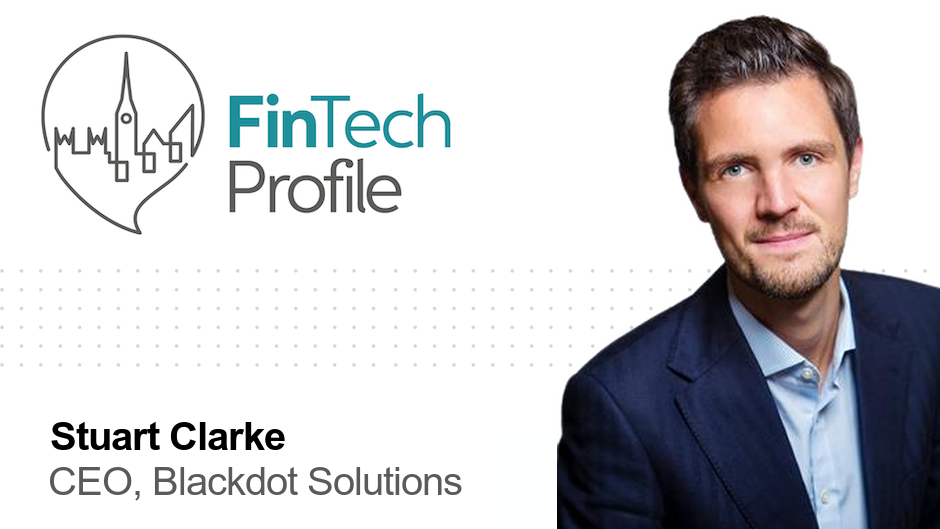
Today I'm delighted to feature Stuart Clarke, CEO of Blackdot Solutions, the creator of Videris, an AI-enabled Open Source Intelligence (OSINT) investigations solution for fighting serious, organised, and economic crime.
With a background as an investigator frustrated by inadequate tooling, Stuart has spent over a decade building better investigation technology, recently securing £5 million in funding to accelerate AI and automation capabilities.
My questions are in bold - over to you Stuart:
Who are you and what's your background?
I started my career as an investigator across a range of public and private sector cases, but found myself becoming frustrated by a lack of suitable tooling and technology. For over a decade I have pursued my mission of building better investigation technology for investigators.
My background gives me a unique perspective on the challenges our customers face - I understand both the strategic, technical, and operational realities of financial crime investigation. Money is often at the heart of most criminal activity.
If we at Blackdot, with our platform Videris, can stop or disrupt the flow of illegal funds to criminals, it will have a far-reaching positive impact on preventing serious and organised crime.
What is your job title and what are your general responsibilities?
I'm CEO of Blackdot Solutions, responsible for the company's overall strategy and direction. Supported by an incredible team, I am focused on solving real problems for our customers and delivering innovative technology to investigators and compliance specialists.
Day to day, I sit between our customer-facing team and our R&D teams to both craft and execute our product, AI, and go-to-market strategies. This includes spending time working with our customers – who are at the heart of our mission – to tackle financial crime. I also represent Blackdot in the market. This includes at conferences, with our partners, and with other thought leaders to increase awareness and understanding of the value of Open Source Intelligence (OSINT).
Can you give us an overview of your business?
Financial institutions face growing pressure to detect and prevent financial crime, yet accessing critical intelligence from publicly available sources remains a major challenge. Open Source Intelligence can help investigators uncover money laundering networks, sanctions evasion schemes and fraud risks that traditional systems miss. But collecting and analysing this complex, disparate data at scale is inefficient, insecure and error-prone when done manually.
Blackdot brings OSINT to the enterprise. Our platform, Videris, combines the sources that investigators need, including corporate records, adverse media, publicly available social media and network data, and deep and dark web sources, in a single interface. Offering advanced analysis and visualisation tools, Videris streamlines complex investigations while maintaining the operational security and auditability that regulated industries require.
Videris is used across the globe by financial institutions, public sector entities and major corporates to fight financial and economic crime. Our customers report 400% increases in efficiency as a result of using the platform.
Our latest solution, Videris Automate, uses AI to automate data collection, risk analysis and reporting. This accelerates anti-money laundering processes, screening, and enhanced due diligence. However, it crucially keeps human investigators in the loop and in control for ethical, compliant decision-making.
Tell us how you are funded?
Blackdot has grown organically as a bootstrapped business with support from angel investors. In February 2025, we secured £5 million in funding led by Maven Capital Partners.
This accelerated our product development, particularly around AI and automation – leading to the launch of Videris Automate later that year. The investment reflects a broader shift: OSINT is transitioning from a nice-to-have to essential infrastructure for financial crime prevention.
What's the origin story? Why did you start the company? To solve what problems?
Blackdot was founded in Cambridge in 2011 around a straightforward premise: investigators need purpose-built tools to harness Open Source Intelligence and use it to disrupt financial crime.
The intelligence gap was clear. Traditional data sources leave blind spots that criminals exploit. Building a complete picture of risk requires accessing and analysing data from across the live internet - corporate registries, social media, news archives, even the dark web.
The problem was scale and security. Open-source data isn't centrally stored and is largely unstructured. Investigators were either conducting risky manual searches that compromised their anonymity, or avoiding OSINT altogether. Financial institutions needed an enterprise-grade solution that could deliver OSINT at scale while meeting strict security and compliance standards.
That's what we build. Our expertise in both investigations and data, now combined with explainable AI, makes OSINT practical and effective for regulated industries.
Who are your target customers? What's your revenue model?
Our primary customers are financial institutions - alongside government agencies, law enforcement, and Financial Intelligence Units. Essentially, any organisation with complex financial crime investigation requirements and strict security standards.
Within financial institutions, we serve multiple teams. This includes financial crime risk management, AML compliance, enhanced due diligence, sanctions screening, fraud investigation, and financial crime intelligence units. What these teams share is the need to build complete risk pictures - and that requires going beyond traditional data sources.
We operate a SaaS model, offering Videris as a secure cloud platform that can be hosted by Blackdot, or in a customer private cloud. This delivers rapid deployment, high scalability, and consistent investigation processes across teams. Our clients report faster risk identification, more effective investigations, and significant efficiency gains.
If you had a magic wand, what one thing would you change in the banking and/or FinTech sector?
I'd change the mindset that financial crime prevention can rely solely on internal and curated data sources. Too many institutions still treat OSINT as optional or ad-hoc - something investigators do manually when they have time, rather than systematic intelligence collection that's core to their operations.
The reverse is true in the government world, where investigators regularly cite the value of OSINT, and there are often suggestions that as much as 90%+ of intelligence is now found in open sources.
The challenge is that without proper OSINT infrastructure, you're operating with blind spots that criminals actively exploit. Commercial databases of PEPs, sanctions lists, and adverse media only capture part of the picture. Criminals hide in the gaps - complex ownership structures, networks that span jurisdictions, connections that only become visible through open-source intelligence. Beyond filling these gaps, OSINT allows organisations to extract far greater value from their internal data. Overlaying existing information about customers, transactions, and relationships with open-source intelligence helps teams to build a much more complete and actionable picture of risk.
The good news is that AI is delivering tangible results in financial crime prevention - accelerating investigations, automating routine analysis, and surfacing risks that would take humans weeks to identify. However, AI in these contexts must be explainable, auditable, and supervised by human investigators. The institutions that invest in proper OSINT infrastructure today will be the ones detecting emerging threats faster, closing cases more efficiently, and demonstrating to regulators that they're taking a comprehensive approach to financial crime.
What is your message for the larger players in the Financial Services marketplace?
Financial crime is evolving faster than traditional systems can keep pace with. Criminals are leveraging AI, exploiting complex ownership structures, and operating across jurisdictions to evade detection. If your teams rely solely on commercial databases and static risk lists, you're missing critical intelligence and putting your organisation at risk of fines and reputational damage.
Ask your due diligence and investigations teams how they're accessing open-source intelligence today. If the answer involves manual searches or 'we don't really do OSINT' - that's a significant vulnerability. The organisations that stay ahead are those building comprehensive intelligence capabilities that combine traditional sources with systematic, AI-enabled OSINT. The technology exists to make this practical, secure, and auditable at enterprise scale - the question is whether you'll invest before or after criminals exploit those gaps.
Where do you get your Financial Services/FinTech industry news from?
I make use of several resources - I subscribe to several podcasts, and track a number of well-known FinTech publications. The FT is also a great source, but I find our network and industry of thought leaders to be a strong source of up-to-date news.
Can you list 3 people you rate from the FinTech and/or Financial Services sector that we should be following on LinkedIn, and why?
- Graham Barrow - Co-founder of Risk Alert 247 and co-host of The Dark Money Files podcast alongside Ray Blake, renowned for his pioneering work identifying suspicious corporate networks and investigating financial crime through UK company data.
- Alex Pillow - Host of the KYC Decoded Podcast, exploring the evolving challenges and innovations in identity verification and compliance with industry experts.
- Vito Armonavicius - Financial crime prevention specialist sharing thoughtful analysis on AML trends, regulatory developments, and the intersection of technology and compliance.
What FinTech services (and/or apps) do you personally use?
I like to keep up to date with what is happening in the market so Pitchbook and CB Insights are useful. I have a keen interest in stock markets and make use of trading platforms like Freetrade.
What's the best new FinTech product or service you've seen recently?
I am a big advocate for automation and I believe platforms like n8n have huge potential. There are some really exciting things happening in the agentic AI space with the development of agents to assist with KYC/AML or to detect fraud. I am also keeping a keen eye on the green FinTech movement, which emphasises environmental sustainability in developing fintech solutions.
Finally, let's talk predictions. What trends do you think are going to define the next few years in the FinTech sector?
OSINT will transition from optional to essential. There's growing recognition that over 90% of the intelligence we need exists in public sources, and organisations are maturing their approach accordingly. We're seeing a shift from reactive, one-time investigations towards proactive, continuous monitoring - and increasing appetite to integrate internal data with external intelligence for a complete risk picture.
Regulation will accelerate this. New legislation like the UK's Failure to Prevent Fraud offence under the Economic Crime and Corporate Transparency Act 2023 is a clear example. Large organisations are now accountable if an associated person commits fraud to benefit the company - unless they can prove they had reasonable fraud prevention procedures in place. This means understanding not just immediate counterparties, but the full network: who owns what, where money flows, what risks exist in the chain. OSINT is essential for mapping these ownership structures and identifying both direct and indirect exposures.
At the same time, AI-enabled financial crime is already escalating. We're seeing more sophisticated disinformation campaigns, deepfakes, and synthetic identity documents designed to bypass eKYC checks. This will amplify significantly in 2026. As the reliability of information becomes harder to assess, access to broad, high-quality data with proper validation becomes crucial.
When it comes to using AI in investigations, the challenge therefore centres on validation and trust. As financial institutions use AI for screening, risk assessment, or due diligence, they need platforms that combine open-source intelligence with trusted, validated datasets. Sourcing transparency becomes critical - organisations must demonstrate they're using reliable data and can validate every finding, especially as they combine internal and external intelligence.
AI represents both opportunity and risk. Used thoughtfully within investigative workflows, it can transform investigator effectiveness. But it requires human oversight and can't be treated as a silver bullet. Building effective financial crime prevention requires purpose-built platforms, not improvised workarounds with consumer AI tools.
Many thanks to Stuart for taking the time to speak with us. You can find out more about Blackdot Solutions and their Videris platform on their website.