Simon Axon, Global Financial Services Industry Strategist, Teradata
Simon Axon of Teradata discusses the shift from AI experimentation to operational execution in financial services, emphasising governance, data lineage, and embedding AI into core workflows.
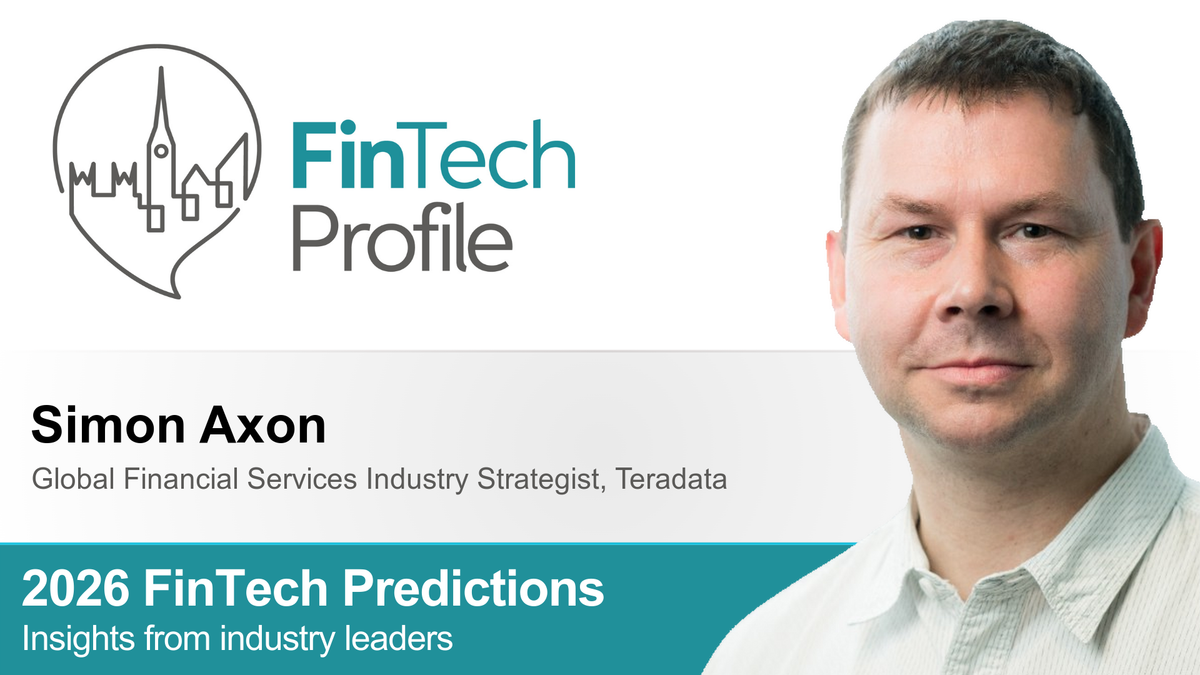
Today we're delighted to speak with Simon, Global Financial Services Industry Strategist at Teradata.
As financial institutions move beyond AI experimentation, Simon shares his insights on operational AI, the importance of governance and data fabric architectures, and the strategic priorities banks must focus on to remain competitive in 2026 and beyond.
My questions are in bold - over to you Simon:
What's the biggest shift you expect across financial services in 2026?
In 2025, agentic AI was the exciting new toy that everyone was talking about. I think the biggest shift in 2026 will be the move from AI experimentation to using it as an operational, enterprise-scale capability. As the hype subsides, boards and regulators alike are demanding measurable value, explainability, and accountability. This will push institutions to embed AI directly into core workflows rather than confining it to innovation labs, turning compliance into confidence and innovation into results.
Which emerging technology will have the most practical impact on banks and the FinTechs that support them?
Operational AI will have the most practical impact, particularly when combined with agentic AI and data fabric architectures. Agentic AI has the potential to transform client engagement and internal efficiency by reasoning, planning and acting autonomously, but only if it is traceable, auditable and governed. Data lineage will underpin this by standardising and democratising access to trusted data, supporting real-time analytics, regulatory reporting and AI at scale. Together, these technologies move AI from insight generation to action.
However, in a sector governed by the EU AI Act and similar regimes, agentic AI will be classified as high-risk. This means it must be traceable, auditable, explainable and under human oversight. The real differentiator will not be the cleverness of the model itself, but how well agentic AI is embedded into a governed data fabric with strong operational and compliance controls. When those elements come together, financial institutions will be able to deploy AI at scale.
What customer behaviours or expectations will most challenge banks and financial service providers?
Customer expectations will increasingly test banks' ability to balance speed, intelligence and trust. Customers now expect more proactive and responsive services, whether that is faster onboarding, real-time fraud detection, or risk issues being anticipated rather than reacted to.
At the same time, trust, privacy and transparency remain non-negotiable. Delivering personalised and predictive experiences at scale, while meeting strict governance and explainability requirements, will be one of the toughest challenges for financial institutions moving into 2026.
What risks or blind spots do you think the industry is underestimating as we move into 2026?
A major blind spot is that many institutions still sit between intent and impact in their use of AI. After years of experimentation, they have pilots and proofs of concept, yet they have not reached consistent operational results. The danger is that they see activity as progress, while real success is judged by what performs effectively in the real world.
Another risk lies in the way AI projects are managed. Models are often created in isolation with little insight into how they behave once they leave the lab. Without strong oversight and governance, they are not deployed, monitored or improved in a disciplined way. This leaves banks exposed when accuracy falls or behaviour shifts over time.
There is also an underestimated risk in the quality and traceability of data. AI systems are only as dependable as the data that fuels them. If institutions cannot trace the origin, transformation or reliability of their data models, then they become opaque and hard to explain to supervisors.
Finally, many organisations overlook how little of their AI actually reaches day-to-day workflows. A lot of effort remains trapped in innovation labs rather than embedded in business systems. Until intelligence is placed where decisions are made, the gap between AI ambition and real outcomes will remain a significant risk for the industry.
If you were advising a bank's leadership team today, what strategic priority should they focus on to stay competitive in 2026 and beyond?
I would urge them to make operational execution at scale their strategic priority. Bank leadership needs to be relentless about turning AI from an experimental capability into a tool that drives core business operations. This would involve inserting AI directly into core processes, ensuring models are governed, explainable, and continuously monitored, and closing the gap between insight and action.
To do this well, they should be more selective about where they start by prioritising the use cases most likely to deliver on ROI goals. They should also consider resources like AI Services that can help identify the use cases most likely to deliver on ROI goals, as well as ensure the models can find and use the data they need. Getting that combination right speeds the transition to operational AI and thus ROI.
Institutions that achieve this will not just use AI more effectively, but will operate faster, manage risk more efficiently, and compete with far greater confidence in 2026 and beyond.
Thank you to Simon for sharing his insights with us. You can connect with him on LinkedIn and learn more about his company via Teradata.com.