Richard Karlsson, Co-founder and CEO, Grasp
Former McKinsey consultant Richard Karlsson discusses how Grasp is automating investment banking and consulting workflows using AI multi-agent systems.
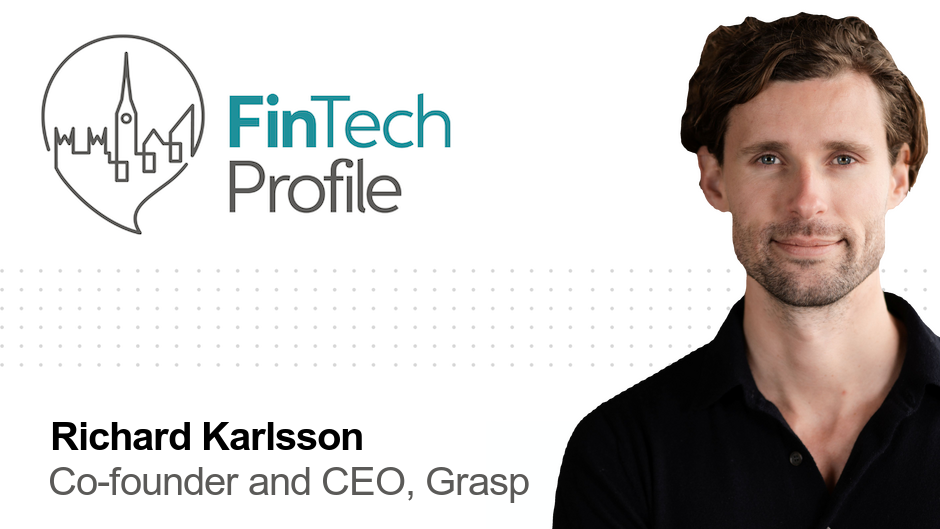
Today we're delighted to speak with Richard, Co-founder and CEO of Grasp, the Swedish AI startup automating investment banking and management consulting work using multi-agent systems. With his background at McKinsey and a recent $7M Series A raise, Richard shares insights on how AI is transforming finance workflows and why executive teams need to move faster on AI adoption.
My questions are in bold, over to you Richard:
Who are you and what's your background?
I'm a former McKinsey consultant, where I advised on corporate strategy and M&A transactions. During my time there, I saw firsthand how much of the consulting workflow relied on inefficient manual research and data analysis. My co-founder, Johan Devér, and I understood these pain points intimately. Together with former Ericsson AI engineer and our third co-founder Simon Hällqvist, we combined deep industry experience with technical expertise to build AI solutions for the finance sector.
What is your job title and what are your general responsibilities?
I'm the Co-founder and CEO of Grasp. I'm heavily involved across most areas of the company - from supporting product development using my industry background to driving sales and recruitment. We recently completed a funding round and are now hiring aggressively, so I spend a significant amount of time identifying and speaking with the most exceptional talent in Stockholm and London, where we are expanding.
Can you give us an overview of your business?
Grasp is an AI company automating investment banking and management consulting workflows using multi-agent systems. Our platform replaces complex, expensive, and time-consuming manual tasks by connecting domain-specific AI agents to trusted datasets and professional tools. Grasp automates work such as identifying buyers, targets, and precedent transactions in sell-side and buy-side M&A, as well as conducting top-down and bottom-up market analysis for strategy development and due diligence. We help teams produce higher-quality output by uncovering more relevant companies, surfacing deeper insights, and dramatically reducing time spent on manual research. The platform generates ready-to-present spreadsheets and PowerPoint presentations tailored for investment banks, management consultants, and private equity firms.
We serve more than 200 customers across 30 countries, including all Big Four consulting firms. We've achieved 4x ARR growth over the past 12 months and recently opened our first international office in London, hiring former PitchBook director Lukas Otto as UK Managing Director to lead our expansion. Grasp currently employs around 30 people in Stockholm, with plans to grow to 60 next year.
Tell us how you are funded?
We raised a $7M Series A round in October and are backed by investors including Octopus Ventures and Yanno Capital.
What's the origin story? Why did you start the company?
While working at McKinsey on M&A projects, Johan and I realised that despite the enormous amount of manual work required to serve clients, almost no one was challenging long-standing processes or building systems to automate them. My experience highlighted just how inefficient the research workflows were. Together with Simon, we built the first version of Grasp to automate part of this work - specifically, M&A deal origination. In a single weekend, Grasp produced the equivalent of what would normally take four people more than a month to complete. That experience demonstrated the transformative potential of AI in automating and accelerating finance workflows.
Today, we automate many of the most manual tasks in finance, including top-down and bottom-up market analysis, buyer and target identification, and precedent transaction analysis. Grasp not only saves significant time but also uncovers new insights and opportunities that would otherwise have been missed. This enables our customers to do more with less - while expanding the scope and quality of the opportunities they identify.
Who are your target customers? What's your revenue model?
Our customers include investment banks, management consultants, private equity firms, and corporate strategy teams. Today, we work with more than 200 companies across 30 countries, including all of the Big Four consulting firms. We consistently hear about the meaningful impact Grasp has on their workflows. For example, a large European investment bank recently shared that they arrived at a client meeting with a week-one analysis so comprehensive that the client couldn't believe how much progress had been made in such a short time. This early momentum ultimately enabled them to bring five additional bidders into the sell-side process, significantly increasing the deal value.
If you had a magic wand, what one thing would you change in the banking and/or FinTech sector?
I would elevate AI even further up the executive agenda across every financial services organisation. The technology is transformative and advancing at an incredible speed. New capabilities are emerging almost weekly, opening up use cases that were previously impossible to automate. The sooner executive teams recognise this, the sooner they can move quickly to identify their biggest pain points and implement frontier AI products like Grasp to address them.
What is your message for the larger players in the Financial Services marketplace?
Most finance organisations are underestimating the impact AI will have on the industry. Today's models are already capable of handling highly complex workflows - from analysing market size, growth, and trends to translating that into an inorganic growth strategy with a prioritised shortlist of targets.
In the coming years, models will be able to understand the full context of your organisation - what you do, how you work, and the nuances of your internal processes - and incorporate this directly into the outputs they generate, even anticipating your needs before you state them. This trajectory is clear when you look at the current pace of progress and the massive investments going into compute infrastructure.
In early 2026, the first models trained on large clusters of Nvidia's new Blackwell GPUs will be released, likely delivering a significant performance leap over what exists today. We will integrate these advancements into Grasp, enabling even more automation and value generation.
The sooner you begin adopting AI products like Grasp, the better prepared you'll be for the next evolution of the finance sector.
Where do you get your Financial Services/FinTech industry news from?
I read a mix of the large newspapers such as Financial Times and Wall Street Journal, and try to spend as much time as possible on X, which is where the latest in AI is shared almost instantly.
Can you list some people you rate from the FinTech and/or Financial Services sector that we should be following on LinkedIn, and why?
My co-founders Johan Devér & Simon Hällqvist!
What FinTech services (and/or apps) do you personally use?
I, of course, spend a lot of time on Grasp. Aside from that, I use X to follow the latest in AI.
What's the best new FinTech product or service you've seen recently?
I try to stay close to AI progress in general - not just in fintech. There's a lot of exciting work happening in other areas, such as robotics and creative applications. A good example of the latter is the emergence of world models, a new frontier in AI driven by spatial intelligence. One cool player in this space is World Labs.
Finally, let's talk predictions. What trends do you think are going to define the next few years in the FinTech sector?
I believe several key trends will define the finance sector in the coming years.
First, as mentioned earlier, the impact of AI on finance is still widely underestimated. AI products like Grasp will soon have full context of the market and customer preferences, enabling them to produce high-quality work before you even know you need it - and at a fraction of today's cost. Firms that fail to adopt AI will fall significantly behind. As a result, the industry will shift from being predominantly human-capital driven to being fundamentally technology-driven. This trend will accelerate year over year as increasingly capable models are built on the massive compute investments being deployed worldwide today.
Second, a cultural transformation is already underway. The perception of AI in finance is moving rapidly from scepticism to active adoption. Use of AI tools will become directly tied to career progression: professionals who embrace AI will advance faster, while those who do not will fall behind and, over time, be phased out.
I'd like to thank Richard for taking the time to speak with us. You can learn more about Grasp on their website.