My Advice to Banks on AI: Tom Pirone of Appian
Tom Pirone shares why banks must anchor AI investments to measurable outcomes, not experimentation—and where executives are avoiding the hardest decisions.
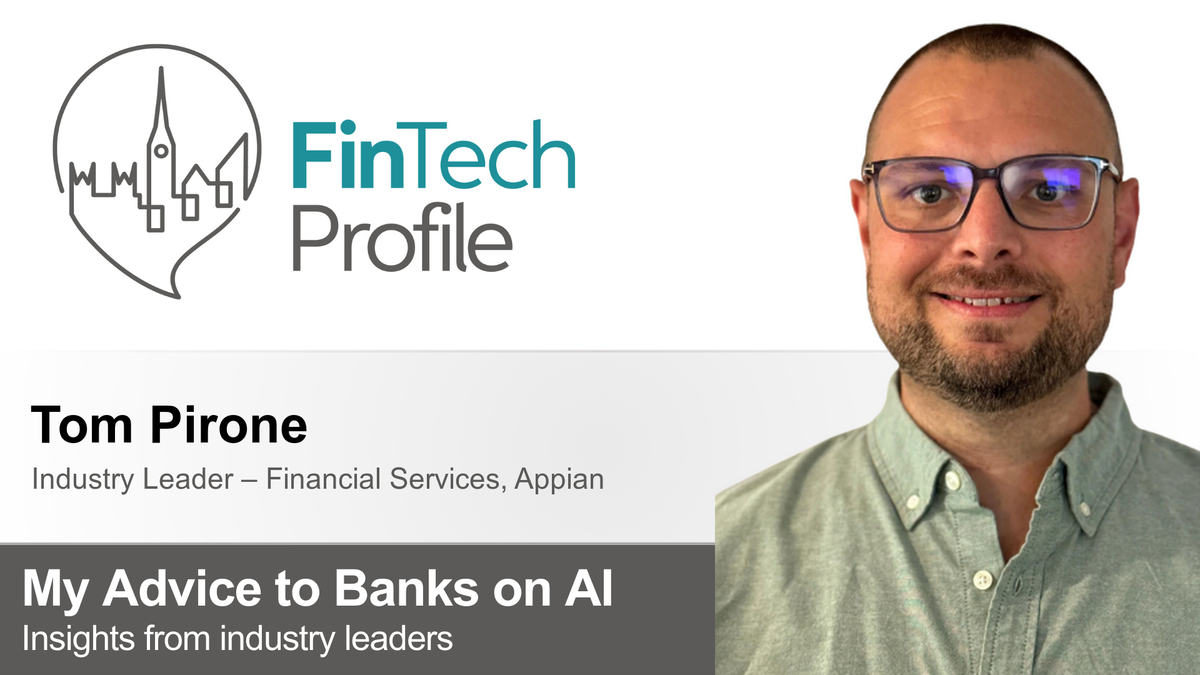
I spoke with Tom Pirone, Industry Leader for Financial Services at Appian, who brings over two decades of financial services experience to the question of how banks should approach AI and data strategy. His perspective is refreshingly pragmatic: AI must be embedded in production workflows and tied to measurable outcomes—not positioned as innovation for its own sake.
Over to you Tom - my questions are in bold:
Can you give us an introduction to you and an overview of your organisation?
I've spent more than two decades inside financial services, much of that time focused on operations and control functions. My perspective has always been straightforward: inefficiency and risk are rarely separate problems. When a process is broken, it usually increases cost and exposure at the same time.
Today, as Industry Leader for Financial Services at Appian, I work with banks and asset managers to modernise the operating models that underpin onboarding, regulatory compliance, payments, servicing, and risk management. Appian is a Nasdaq-listed software company, but our value is not in a single AI capability. It's in orchestrating complex, regulated processes end-to-end and embedding AI precisely where it drives measurable improvement.
My focus is not on AI for its own sake. It's on ensuring that AI deployment results in tangible gains in efficiency, risk reduction, and transparency — outcomes that resonate across the C-suite and stand up to board and regulatory scrutiny.
If you were advising a bank CEO today, what would you say is the single biggest mistake they're making with data and AI?
The biggest mistake isn't experimentation — it's the absence of clearly defined outcomes.
Many institutions are investing heavily in AI without anchoring those investments to specific operational or regulatory metrics. What, precisely, is being improved? Onboarding cycle time? False positive rates? Operational loss exposure? Cost-to-serve? Board-level visibility into risk posture? Without clarity up front, it becomes nearly impossible to demonstrate value.
Eventually, the board asks a simple question: what return are we realising on this AI spend? If the answer is a collection of pilots rather than measurable improvements in regulatory and operational resilience, that signals a governance gap. AI must be embedded directly into production workflows and tied to accountable outcomes — not positioned as innovation for its own sake.
What's one AI or data capability banks should prioritise in the next 12–18 months, and why?
The priority shouldn't be a specific use case. It should be disciplined selection.
Banks need to identify the processes where AI can generate the highest risk-adjusted return and be explicit about the cost of inaction. That includes areas such as KYC, AML, lifecycle servicing, event-driven execution, and systemic issue resolution. But the unifying question is: where is friction today creating unnecessary cost and regulatory exposure?
Rather than chasing trend-driven initiatives, executives should evaluate AI investments through a risk-adjusted lens. Where is the operational drag most acute? Where does delay amplify risk? Where does opacity create supervisory vulnerability? When AI strategy is anchored to those questions, it becomes a lever for operating model transformation — not just incremental automation.
Where do you see banks overestimating AI, and where are they underestimating it?
Banks often overestimate the idea that AI is interchangeable — that a single model or approach can solve multiple complex problems. In reality, different AI capabilities are designed for different tasks. Generative models, predictive analytics, document intelligence, and agent-based workflows each serve distinct purposes. Deploying them without a clear objective and defined success metric introduces complexity rather than clarity.
At the same time, banks underestimate the power of AI when it is embedded within a transparent, governed process. Transparency is what enables scale. When automated decisions are traceable, measurable, and explainable, leadership gains confidence to expand adoption. Without that visibility, AI remains constrained to isolated use cases.
The real advantage isn't novelty. It's disciplined, controlled augmentation inside regulated workflows.
What does "good" actually look like when AI and data are working well inside a bank?
When AI and data are working well, they are largely invisible.
Operations teams experience fewer escalations, cleaner hand-offs, and less rework. Customers move seamlessly across products and transactions without encountering friction. Risk and compliance teams review well-prepared, context-rich cases rather than piecing together fragmented information.
At the management level, there is real-time visibility into cost drivers, process performance, and key risk indicators. Regulators see clear, auditable control frameworks rather than opaque automation. "Good" feels dependable, predictable, and measurable. It reflects an institution operating with control and clarity — not experimentation and improvisation.
What's the hardest AI or data decision bank executives are avoiding right now, and why?
The most difficult decision is moving AI from experimentation to accountable production use.
Innovation labs and pilots are relatively low-risk. Embedding AI into core operating processes — and holding it responsible for measurable improvements in efficiency and risk mitigation — requires structural change. It demands workflow redesign, cross-functional alignment, and often a candid assessment of legacy technology limitations.
That level of commitment is uncomfortable. But without it, AI remains a cost centre rather than a strategic capability. Institutions that succeed will treat AI not as a side initiative, but as embedded operational infrastructure — governed, measurable, and directly tied to performance and resilience.
Thank you Tom! You can connect with Tom on his LinkedIn Profile and find out more about the company at appian.com.