My Advice to Banks on AI: Teo Blidarus of FintechOS
FintechOS CEO Teo Blidarus shares practical advice for bank executives on embedding AI into operations, avoiding common mistakes, and building foundations for agentic execution.
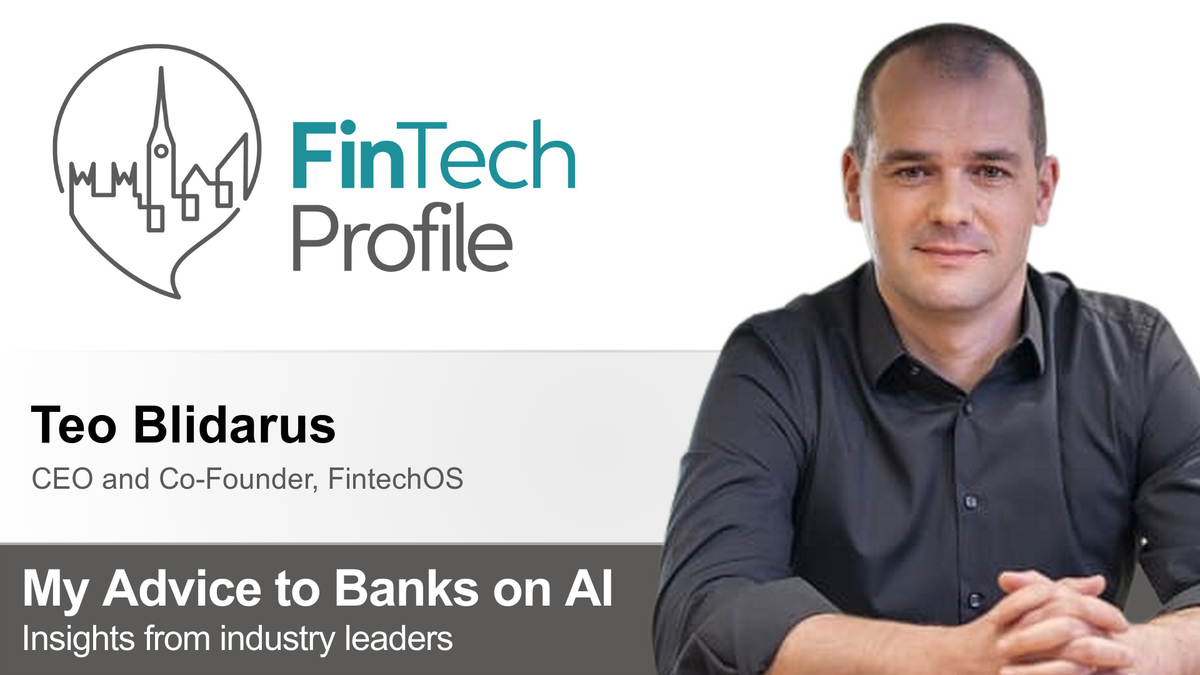
I spoke with Teo Blidarus, CEO and Co-Founder of FintechOS, a platform that helps banks and insurers modernise and operate products without replacing core systems. With over 25 years in financial technology and a track record of scaling companies that serve Fortune 500 customers, Teo brings a pragmatic perspective on where AI strategies succeed and where they fail. In this conversation, he shares his practical advice for bank executives navigating AI and data modernisation.
Over to you Teo - my questions are in bold:
Can you give us an introduction to you and an overview of your organisation?
I've spent more than 25 years working in financial technology, mainly with banks and insurers, leading the rollout of new technology across international markets. Over that time, I've founded and scaled several companies, three of which now serve Fortune 500 customers. What's driven me throughout is closing the gap between what financial institutions want to do and what their technology actually lets them do.
That frustration led me to start FintechOS in 2017. The goal was simple: make financial technology easier to build, launch and run. We provide an AI-fluent, Unified Product Operations platform, an operating layer that sits above and progressively replaces legacy systems and applications. This allows banks and insurers to modernise and launch products without ripping out their core infrastructure.
By doing so, financial institutions can evolve their operating model and create the right foundation for impactful AI initiatives, without turning every change into a major transformation programme. Ultimately, this enables them to achieve their objectives, whether that's driving incremental revenue, improving operational efficiency or creating space for innovation.
If you were advising a bank CEO today, what would you say is the single biggest mistake they're making with data and AI?
I would say the single biggest mistake is trying to layer AI on top of foundations that aren't built for it.
I consistently observe two recurring problems in our industry.
First, data is still treated as a byproduct of operations rather than as a governed, reusable product with its own lifecycle and measurable business value. This leads to fragmented investments with overlapping scope that fail to deliver meaningful insights i.e., whether in personalisation, dynamic pricing or fraud prevention.
Second, AI initiatives are too often tested in isolated innovation labs or side projects, rather than embedded where real operational decisions are made. Many studies suggest that more than 50% of AI's value comes from embedding it directly into operational platforms and workflows, not from standalone experiments.
The underlying issue is structural. AI is a powerful amplifier: it accelerates success when it runs on a well-designed product and operational backbone, but it amplifies inefficiency and complexity when those foundations are weak.
Before approving another AI initiative, CEOs should ask a harder question: are our products and operating model actually built to absorb intelligence?
If the answer is no, the priority isn't another pilot, it's modernising the foundations. AI is not a strategy on its own. It is an accelerator of whatever system it runs on. Strengthen the system first.
What's one AI or data capability banks should prioritise in the next 12–18 months, and why?
If I had to prioritise one capability, it would be building the ability to design and launch products intelligently, with AI embedded from day one.
Every institution has different objectives, whether it's driving incremental revenue in a specific market, improving cost efficiency, or accelerating time to market. But in all cases, AI investments should be tightly aligned to the outcomes the bank is trying to deliver.
Before deploying AI into operations, banks need to assess their readiness end-to-end, from the customer experience layer down to product configuration, workflows, integration and data infrastructure. The key question is: can the organisation safely and continuously evolve products in production?
That's why we place strong emphasis on the design-time. At FintechOS, for example, we've developed a capability called Generative Product Factory. It allows banks to use AI to design products, workflows, connectivity and intelligent data processing directly within their operational platforms, not as isolated experiments, but as production-ready assets.
Once that foundation is in place, runtime AI use cases can scale much more effectively.
In the next 12–18 months, the competitive advantage won't come from isolated AI features. It will come from building the capability to create, adapt and deploy intelligent products continuously.
Where do you see banks overestimating AI and where are they underestimating it?
Banks tend to overestimate AI as a shortcut. There's still a belief that better models will compensate for slow delivery cycles or stitch together fragmented legacy systems. They won't. AI doesn't smooth over structural weaknesses; it exposes them quickly.
Where banks underestimate AI is in how rapidly the industry is moving toward agentic execution. AI is no longer just about generating insights or assisting decisions; it is increasingly about orchestrating actions within defined operational guardrails.
The institutions that will move ahead are those building governed agentic frameworks where AI agents operate within clearly defined product, risk and compliance boundaries and where humans remain accountable for results.
That requires more than access to powerful models. It requires an operational layer capable of embedding AI agents directly into products, workflows, decision logic or handling customer inquiries.
The practical impact is significant: unstructured content processed intelligently, manual interventions reduced with purpose and thousands of hours redirected toward higher-value business activity. Done well, agentic AI doesn't replace control, it industrialises it.
What does "good" actually look like when AI and data are working well inside a bank?
Good looks uneventful, and that's precisely the point.
Product teams can make changes to products without multi-month delivery cycles. Operational changes don't require system rewrites. Risk and compliance have visibility built into the platform, not layered on afterward.
Data is accessible within the product lifecycle itself, not extracted into separate AI environments. Decisions are more accurate, explainable and embedded directly into workflows.
AI isn't treated as a separate programme. It's integrated into the product operations layer, supporting design-time configuration as well as runtime execution.
That's when banks stop talking about pilots and start compounding value across the whole product lifecycle.
What's the hardest AI or data decision bank executives are avoiding right now, and why?
The hardest decision is what they are willing to standardise within their product operations model and what they are willing to stop customising.
Many banks expect AI to operate consistently across multiple product versions, fragmented rule engines and inconsistent taxonomies. But without a unified product operations layer that enforces shared logic, shared data definitions and clear governance, AI becomes difficult to scale and even harder to control.
That decision is avoided because it forces simplification. It requires rationalising product variants, clarifying ownership and accepting trade-offs. It means treating products as governed, continuously evolving assets, not static releases handed off between silos.
Without that shift, AI remains dependent on fragile foundations. The banks that confront this directly will convert AI ambition into measurable performance.
Thank you Teo! You can connect with Teo on his LinkedIn Profile and find out more about the company at fintechos.com.