My Advice to Banks on AI: Meryem Habibi of Bitpace
Bitpace's CRO shares why banks must treat AI as infrastructure, not features, and the hard decisions executives are avoiding on legacy transformation.
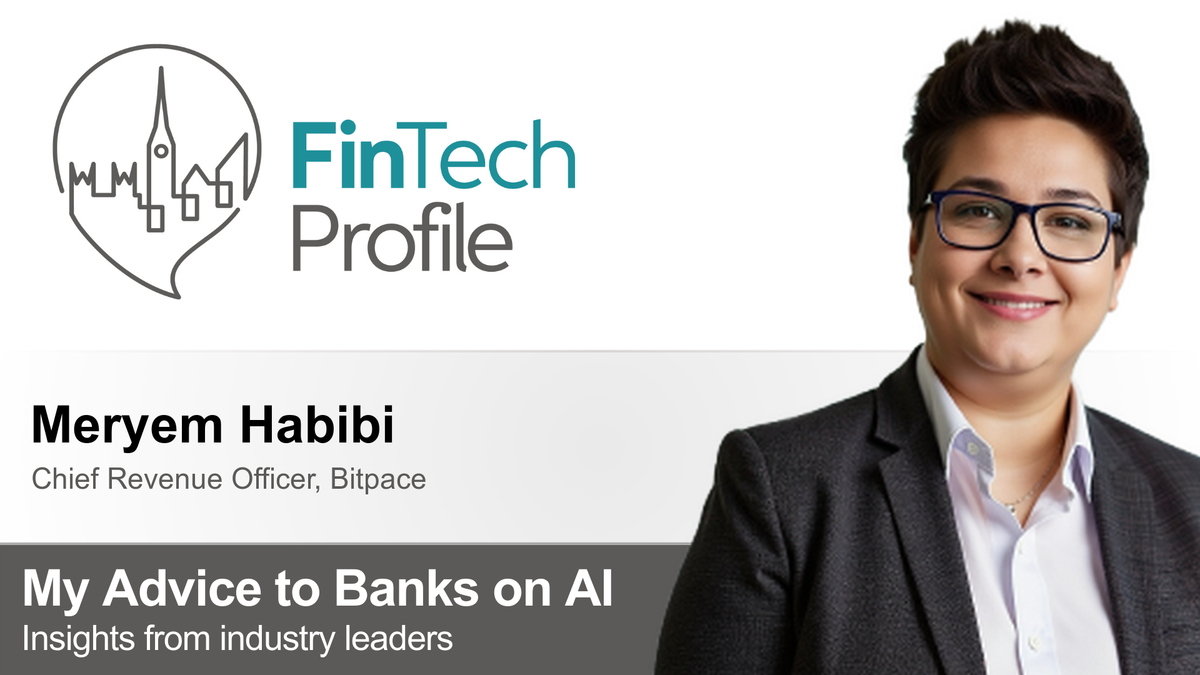
I spoke with Meryem Habibi, Chief Revenue Officer at Bitpace, a regulated crypto payment gateway processing over five million monthly transactions across 50+ countries. Meryem shares her practical advice for bank executives on building AI-native infrastructure and avoiding the costly mistakes that hold institutions back.
Over to you Meryem - my questions are in bold:
Can you give us an introduction to you and an overview of your organisation?
I'm Meryem Habibi, Chief Revenue Officer at Bitpace. I joined in 2022 during a pivotal shift in the industry, moving from "crypto curiosity" to "institutional utility". My focus has been on transforming crypto payments from a fragmented alternative into a trusted, high-velocity financial rail.
Today, Bitpace is a regulated infrastructure powerhouse. We process over five million monthly transactions for 1,000+ merchants across 50+ countries. Since 2023, we've seen a 900% growth in transaction volume, driven largely by our "compliance-first" philosophy. We don't just move assets, we provide a context-aware architecture that integrates AI for real-time routing and fraud detection. This allows our partners to scale across borders without fear of regulatory drift or technical obsolescence.
If you were advising a bank CEO today, what would you say is the single biggest mistake they're making with data and AI?
The biggest mistake is treating AI as a feature rather than as infrastructure.
Most banks are layering AI "band-aids", such as chatbots or automated reporting, onto siloed, legacy cores. This is essentially putting a Ferrari engine on a horse-drawn carriage. AI cannot compensate for "dirty data" or fragmented ownership.
The strategic unlock is Embedded Intelligence. At Bitpace, our routing engines don't just "send" money, but they read live congestion signals, jurisdictional policy changes, and liquidity depths to select the optimal path in milliseconds. For a CEO, the goal shouldn't be "having an AI strategy", but it should be building a context-aware architecture where compliance is executable, risk is adaptive, and liquidity is predictive. If your AI isn't sitting at the protocol layer, it's just overhead rather than a competitive advantage.
What's one AI or data capability banks should prioritise in the next 12–18 months, and why?
Unified Orchestration Intelligence. Currently, a single cross-border transaction triggers four or five separate workflows: AML screening, liquidity sourcing, FX hedging, and routing. In legacy banking, these functions "talk" to each other through delayed handshakes.
Banks must prioritise a shared context layer. Imagine a system where the fraud check, the regulatory validation, and the route optimisation happen simultaneously because the AI understands the entire intent of the transaction, not just the individual data points. This eliminates "false positives" that kill customer experience and reduces the capital lock-up required for slow settlements. Speed is a commodity; intelligent resilience is the new gold standard.
Where do you see banks overestimating AI, and where are they underestimating it?
Banks overestimate AI's ability to act as a "black box" solution that works without governance. In financial services, "the AI said so" is not a legal defence. Blind trust in algorithmic output without human oversight creates systemic risk that can lead to catastrophic regulatory failures.
Conversely, they underestimate AI's power to solve the "Integration Tax". Usually, when a regulation changes, banks have to manually update dozens of different systems. With an AI-driven infrastructure, you can update a policy at the core, and the AI makes that policy executable across every integration point instantly. We underestimate AI as a tool for architectural agility.
What does "good" actually look like when AI and data are working well inside a bank?
"Good" isn't just a faster transaction; it's invisible complexity. When AI is working, the Treasury team isn't reacting to liquidity crunches, but rather anticipating them because the system modelled the volatility of a specific corridor three days in advance. "Good" means Explainable AI. When a transaction is flagged or a route is chosen, the system can tell a regulator exactly why in plain English.
Ultimately, the metric for success is Capital Efficiency. If you are moving more volume with less collateral and lower operational friction while maintaining a "bulletproof" compliance record, your AI is working.
What's the hardest AI or data decision bank executives are avoiding right now, and why?
The decision to kill the "Legacy Pilot" cycle and commit to a fundamental architectural transformation.
It is easy and safe to fund a dozen AI pilots. It is hard and risky to admit that your 30-year-old core banking system is the ceiling on your growth. Executives avoid this because of the "Transformation Paradox": the cost of fixing the foundation is high, but the cost of not fixing it is eventual irrelevance.
Agile fintechs and "borderless" competitors are building on clean, context-aware stacks. To compete, banks must move past incrementalism. The winners will be those who stop trying to "bolt on" AI and start rebuilding their systems to be AI-native.
Thank you Meryem! You can connect with Meryem on her LinkedIn Profile and find out more about the company at www.bitpace.com.