My Advice to Banks on AI: Krishna Subramanyan of Bruc Bond
Krishna Subramanyan, CEO of Bruc Bond, shares practical advice for bank executives on AI governance, fraud detection priorities, and why legacy infrastructure is the hardest decision leaders are avoiding.
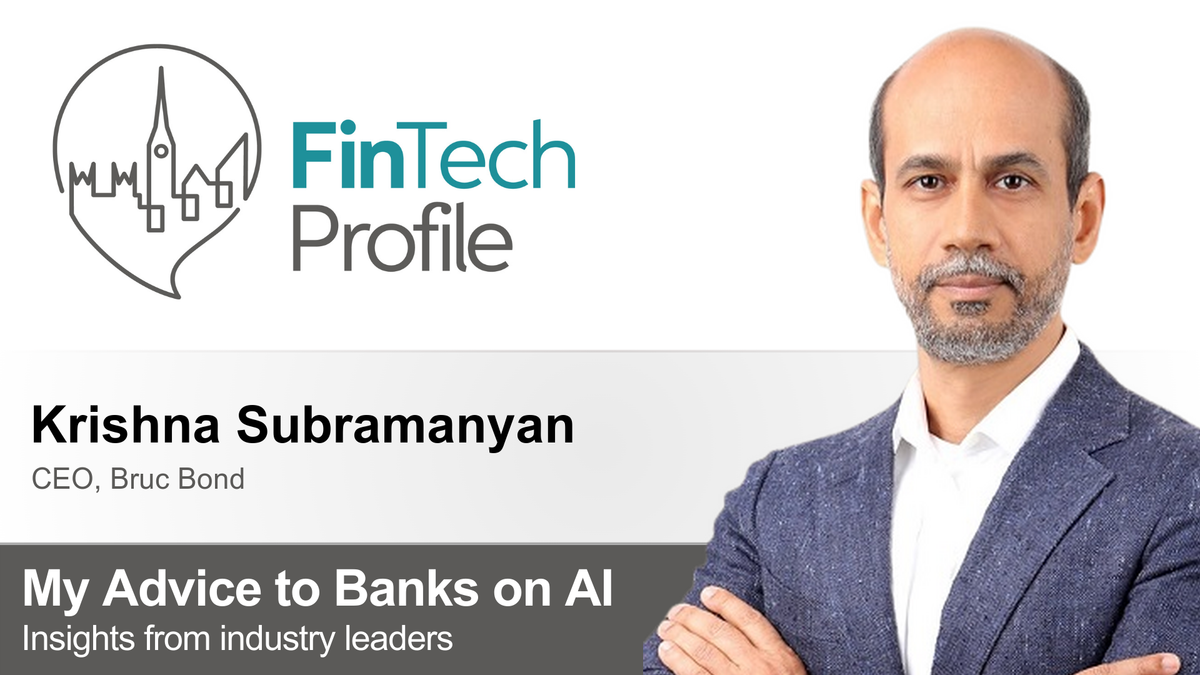
I spoke with Krishna Subramanyan, CEO of Bruc Bond, a regulated cross-border payments institution helping financial institutions navigate complex international banking and compliance demands. With a career spanning GE Capital, Citi, Macquarie, and Scotiabank, Krishna brings deep experience in building compliance architectures that embed regulatory alignment directly into financial infrastructure.
Over to you Krishna - my questions are in bold:
Can you give us an introduction to you and an overview of your organisation?
My career began in industrial sectors where operational precision and reputational trust were paramount, and that experience shaped how I later approached my transition into financial services during the 2008 crisis. Since then, across roles at GE Capital, Citi, Macquarie, Scotiabank and now Bruc Bond, I've focused on building compliance architectures that are not just reactive but foundational.
Bruc Bond exists at the intersection of finance, regulation, and infrastructure. We serve corporate clients and financial institutions with cross-border banking capabilities designed for multi-jurisdictional complexity. Our systems integrate compliance directly into the transaction layer itself, enabling real-time oversight, regulatory alignment, operational resilience, and increasingly, interoperability across both fiat and tokenised environments. We believe compliance should be a source of strategic agility, not a hurdle.
If you were advising a bank CEO today, what would you say is the single biggest mistake they're making with data and AI?
Implementing AI remains a challenging area for banks, for a number of reasons, one of which is achieving satisfactory regulatory validation. In particular, for generative AI, the lack of a clearly defined framework for ongoing governance is currently the most pressing concern for banks and other financial institutions, regardless of where the technology is applied.
Several key aspects of governance require close collaboration between financial regulators and financial institutions. Examples include:
- Consistent risk materiality assessments, including the evaluation of impact, complexity, and the level of reliance placed on AI systems.
- Proportionate lifecycle controls, informed by these assessments, covering data management, fairness, explainability, and human accountability touchpoints.
- Board-level and senior management cross-functional committees to provide oversight and ongoing monitoring of these governance areas.
What's one AI or data capability banks should prioritise in the next 12–18 months, and why?
Banks should prioritise AI-powered fraud and anomaly detection, particularly in identity verification and transaction monitoring in general. But a more realistic approach would be to begin with their respective jurisdictional national risk assessments and threats that tend to evolve over time
Another context to consider is advances in generative AI that have changed the landscape and introduced new threats. These bring into play synthetic identities and deepfakes that now replicate legitimate onboarding behaviours, making traditional verification tools less reliable in a domain that all financial institutions have come to rely on such nearly uniform traditional tools
At the same time, transaction monitoring systems must process larger data volumes with more complex typologies. AI can help identify subtle behavioural deviations and reduce false positives, but only when deployed within structured, strong governance frameworks and supported by high-quality data. Getting this right will be critical for institutions that want to maintain trust and protect the integrity of financial systems as real-time payments and digital assets continue to scale.
Where do you see banks overestimating AI, and where are they underestimating it?
There is sometimes an overestimation of what AI can do without the right governance. In areas like onboarding, fraud detection, or transaction screening, banks may assume that AI can fully replace structured human judgement. But in reality, regulatory scrutiny is increasing, and explainability and accountability remain essential. AI models still require careful oversight, especially when they inform risk decisions that have compliance implications.
AI is often underestimated in its ability to strengthen operational resilience. Its real value is not just in speed, but in how it can improve data quality, streamline reconciliation, and enhance transparency across complex cross-border flows. These are areas where AI can reduce friction and increase the capacity of teams to respond quickly to change.
The real benefit comes when AI is not just applied at the edge, but embedded into the infrastructure in a way that supports both agility and trust.
What does "good" actually look like when AI and data are working well inside a bank?
In an ideal banking world, AI and data are fully integrated, processes become more predictable, risks are surfaced earlier, and decisions are made with greater clarity. Teams are also not overwhelmed by alerts or weighed down by manual reconciliation. Instead, they are focused on oversight and escalation, trusting that the system is doing the work upfront.
Clients feel the difference as well. Onboarding becomes smoother, transactions are processed quickly, and delays become the exception rather than the norm. The institution adapts to change as it happens, without needing to pause or restructure just to keep up.
What defines a strong use of AI is not speed or volume, but control. The organisation is no longer operating reactively and begins to move with integrity, because the infrastructure makes that possible.
What's the hardest AI or data decision bank executives are avoiding right now, and why?
Many are avoiding the decision to rebuild their core infrastructure, even though legacy platforms were not designed to support 24/7 compliance. The reality is, retrofitting modern capabilities onto these systems often leads to patchwork solutions that increase operational risk.
The difficult but necessary decision is to invest in modular, AI-native platforms that can scale across regulatory environments and asset classes. While the upfront investment may be significant, postponing this transition increases long-term risk and opportunity cost and constrains strategic flexibility. In a financial system that is becoming faster, more fragmented and more regulated, infrastructure choices are no longer purely technical decisions, but strategic ones as well.
Thank you Krishna! You can connect with Krishna on his LinkedIn Profile and find out more about the company at www.brucbond.com.