My Advice to Banks on AI: Dr Seena Rejal of NetMind.AI
NetMind.AI's Chief Commercial Officer shares practical guidance for bank executives on AI strategy, governance, and where banks are getting it wrong.
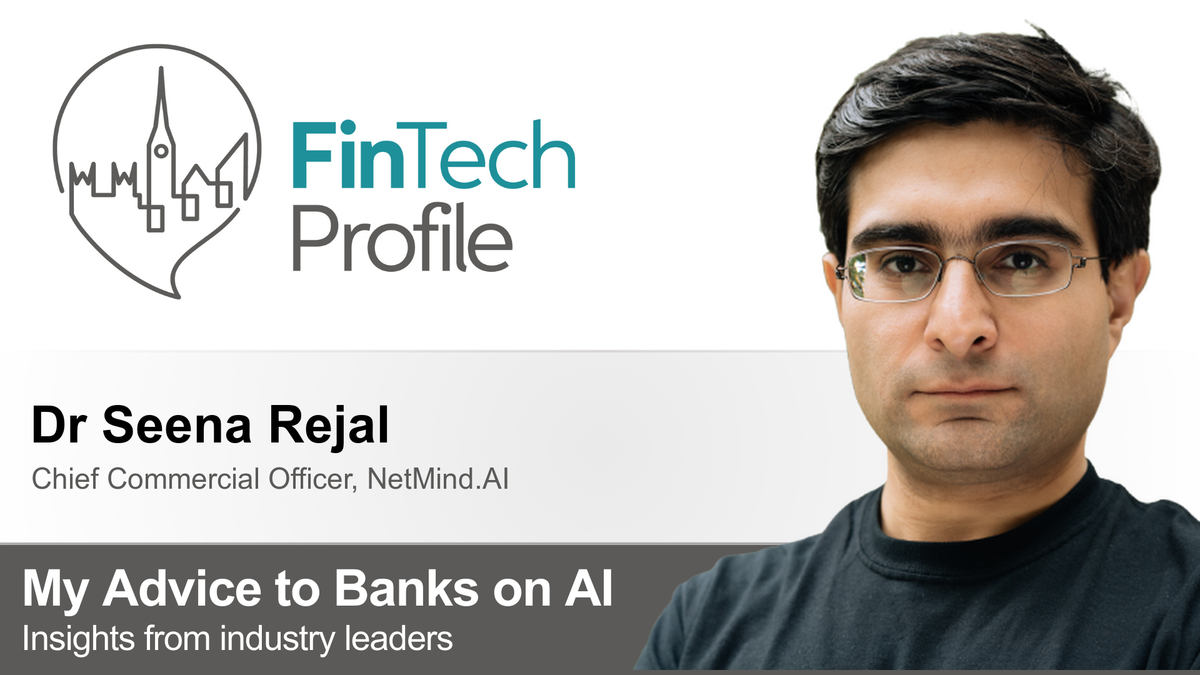
I spoke with Dr Seena Rejal, Chief Commercial Officer at NetMind.AI, a London-based enterprise AI solutions company helping financial institutions deploy AI agents directly into workflows. With a background in taking deeptech from lab to commercial reality and a PhD from Cambridge, Seena shares practical advice for bank executives navigating AI strategy and transformation.
Over to you Seena - my questions are in bold:
Can you give us an introduction to you and an overview of your organisation?
I'm Dr Seena Rejal, Chief Commercial Officer at NetMind.AI. My background is in taking deeptech from the lab to commercial reality. I've founded and led ventures in Visual AI, Generative AI, autonomous mobility and Web3. I have a Master's and a PhD from Cambridge. At NetMind.AI, we help enterprises in law, finance, insurance and banking, amongst others, deploy AI agents directly into their workflows; not as experiments, but as production-ready systems that do real work. The opportunity in banking and finance specifically is enormous, and we're at the point where the conversation has shifted from "should we do this" to "how fast can we move."
If you were advising a bank CEO today, what would you say is the single biggest mistake they're making with data and AI?
Treating AI as a technology initiative rather than a business transformation. Too many banks have AI programmes sitting in IT departments, reporting on model accuracy and compute costs, when the conversation should be happening in the boardroom about customer outcomes, revenue, and risk. The result is a proliferation of pilots that never reach production, and a growing gap between what the technology can actually do and what the organisation is capturing from it. The banks moving fastest are those where the CEO has made AI a strategic priority, not one they have delegated.
What's one AI or data capability banks should prioritise in the next 12–18 months, and why?
Agentic AI embedded directly into core workflows; not copilots, not dashboards, but agents that can actually complete tasks autonomously within compliance guardrails. The productivity gains from AI that assists are meaningful, but the gains from AI that acts — drafting, processing, analysing, deciding within defined parameters — are transformational. In banking, where highly skilled people spend significant time on repetitive, high-stakes tasks like document review, credit analysis, and regulatory reporting, the ROI of getting this right is immediate and measurable.
Where do you see banks overestimating AI, and where are they underestimating it?
Banks overestimate how quickly AI will replace front-line roles, and underestimate how rapidly it will reshape the middle and back office. The customer-facing chatbot gets all the attention, but the real disruption is happening in operations, compliance and risk; areas where the volume of structured, repetitive work is enormous, and the tolerance for error is high enough that AI can operate with appropriate oversight. Banks are also underestimating the competitive risk posed by non-bank entrants that don't carry legacy infrastructure and can build AI-native operations from the ground up.
What does "good" actually look like when AI and data are working well inside a bank?
It looks invisible. When AI is working well, the analyst isn't aware they're using an AI tool; they're just getting better outputs faster, with fewer bottlenecks. A credit team runs a complex assessment in hours rather than days. A compliance officer surfaces a risk flag they would previously have missed in a stack of documents. The AI isn't the headline; the outcome is. The other marker of "good" is that the organisation trusts the outputs, which only happens when there's genuine explainability, clear governance, and the humans in the loop feel augmented rather than bypassed.
What's the hardest AI or data decision bank executives are avoiding right now, and why?
Committing to a model for AI governance before they feel fully ready, because that moment of full readiness will never come. Executives know they need frameworks for explainability, auditability and accountability, but the regulatory landscape is still evolving, and the technology is moving faster than policy. The temptation is to wait for certainty before committing, but that delay is itself a decision; one that cedes ground to competitors who are building governed systems now and iterating as the rules crystallise. The banks that will lead in three years are the ones making imperfect but principled governance decisions today.
Thank you Seena!
You can connect with Seena on his LinkedIn Profile and find out more about the company at www.netmind.ai.