My Advice to Banks on AI: Dr. Antoni Vidiella of Globant
Dr. Antoni Vidiella shares why banks must modernise data foundations before scaling AI, and explains the capabilities that will separate leaders from laggards in 2026.
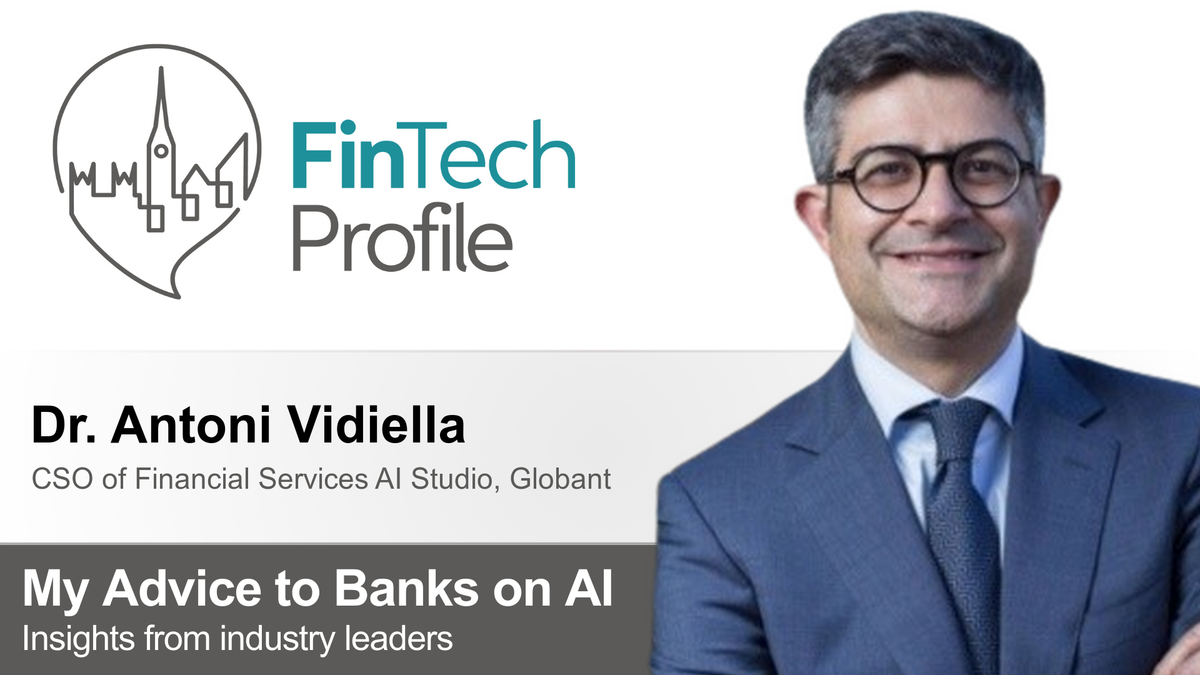
I spoke with Dr. Antoni Vidiella, PhD, CSO of the Financial Services AI Studio at Globant, who has spent 25 years guiding global financial institutions through complex transformations. He shares practical advice on the biggest mistakes banks are making with AI, the capabilities they should prioritise, and what 'good' actually looks like when AI is working well inside a bank.
Over to you Antoni - my questions are in bold:
Can you give us an introduction to you and an overview of your organisation?
I'm Antoni Vidiella, PhD, CSO of the Financial Services AI Studio at Globant. For the past 25 years, I've guided the world's leading financial institutions through complex, end-to-end transformations—taking them from high-level strategic vision to real-world global deployment. My expertise lies at the critical intersection of advanced analytics, digital and tech transformation, and risk and compliance.
Today, as financial institutions face the challenge of integrating modern technologies like AI whilst navigating legacy systems and strict regulations, tech and risk management must be engineered together.
Globant is a digital transformation company and we partner with leading organisations to reinvent how they operate through technology, design and innovation. In financial services, our focus is on helping institutions move beyond isolated AI initiatives and build modern, cloud-native foundations that allow intelligence to scale securely, responsibly and at pace. A key part of this is through our AI Pods, an innovative, outcome-based model that pairs our experts with agentic AI to accelerate delivery.
In a recent use case, a leading worldwide bank leveraged Globant's AI Pods to define a business application from scratch, which effectively cut the timeline in half (from 6 months to 3); in another, a leading Irish bank was able to beat its compliance deadline using AI Pods to complete data migration 40% faster.
If you were advising a bank CEO today, what would you say is the single biggest mistake they're making with data and AI?
The single biggest mistake is assuming AI can simply be layered on top of a bank's existing architecture without fundamentally changing the underlying systems, processes, and culture.
Globally, AI adoption is now widespread, with a recent Wharton School study finding that 82% of executives now use Gen AI weekly and 46% daily, yet adoption in banking and financial services remains far lower than in tech or telecom – but it is gaining traction. Many are still operating on fragmented, legacy architectures that were never designed for real-time intelligence.
Leaders often put the cart before the horse—pushing for flashy AI implementations before doing the hard work of building a modern, governed data infrastructure. Without modern data foundations, AI initiatives remain reactive, difficult to govern and hard to scale. The risk is that banks continue to increase AI investment whilst failing to unlock meaningful value because the infrastructure underneath cannot support speed, transparency or trust at scale. Banks must move beyond disjointed 'pilot traps' to focused, top-down execution transforming the entire value chain for measurable ROI.
Crucially, AI demands deep operational and cultural transformation—it's not just an IT project. Implementing Agentic AI requires a complete operating-model redesign, intentionally breaking down silos (product, risk, compliance, tech) and mapping workflow changes.
So my advice to a CEO is this: If you want to unlock meaningful value safely and at scale, your data foundation, your operational processes, and your company culture all have to be modernised together.
What's one AI or data capability banks should prioritise in the next 12–18 months, and why?
We are currently seeing a massive gap between intent and execution in the market. Banks should prioritise building a governed, enterprise-wide AI and data foundation that enables trusted, agentic AI at scale. Competitive advantage won't come from isolated pilots, but from connecting high-quality, well-catalogued data to AI systems that can reason, decide and act across journeys. That means unifying customer and transactional data, embedding strong governance and model risk controls, and creating reusable AI services.
With this foundation, banks can unlock hyper-personalised experiences, smarter risk decisions, and operational autonomy, securely and compliantly. The institutions that industrialise AI on top of reliable data will move from experimentation to measurable business impact.
Where do you see banks overestimating AI, and where are they underestimating it?
Banks often overestimate how quickly AI alone can transform outcomes. There's an expectation that AI will compensate for outdated processes or infrastructure, which it simply cannot do.
At the same time, they drastically underestimate its ability to fundamentally reinvent their business model and unlock new markets once the foundation is solid. Many financial institutions underutilise AI, seeing it only for basic cost reduction or as a quick fix for messy data. Properly integrated Agentic AI can revolutionise revenue, not just cut costs. Examples include transitioning to hyper-personalised money management platforms and safely expanding credit access using novel data sources for lending.
Institutions mistakenly overestimate AI as an infrastructure patch whilst underestimating its strategic power to reinvent operations and tap new markets—provided data foundations are solid.
What does "good" actually look like when AI and data are working well inside a bank?
In 2026, 'good' means that intelligence is deeply embedded into a bank's everyday operations rather than being isolated in experimental pilot programmes. It fundamentally reshapes the operating model from the back office all the way to the customer interface.
On the operational side, we see autonomous agents driving zero-touch processes, successfully cutting manual workloads in heavy compliance tasks like AML investigations. This automation doesn't just cut costs; it actively empowers the workforce. Frontline staff and relationship managers are now supported by 'digital colleagues' that instantly consolidate data, freeing human employees to focus entirely on high-value, strategic client conversations.
For the customer, this means the traditional banking app is no longer just a static ledger, but a proactive, intelligent agent that anticipates their needs and autonomously optimises their financial journey.
What's the hardest AI or data decision bank executives are avoiding right now, and why?
The hardest decision is committing to large-scale modernisation of core systems. It is complex, high-stakes and challenges long-established operating models, which makes it easier to delay.
However, AI investment across financial services continues to accelerate, and expectations around speed, transparency and regulatory compliance are rising. Delaying foundational change only widens the gap between AI ambition and real-world performance. Institutions that act decisively now will be far better positioned to compete and innovate responsibly in order to adapt over the next decade.
Thank you Antoni! You can connect with Antoni on his LinkedIn Profile and find out more about the company at www.globant.com.