My Advice to Banks on AI: Daniel Meyer of Camunda
Daniel Meyer, CTO at Camunda, shares practical advice on closing the gap between AI vision and reality through agentic orchestration in banking.
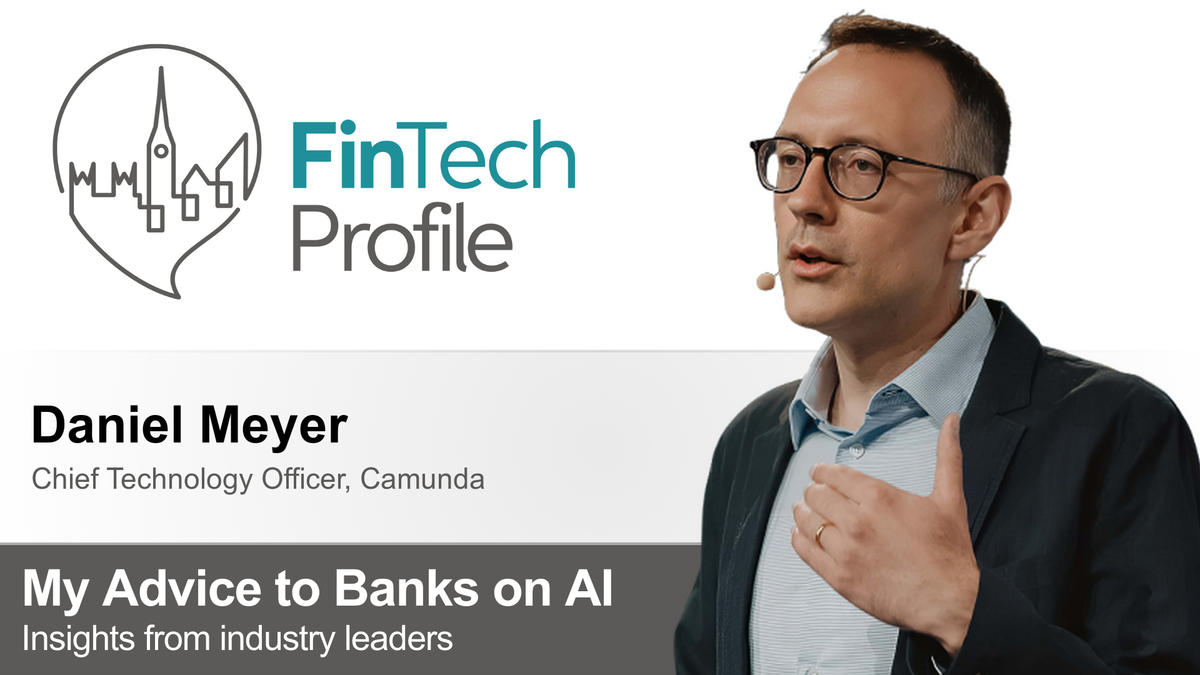
I spoke with Daniel Meyer, Chief Technology Officer at Camunda, who oversees the development of their orchestration platform for clients including Santander, NatWest, and Rabobank. Daniel shares his practical advice on how banks can close the gap between their AI vision and operational reality through agentic orchestration.
Over to you Daniel - my questions are in bold:
Can you give us an introduction to you and an overview of your organisation?
I'm Daniel Meyer, Chief Technology Officer at Camunda, where I oversee the development and maintenance of our orchestration platform. My current focus is helping clients like Santander, NatWest, and Rabobank maximise the value of agentic AI and automation investments through agentic orchestration.
Camunda specialises in agentic orchestration, automating complex business processes, including high-value knowledge work, across people, systems, and AI agents. By creating production-ready, enterprise-grade agents with built-in governance, we help organisations to implement trusted AI agents across business-critical processes at scale.
If you were advising a bank CEO today, what would you say is the single biggest mistake they're making with data and AI?
Financial services leaders have admitted to a gap between their agentic AI vision and the current reality. The biggest mistake is letting that gap persist. Many firms have a clear vision of what AI could do but in practice, agents are often deployed in isolation as fears around trust, blind spots, and compliance prevent full adoption. According to our latest State of Agentic Orchestration and Automation report, 78% of firms are concerned about a lack of transparency into how AI is used.
Agentic orchestration provides a model to close the vision-reality gap. Orchestration ensures that every step of an end-to-end automated process, whether it's handled by a human, a legacy system, an automation tool, or an AI agent, fits together in a coordinated, auditable sequence. This framework ensures AI agents act on the right data at the right points, with humans able to intervene or approve decisions as needed.
This is especially important in financial services, where compliance and auditability are non-negotiable. AI agents making autonomous decisions about customer risk profiles, transaction limits, or fraud detection must operate under clear governance and defined controls, with a transparent audit trail. Orchestration provides the guardrails that make this possible.
What's one AI or data capability banks should prioritise in the next 12–18 months, and why?
I would tell a bank CEO to prioritise moving AI agents out of isolated use cases and into mission-critical workflows. Most AI agents in financial services are currently limited to chatbots or assistants that summarise or answer basic questions. These agents rarely drive business impact, and almost half (49%) operate in silos and are not woven into end-to-end processes.
Agentic orchestration is key to unlocking the full value of AI agents. It allows banks to blend deterministic and dynamic workflows. Deterministic rules are applied to process parts which are predefined and don't have or don't allow for any deviations like loan origination or KYC, while dynamic AI-driven steps handle exceptions or complex decision-making in real time. This hybrid approach provides control where it matters and flexibility where it counts. Imagine a KYC process: basic steps like collecting documents and verifying identity are predefined, while an AI agent can handle exceptions – guiding the customer, requesting additional information, or escalating to a human when needed. Both deterministic and dynamic workflows operate together under a single orchestrated layer, ensuring the process remains efficient, auditable, and fully compliant.
By embracing agentic orchestration, banks can unlock better customer experiences, improved compliance and faster, more resilient operations. In fact, in our survey, the majority of firms (86%) say AI needs to be orchestrated across business processes to get the full value of their AI investments. Most importantly, banks can scale AI initiatives without losing control, using standardised processes, reusable components, and consistent governance to achieve both efficiency and oversight. Firms that prioritise investing in the architecture to operationalise AI will be the ones who win.
Where do you see banks overestimating AI, and where are they underestimating it?
Banks often overestimate AI when they assume it's easy to scale or that it can automatically fix problems. The gap between the agentic AI vision and reality is huge. Our report also confirmed this: While most financial services firms are experimenting with AI agents, only very few use cases (12%) actually reached production last year. Without the right structure and oversight, AI agents can actually make existing inefficiencies worse: around half of financial services leaders (49%) say untamed agentic AI risks "fanning the flames" of poorly implemented processes. Agentic AI isn't a magic fix, and can only deliver real value when it's properly orchestrated and within mission-critical processes.
When AI agents are embedded in end-to-end processes with agentic orchestration, they can add real-time reasoning and autonomy while still maintaining control, transparency, and compliance. Agentic orchestration – blending deterministic rules with dynamic AI decision-making – offers flexibility for exceptions and complex cases, without sacrificing auditability or governance.
What does "good" actually look like when AI and data are working well inside a bank?
When agentic AI is orchestrated into end-to-end processes and has access to the right data at the right time, banks can balance autonomous decision-making with human oversight, keeping operations transparent, compliant, and under control.
For example, EY has worked with financial services clients to bring agentic AI into trade exception management. Many of these firms already have mature AI models, but they often lack the orchestration layer to translate those capabilities into tangible business outcomes. With Camunda, EY is helping these organisations embed existing AI assets into structured, auditable workflows with guardrails, so AI is only triggered when appropriate. This lets clients avoid rebuilding AI from scratch, instead focusing on governance, visibility, and scalable deployment. In one capital markets case, this approach cut manual work by 86%, reduced T+1 delays almost completely, and boosted analyst productivity sevenfold.
What's the hardest AI or data decision bank executives are avoiding right now, and why?
Many leaders in financial services prioritise quick, short-term wins under boardroom and competitive pressures rather than investing in the architecture needed to orchestrate AI. But without agentic orchestration, these initiatives often fail to scale, create operational silos, and introduce compliance risk.
Building a solid foundation requires cross-department collaboration and a shift from automating individual tasks to thinking about end-to-end processes. When AI is embedded in governed, enterprise-wide workflows, firms can accelerate decision-making, improve customer outcomes, and maximise return on investment.
Thank you Daniel! You can connect with Daniel on his LinkedIn Profile and find out more about the company at camunda.com.