My Advice to Banks on AI: Ciaran Cosgrave of Nearform
Nearform CEO Ciaran Cosgrave shares his advice for bank executives on avoiding the 'field of dreams' fallacy and delivering real AI value in weeks, not years.
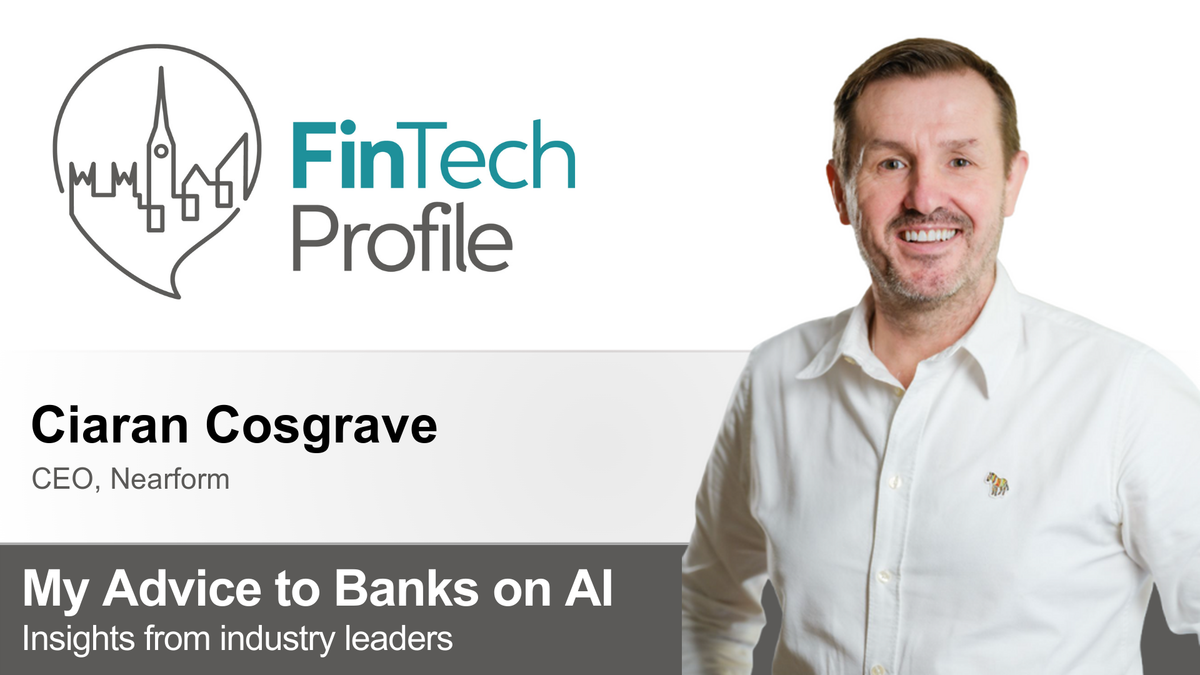
I spoke with Ciaran Cosgrave, CEO of Nearform, a global leader in AI-native engineering for large, regulated enterprises. With extensive experience helping banks, insurers and wealth managers turn AI from hype into genuine business value, Ciaran shares his practical advice for banking executives navigating data and AI strategy.
Over to you Ciaran - my questions are in bold:
Can you give us an introduction to you and an overview of your organisation?
I'm Ciaran Cosgrave, CEO of Nearform. We use AI-native engineering to help large, regulated and highly complex organisations to turn AI from a hype‑cycle distraction into a genuine driver of profitability, security and customer value.
Our focus is on solving real business problems, not building tech for its own sake. That means delivering AI capabilities that are fast, secure, transparent and deeply connected to the outcomes that matter to executives today.
We work extensively across regulated industries including banking, insurance and asset/wealth management, where trust, compliance and operational resilience define whether AI actually ever makes it into production.
In banking alone, we support organisations, including established mainstream institutions as well as FinTechs, across three major areas:
AML and risk remediation. We automate the vast majority of high-volume remediation work, while maintaining human in the loop oversight and guardrails to ensure focus on true exceptions and risk judgement. AI automation handles the bulk of high-volume remediation work under human oversight and compliance guardrails, allowing teams to focus their expertise on genuine exceptions and complex risk decisions.
Wealth management personalisation. We enable banks to use transaction data, behavioural signals and institutional expertise to enhance advisor capability, improve client segmentation and provide advanced decision support, particularly for the fast-growing emerging wealth segment that expects a digital-first, hyper-personalised experience.
Legacy modernisation. Significant enterprise value remains locked inside legacy infrastructure, and we can unlock it far faster than most institutions assume.
We pride ourselves on delivering meaningful value quickly, not multiyear, multi-million-pound transformation programmes that never reach the finish line. Increasingly, we're finding that banking's real challenge isn't the technology itself; it's everything wrapped around it: governance, risk, security, regulated decision‑making, and ensuring AI doesn't erode trust with customers or regulators. That's where our expertise lies.
If you were advising a bank CEO today, what would you say is the single biggest mistake they're making with data and AI?
The biggest mistake is what I call the 'field of dreams' fallacy - the idea that if you build the perfect data foundation, business value will magically follow. Banks are being sold on sprawling, multi-year data-modernisation programmes that devour budgets and promise that AI will only deliver value once everything is unified, clean and centralised. This is simply not the case.
In reality, by the time these 'pristine' data platforms are finally ready, the market has moved on, the AI models have advanced, and the business has run out of patience. And more practically: banks will acquire new businesses, tweak products or overhaul risk models long before the 'perfect' platform is even operational, leaving it outdated before it's even live.
Instead of starting with technology, banks should start with the business value stream - loan approvals, customer prospecting, risk remediation, customer prospecting, fraud detection - and work backwards to the data required for that specific outcome. A thin, deep, end-to-end slice will outperform a wide, shallow, platform-first approach, because applying AI and governance to the end to end processes in these thin slices delivers immediate value, builds confidence and accelerates learning cycles…something bloated data programmes simply can't do.
If you're not tying your AI and data investments directly to revenue, cost, risk or customer experience uplift, you're wasting time and burning money.
What's one AI or data capability banks should prioritise in the next 12–18 months, and why?
I'd say pick one high‑value workstream and go incredibly deep. Not ten pilots. Not a broad AI 'capability uplift'. Pick one specific business process with clear commercial impact - mortgage approval, credit decisioning, customer prospecting, AML remediation or wealth‑management advisory - and build a team that becomes world‑class at delivering AI for that outcome.
The banks leading the pack aren't spreading AI thinly across the organisation. They're creating expert pods - teams that live and breathe the business context, the data, the compliance constraints and the customer journey. That deep focus drives speed, trust, repeatable patterns and replicable value. Nail it in one area, fold it back into your core AI engine or centre of excellence, then scale horizontally. You want your AI to be exceptional somewhere, not average everywhere.
This should run from top to bottom: customer experience → business workflow → compliance → data → models → deployment → feedback loop. This isn't a prototype; it's production grade. When you go deep, with a small dedicated team of experts, you uncover the real constraints earlier -regulatory guardrails, data gaps, workflow bottlenecks - and solve them properly. That becomes part of your repeatable playbook
Take wealth management as an example. Don't rebuild the entire CRM or try to personalise every segment. Instead, focus on one target group, let's say, pre-retirees navigating the transition from wealth accumulation to preservation. Go deep: understand their needs, the products that serve them, how advisors train, how decisions are made and where AI creates leverage. Build the end-to-end capability for that journey, and then scale it. Once you've proven impact in that first 'slice', you replicate the approach.
Where do you see banks overestimating AI, and where are they underestimating it?
I see most banks overestimating how much they need to spend on AI before they can do anything meaningful - especially on top-down governance frameworks, big infrastructure programmes and 'perfect' data foundations. They've been sold a story that unless they rebuild their entire data platform globally, they can't safely or valuably use AI. That leads to huge, multi-year data projects that are only loosely connected to real business outcomes.
At the same time, they massively underestimate the value already sitting in the data they have today. Today's AI can generate real-time insight on a single customer or transform a specific value stream, loan approval, risk remediation, using existing data. Modern AI models and tools can extract meaningful insights from imperfect, messy datasets, particularly in customer insight, risk review, wealth segmentation and operational automation.
The other blind spot is confidence and an approach to move at pace, securely. Many underestimate how quickly AI can move from prototype to production if assembled with the right trust, security and regulatory controls. The fear of "what if something goes wrong?" is often greater than the actual risk - especially when humans today already make the same mistakes AI is blamed for. The barrier to enterprise AI adoption isn't model performance or a perfect data warehouse: it's the absence of production-grade resilience across architecture, governance, deployment, and operating models. Unlock what you already have before building what you don't yet need.
What does "good" actually look like when AI and data are working well inside a bank?
"Good" means cutting the time between spotting a business problem and deploying an intelligent solution that's live, trusted and delivering measurable impact. Banks that get this right pick high‑value (loan approval, risk remediation, customer prospecting), cross‑bank value streams and deliver them end‑to‑end in weeks or months - not multi‑year programmes stuck behind governance bottlenecks.
Practically, this boils down to three things. First, very short cycle times from identifying a business problem to live deployment, measured in weeks, not quarters.
Second, cross-functional teams (business, data, risk, compliance, tech) own those value streams end-to-end. They work with the data the bank already has, instead of waiting for some mythical, perfect enterprise data platform, and they iterate in production rather than getting stuck in pilot purgatory.
Third, trust is built in, not bolted on. Customers, regulators and internal stakeholders are confident the systems are secure, compliant and are being governed in a transparent manner.
But the real shift is mindset…If your teams are running "AI projects", you're already off course. You should be running business projects - where AI is fundamental to delivering the outcome - with the outcome being the thing that still matters the most. Think of it as running loan approval projects, risk remediation projects, wealth insight projects, with AI simply being the hidden (but most effective) tool inside those flows. When banks stop treating AI as a separate category and embed it into the product and value stream itself, that's when velocity and trust skyrocket.
When AI and data are working well in a bank, you stop talking about "AI projects" and start seeing faster, better business outcomes.
What's the hardest AI or data decision bank executives are avoiding right now, and why?
The hardest AI decision most bank executives are avoiding isn't about which model to use or which vendor to pick, it's whether they're willing to fundamentally reorganise their businesses around intelligent products instead of functions.
AI demands cross-functional, product-centric teams that unite business, data, compliance and risk. But this shift challenges entrenched organisational structures, and that's exactly why so many banks avoid it.
Right now, banks operate in silos. Data is over here, compliance is over there, credit lives in its own bubble, and risk is somewhere else entirely. These functional divides don't just slow everything down…they erode trust in AI before customers even get near it.
Customers don't buy functions; they buy products: a loan, a mortgage, a pension, a way to protect their wealth. AI can transform these products only if the teams building them are structured around the product, not internal organisational charts.
This shift is uncomfortable; it disrupts decades of organisational design, power structures and career paths. That's exactly why executives avoid it. But until banks make this leap, AI will always be constrained by structure, not capability
Thank you Ciaran! You can connect with Ciaran on his LinkedIn Profile and find out more about the company at nearform.com.