My Advice to Banks on AI: Brian Unruh of ABBYY
ABBYY's CFO Brian Unruh shares practical advice for bank executives on avoiding AI investment mistakes, prioritising KYC capabilities, and building defensible returns through purpose-built AI.
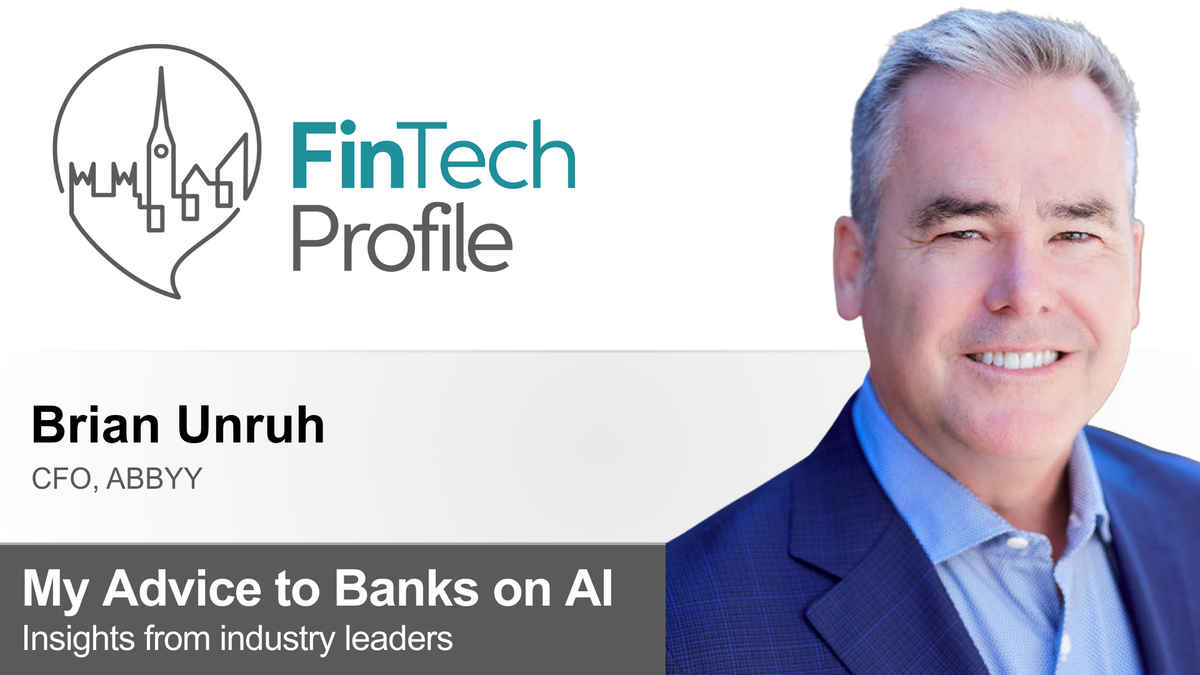
I spoke with Brian Unruh, CFO of ABBYY, who brings over 20 years of executive experience in finance and operations across software and platform-as-a-service companies. Brian leads the finance and operations teams at ABBYY, where he focuses on ensuring their purpose-built AI solutions for document process automation deliver measurable business impact for customers. He shares his practical advice for bank executives navigating AI investment decisions and data strategy.
Over to you Brian - my questions are in bold:
Can you give us an introduction to you and an overview of your organisation?
I joined ABBYY as CFO in 2023, and I lead the finance and operations teams in supporting our customers with purpose-built AI solutions for document process automation. My focus is on ensuring these solutions deliver measurable business impact — from operational efficiency and compliance to cost savings — in a market that's evolving rapidly with AI innovation.
I bring over 20 years of executive experience in finance and operations, working with both public and private companies in software and platform-as-a-service. My background includes leading global organisations, managing multiple acquisitions and private equity transactions, and building the systems and processes that allow companies to scale efficiently.
If you were advising a bank CEO today, what would you say is the single biggest mistake they're making with data and AI?
The biggest mistake banking CEOs make is not having AI investment plans reflect capital allocation rigour. By jumping on the next hype train, they risk misallocation when AI investment lacks a defined economic return. CEOs need a control environment with clear focus on capital discipline, measurable ROI and operating leverage.
Banks that utilise purpose-built AI, which excels at solving specific problems within organisations, will immediately see results. One of the most overlooked areas is documentation. Documents sit at the centre of how banks operate: they support decision-making, provide audit defensibility, and minimises regulatory exposure across the organisation.
In areas like Model Risk Management, the entire lifecycle — development, validation, and ongoing monitoring — is heavily dependent on producing, reviewing, and reconciling large volumes of documentation. This work is still largely manual, time-consuming, and prone to inconsistency.
Purpose-built Document AI can automate the assembly and validation of these materials by extracting key assumptions, data sources, parameters, and limitations directly from systems and artefacts already in use. It can then assess that content against internal policies and regulatory expectations, highlighting gaps before they become issues.
From a CFO perspective, this turns Document AI into a first line of control: reducing manual exceptions, improving audit outcomes, and predictable compliance performance. Banks must remain focused on risk-adjusted returns and apply AI where it can deliver immediate, defensible returns.
Capital discipline must be a core focus for companies. AI creates value only when its ROI and operating leverage are clearly defined and rigorously measured - without a well-articulated economic return, AI investments carry a significant risk of capital misallocation.
What's one AI or data capability banks should prioritise in the next 12–18 months, and why?
Customer expectations of financial institutions are rising, and fraud and identity theft are growing. Meanwhile, regulators are also tightening rules. The July 2027 EU AML Regulation, for example, will harmonise standards across all member states, introducing stricter requirements for beneficial ownership data and ongoing due diligence.
Against this backdrop, a capability that banks should prioritise going forwards is Know Your Customer (KYC). It's more than managing regulatory exposure and audit defensibility– it's now a critical trust and customer-experience driver.
Traditionally KYC is a long, complicated process. Regulatory complexity, high volume of customers needing extra checks, a reliance on manual reviews, and getting hold of all the right data in financial firms that are often fragmented and siloed, can massively inflate the time taken to get it all done.
AI can reshape how they verify identity, prevent fraud, and build trust through automating KYC checks, spotting risks earlier, and improving accuracy.
ABBYY and IBM watsonx.ai, for example, have partnered to offer advanced Document AI and Process AI with Orchestrate's AI-driven agents to transform the entire KYC process, from document intake to compliance monitoring, into a transparent, scalable and intelligent workflow.
Using AI in the KYC process is a smart risk-adjusted return. The combination of human expertise with agentic automation helps financial institutions scale and adapt quickly to comply with KYC and AML regulations, while fortifying their own defences against cybercrime.
Where do you see banks overestimating AI, and where are they underestimating it?
In the current rush to adopt AI, many organisations default to broad, general-purpose AI platforms without a clearer focus on capital discipline where they will create measurable ROI. From a CFO perspective, this often leads to long implementation cycles, unclear ownership, and difficulty quantifying return, while introducing new operational and governance risks.
Purpose-built AI is a more approach. It is designed to address specific, high-friction processes where cost, error rates, and control gaps already exist. That focus shortens time-to-value and makes outcomes easier to measure and govern.
In financial operations, documentation is a good example. Large volumes of documents flow through accounting, compliance, and reporting processes, and much of the work to review, validate, and reconcile them remains manual. Purpose-built Document AI can automate these steps with consistency and audit defensibility, reducing manual effort while improving accuracy and control — particularly in areas that directly affect financial reporting and regulatory compliance.
For CFOs, the value is not "more AI," but rather integrated AI execution embedded in core workflows, where cost, risk, and control matter most. Better execution will lower processing costs, improve visibility into financial processes, strengthen controls, and create faster, more reliable outcomes. That's where purpose-built AI tends to deliver the most defensible returns.
What does "good" actually look like when AI and data are working well inside a bank?
When data and automation are working well, they shouldn't draw attention to themselves. Core banking processes should run reliably end-to-end, with minimal manual intervention, exceptions, or ongoing maintenance.
From a CFO perspective, that requires stepping back and evaluating the technology stack as a whole — not as individual tools, but as a part of the organisation's operating leverage. The question is whether the stack is reducing cost, improving control, and scaling efficiently across the organisation.
Some institutions choose to build their own AI capabilities, and in the right circumstances that can make sense. But in many cases, organisations underestimate the cost-to-serve, complexity, and risk involved, and end up recreating capabilities that already exist in mature, proven platforms.
More often, a carefully selected ecosystem of complementary AI partners delivers better outcomes: faster time-to-value, stronger security and governance, and a solution that is easier to sustain over time. For finance leaders, that approach tends to provide clearer accountability and a more predictable return on investment.
What's the hardest AI or data decision bank executives are avoiding right now, and why?
AI is delivering real gains in productivity and customer experience, but it is also changing the risk landscape. The speed and sophistication of financial crime have increased, with organised groups using automation and AI-assisted impersonation to move and launder funds in minutes rather than days.
For banks, the challenge is no longer just identifying suspicious activity — it's doing so quickly enough to intervene. Oversight models and controls designed for slower, more linear processes are increasingly misaligned with how transactions and decisions actually move through the organisation today.
While many banks have strong controls around structured data and systems of record, a significant portion of customer and transaction information still flows through documents. When those documents move across teams and systems with limited visibility, the connection between data, review, and decision-making can break down.
From a finance and risk perspective, documents need to be treated as active sources of risk intelligence, not static artefacts. Purpose-built Document AI can extract, classify, and validate information as it enters the organisation, surfacing inconsistencies and anomalies early — without adding operational burden.
The most effective automation strategies use Document AI to connect documents, processes, and user actions into a single, auditable view. This strengthens fraud detection, improves decision transparency, and supports regulatory expectations around traceability and chain of custody.
Thank you Brian! You can connect with Brian on his LinkedIn Profile and find out more about the company at abbyy.com.