My Advice to Banks on AI: Bob Pisani of Addepar
Addepar's CTO Bob Pisani shares why banks must fix their data foundations before scaling AI, and where executives are overestimating and underestimating the technology's impact.
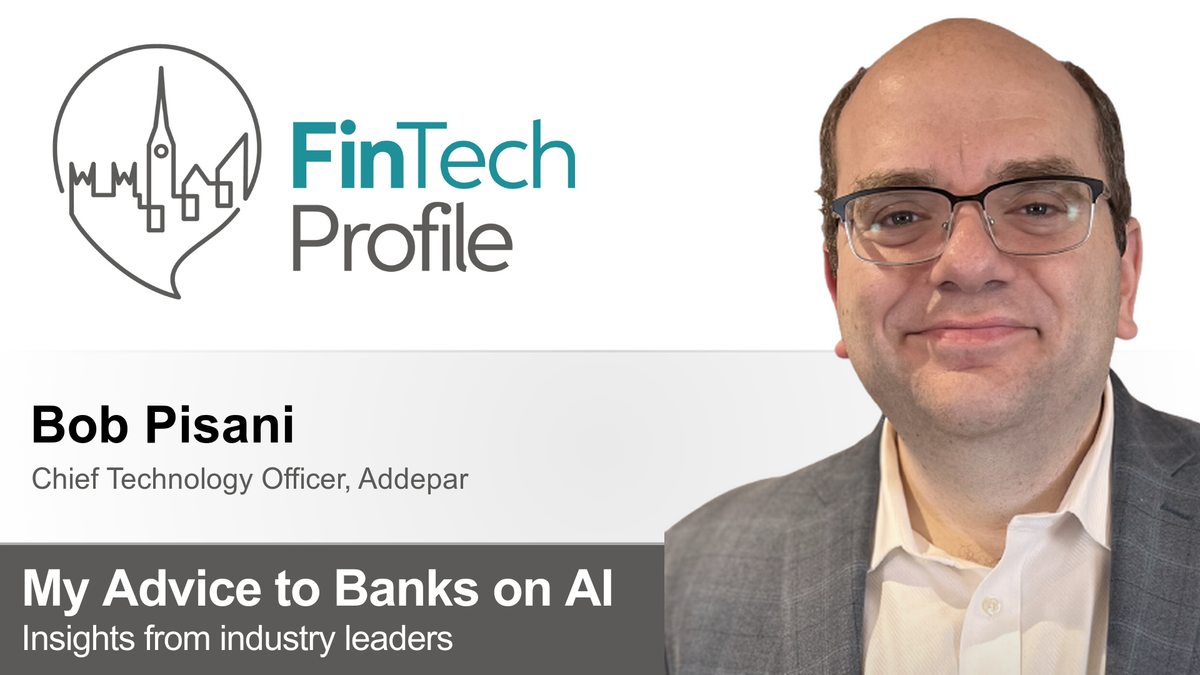
I spoke with Bob Pisani, Chief Technology Officer at Addepar, who leads the engineering, product and design teams for the global data and AI platform. With more than five years on Addepar's leadership team, Bob brings a grounded perspective on where banks are getting AI right — and where they're avoiding the hardest decisions.
Over to you Bob - my questions are in bold:
Can you give us an introduction to you and an overview of your organisation?
As Chief Technology Officer at Addepar, where I've been part of the leadership team for more than five years, I lead our engineering, product and design teams. Together they make up the company's research and development organisation — representing roughly half of Addepar's global workforce.
Addepar is a global data and AI platform empowering investment professionals to turn complex financial information into actionable intelligence. Addepar unifies portfolio, market and client data in a total portfolio view and delivers AI-powered insights within investment and client workflows. More than 1,400 firms in nearly 60 countries – including family offices, IFAs and private banks – use Addepar to manage and advise on nearly $9 trillion in assets.
If you were advising a bank CEO today, what would you say is the single biggest mistake they're making with data and AI?
The biggest mistake I see is firms trying to bolt AI onto fragmented data environments.
There is a lot of focus on models and tools, but far less attention on the underlying data architecture. In banking and wealth management, data is often spread across systems, asset classes and geographies, with a large portion still arriving in unstructured formats such as PDFs. When AI is layered onto that environment, it tends to amplify fragmentation rather than solve it.
A related issue is the proliferation of point AI solutions. Many organisations are experimenting with standalone tools alongside their core systems, but those tools rarely have the context required to understand real portfolios, workflows or governance requirements. In a high-stakes industry like financial services, AI operating outside a trusted data environment can introduce as much risk as value.
AI is only as useful as the data and context it operates on. To scale responsibly, systems must be accurate, explainable and grounded in trusted information. The real opportunity is not simply adopting AI tools, but embedding intelligence into the platforms where data, permissions and workflows already live.
Banks that treat their data foundation as strategic infrastructure will get the most value from AI. When data is unified and governed, AI can move beyond experimentation and support real decision-making — surfacing insights faster and helping firms serve clients with greater confidence.
What's one AI or data capability banks should prioritise in the next 12–18 months, and why?
Banks should prioritise embedding AI directly into everyday workflows so it delivers consistent, practical value rather than acting as a separate tool people occasionally consult.
Many firms are experimenting with copilots or standalone chat interfaces. Those can be useful for exploration, but the real ROI comes when intelligence is integrated into the systems where teams already work and where trusted data and governance already exist.
Natural language is becoming an important interface in this shift. It allows professionals to interact with complex financial data by expressing intent in their own words rather than navigating multiple dashboards and reports.
The real step change comes when natural language is paired with agentic workflows. AI can coordinate tasks across systems, surface relevant insights proactively and move routine processes forward while keeping humans firmly in the loop.
That creates real operating leverage: teams spend less time gathering and reconciling information and more time applying judgment and offering tailored service to clients.
Where do you see banks overestimating AI, and where are they underestimating it?
The current AI narrative is being shaped as much by headlines as by reality. We frequently see claims that AI will replace entire professions or drastically reduce workforces. In financial services, that framing misses the point. The real transformation is not about removing humans — it is about changing how they work.
Where banks often overestimate AI is in its ability to replace human judgment. Large language models can generate plausible answers or generic model portfolio allocations in seconds, which can create the impression that advisory work is becoming obsolete.
In reality, investment advice depends on far more context than a model alone can access. Advisers must understand a client's full portfolio across public and private assets, alongside liquidity constraints, tax considerations, trust structures and long-term objectives. They also must help clients navigate emotionally charged decisions during volatile markets.
Where banks underestimate AI is in its ability to transform operational workflows. When AI lives within trusted data environments, it can analyse portfolios in seconds, surface risks or exposures that might otherwise take hours to uncover and automate many manual processes that consume investment teams' time.
AI's greatest impact will not be replacing advisers — it will be giving them operating leverage. Machines process information at scale, while humans apply judgment, context and responsibility. The firms that succeed will combine those strengths rather than viewing them as substitutes.
What does "good" actually look like when AI and data are working well inside a bank?
"Good" means AI is embedded in the bank's operating model — not sitting off to the side as a tool. Increasingly, that means leveraging agents that can move intelligence into action across workflows.
Today, many institutions still run front, middle and back offices across separate systems with different data and processes. That fragmentation slows decision-making and forces teams to reconcile information before they can act.
When data and AI are working well, AI becomes the connective tissue across those functions. It reconciles and structures data continuously, allowing insights to flow seamlessly from portfolio analysis to risk monitoring, reporting and client conversations.
The next step is turning those insights into execution. Agentic workflows should surface emerging risks and opportunities, recommend next steps and coordinate the work required to act on them. This could include analysing a portfolio exposure, recommending a rebalance or preparing materials for a client conversation. Intelligence doesn't just inform decisions; it helps move work forward across teams while keeping humans firmly in the loop.
The result is a more coordinated organisation: teams work from the same trusted foundation, spend less time stitching systems together, and more time hand delivering better outcomes for clients.
What's the hardest AI or data decision bank executives are avoiding right now, and why?
The hardest decision many bank executives are avoiding right now isn't whether to adopt AI — that conversation is largely settled. The real question is where AI should actually live within the organisation.
Many institutions are still experimenting with point solutions or bolting large language models onto existing systems. That can create the appearance of progress, but it rarely delivers meaningful impact because the intelligence sits outside the core data and workflows of the business.
The harder decision is committing to a platform-level data architecture where AI is embedded directly into the systems where teams already operate. When intelligence sits inside that environment — with trusted data, permissions and governance — it can understand portfolio context, support real workflows and scale across the organisation.
It also requires choosing long-term technology partners carefully. AI capabilities will evolve rapidly, so institutions need platforms that are continuously investing in infrastructure, research and development so it can scale with the business.
The institutions that address this strategically will move beyond experimentation and start seeing real operational impact — with data, agentic workflows and intelligence working together to help teams serve clients more effectively.
Thank you Bob! You can connect with Bob on his LinkedIn Profile and find out more about the company at addepar.com.