My Advice to Banks on AI: Amit Dua of SunTec Business Solutions
Amit Dua, President at SunTec Business Solutions, shares practical advice for bank CEOs on avoiding common AI mistakes and prioritising decision intelligence over deployment.
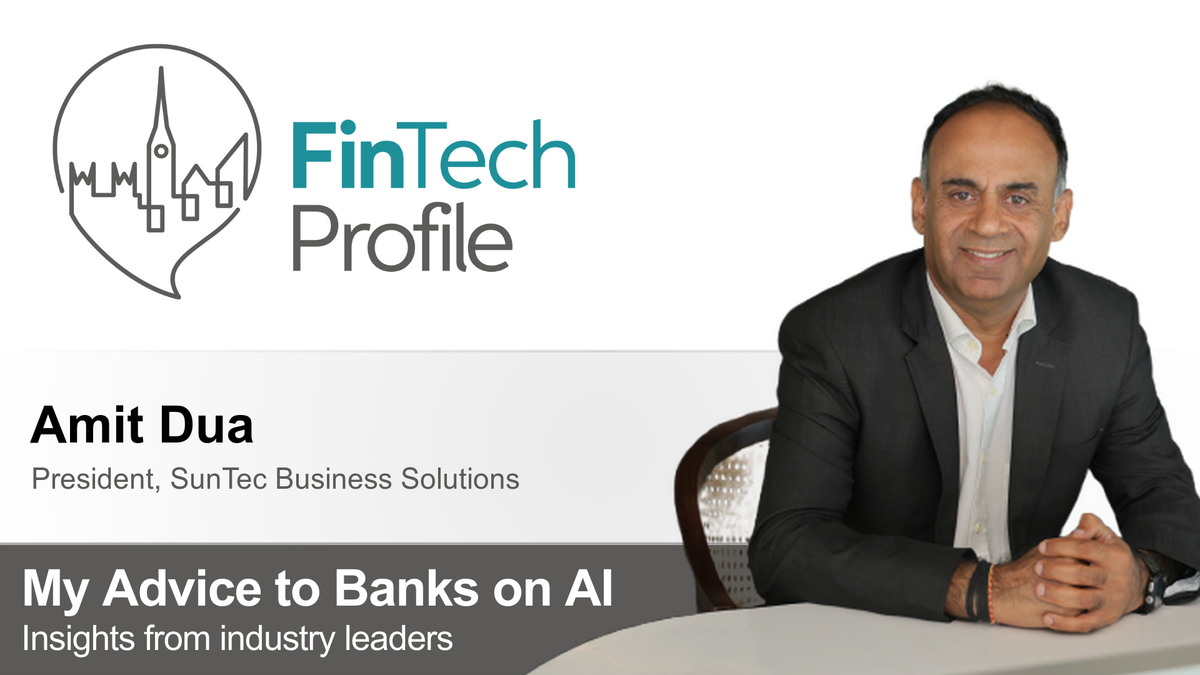
I spoke with Amit Dua, President at SunTec Business Solutions, who brings over three decades of experience helping financial institutions drive business and technology change across global markets. In this Q&A, Amit shares his practical advice for bank executives on AI and data strategy, from avoiding common mistakes to prioritising the capabilities that will actually move the needle on revenue and customer experience.
Over to you Amit - my questions are in bold:
Can you give us an introduction to you and an overview of your organisation?
I'm Amit Dua, President at SunTec Business Solutions, leading global Growth, Delivery and Support functions. That includes sales, business development, client delivery and engagement, strategic alliances, global support, and industry solutions. Based in Dubai, I bring over three decades of experience helping financial institutions drive business and technology change, from digital transformation and customer experience modernisation to revenue optimisation, across Europe, the Americas, Asia, the Middle East, Africa, and Australia. I also contribute thought leadership articles and speak at industry forums on banking technology, digital banking, customer experience, and core transformation.
SunTec is a global leader in revenue management, helping banks and enterprises modernise how they price, package, bill, and monetise products and services. Our SunTec Xelerate suite unifies pricing, billing, offer management, loyalty, taxation, and e-invoicing to reduce revenue leakage, speed up monetisation, and enable personalised experiences. Cloud-native and API-first, SunTec Xelerate integrates with existing systems to support transformation without disruption. Trusted by clients in 50+ countries, SunTec powers revenue- and value-led experiences for millions of end customers worldwide.
If you were advising a bank CEO today, what would you say is the single biggest mistake they're making with data and AI?
Everyone is talking about AI right now, but far fewer banks are using it as a genuine business enabler.
Yes, the upside is real. We are seeing an upside in efficiency ratio improvements of up to 15 percentage points for banks that fully integrate AI across operations. The problem is that many CEOs are still treating AI as a technology programme, not as a capability that sharpens customer relevance and improves monetisation, powered by trusted data.
What I'm seeing in the market is heavy investment in tools, pilots, and models, layered onto fragmented data, siloed processes, and legacy decision-making. The outcome is predictable: AI optimises at the edges, automation here, productivity there, without materially moving the needle on what matters most: better offers, faster time-to-market, cleaner revenue, and more meaningful customer experiences.
The real value of AI doesn't come from algorithms alone. It comes from connected, contextual data that mirrors how the bank makes money, products, pricing, customer behaviour, risk, and revenue flows. Without that foundation, AI simply scales the existing inefficiencies instead of improving decisions.
The CEOs who will win with AI are the ones who stop asking, "How do we deploy AI?" and start asking, "Where should AI advise, decide, and act across our core customer and monetisation journeys?" Then they align data, governance, and accountability around those business outcomes.
What's one AI or data capability banks should prioritise in the next 12–18 months, and why?
If banks had to prioritise just one AI-driven capability in the next 12–18 months, it should be decision intelligence embedded directly into core business workflows.
Many banks already have vast amounts of data and advanced analytics, but insights often sit in dashboards or reports, disconnected from where day-to-day decisions are actually made. The next leap is to use AI to continuously advise and augment decisions in real time, from pricing and offer design to credit, servicing, and retention.
This matters because the competitive gap is no longer about who has more data, but about who can turn insight into action fastest and most consistently. Decision intelligence combines AI models with business rules, context, and governance, allowing banks to respond dynamically to customer behaviour, market conditions, and risk signals, without losing control or explainability.
Over the next 12–18 months, banks that embed AI-driven decisioning into their operational fabric will see faster time-to-market, more relevant customer propositions, and improved revenue. Those that don't risk having sophisticated AI capabilities that look impressive on paper but deliver limited business impact.
Where do you see banks overestimating AI, and where are they underestimating it?
Banks tend to overestimate AI's ability to replace human judgement and underestimate its power to reshape everyday decisions.
On the overestimation side, there's still a belief that AI can fully automate complex, high-stakes decisions, whether in credit, risk, or compliance, without sufficient human oversight. In reality, in a highly regulated environment like banking, AI works best as an advisor and augmenter, not an autonomous decision-maker. Overconfidence here can lead to trust issues, regulatory pushbacks, and brittle outcomes.
Where banks underestimate AI is in its ability to quietly but profoundly improve how thousands of small, routine decisions are made every day. Embedded correctly, AI can continuously fine-tune pricing, personalise offers, optimise servicing costs, and flag revenue or risk anomalies in real time. These incremental improvements compound into significant business impact, often with lower risk, and faster ROI than headline-grabbing use cases.
The most effective banks are learning to deploy AI where it augments human judgement at scale, combining explainable models, business rules, and domain expertise, rather than chasing fully autonomous intelligence before the organisation and data are truly ready.
What does "good" actually look like when AI and data are working well inside a bank?
When AI and data are working well inside a bank, they become largely invisible, but the outcomes are unmistakable.
"Good" looks like decisions being made faster and with greater confidence because insight is embedded directly into everyday workflows, not trapped in dashboards or after-the-fact reports. Relationship managers, product teams, and operations staff are continuously guided by AI-driven recommendations that are explainable, contextual, and aligned to business objectives.
It also looks like consistency. Customers receive fair, relevant pricing and offers across channels; risks are identified early; revenue leakage is reduced; and exceptions are flagged before they become issues. Importantly, humans remain in control, AI advises, humans decide, with clear governance and accountability built in.
At an organisational level, good AI means the bank can test, learn, and adapt quickly. New products can be priced and launched faster, propositions can be refined in near real time, and leadership has a trusted, single view of performance across customers, products, and regions. In short, AI stops being a series of projects and starts functioning as a core decision layer that quietly improves outcomes across the bank.
What's the hardest AI or data decision bank executives are avoiding right now, and why?
The hardest AI and data decision bank executives are avoiding right now is choosing where not to use AI and being explicit about it.
Most leadership teams are comfortable approving AI investments and pilot programmes, but far less comfortable drawing clear boundaries around which decisions should remain human-led, which should be AI-advised, and which, if any, can be automated. That hesitation often comes from a mix of regulatory uncertainty, reputational risk, and fear of getting it wrong in public.
The paradox is that avoiding this decision increases risk. Without clear intent and governance, AI proliferates in pockets across the organisation, using inconsistent data, models, and assumptions. That makes outcomes harder to explain, control, and defend to regulators, boards, and customers alike.
The banks making progress are those willing to take a principled stance: defining decision rights upfront, investing in explainability, and aligning AI use to business and ethical objectives. It's a difficult conversation, but it's foundational. Until executives make this call, AI remains experimental rather than strategic.
Thank you Amit! You can connect with Amit on his LinkedIn Profile and find out more about the company at www.suntecgroup.com.