Matic Jug, Head of Growth, ICONOMI
Matic Jug discusses scaling regulated crypto investing across Europe, behavioural growth systems, and why digital assets are moving from speculation to structured finance.
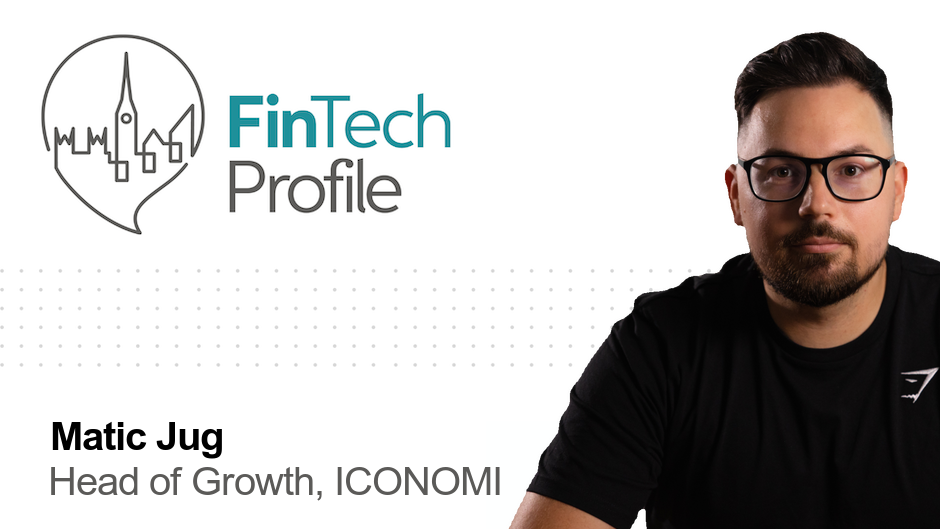
Today I'm delighted to speak with Matic Jug, Head of Growth at ICONOMI, a regulated European digital asset platform.
As crypto investing matures from speculation to structured finance, Matic shares insights on building growth systems under regulatory constraints, solving behavioural bottlenecks, and why the next generation of fintech will be won by those who understand investors deepest.
My questions are in bold - over to you Matic:
Who are you and what's your background?
I'm Head of Growth at ICONOMI, where I spend my days building acquisition engines, fixing behavioural bottlenecks in investing, and scaling a regulated fintech platform across Europe.
I didn't follow the traditional "finance professional → fintech" route. I learned growth by building things, breaking things, and scaling things that shouldn't have scaled. Before ICONOMI, I worked across SaaS, e-commerce, crypto, and AI projects, where I specialised in CRO, performance strategy, and product-led growth. That mix gave me a deep understanding of how people make decisions, and more importantly, where they don't.
FinTech became the natural destination because it's the most behaviour-driven arena in tech. Money is emotional. Markets are irrational. Funnels leak for psychological reasons, not technical ones. And in a regulated environment, you can't brute-force growth; you have to build systems that work under constraints. That challenge hooked me immediately.
At ICONOMI, my role is part detective, part operator. I map how investors behave, where trust is earned or lost, and how to turn interest into actual capital allocation, whether through B2C funnels or the B2B engine. I'm also deeply involved in product direction, narrative strategy, and creating AI tools that automate everything from market commentary to onboarding flows.
So who am I?
A growth architect with a behavioural lens, a systems thinker in a chaotic market, and someone who believes the next generation of fintech will be won not by whoever yells the loudest, but by whoever understands investors the deepest.
If anything, I didn't choose fintech; fintech was the first industry where my obsession with behaviour, clarity, experimentation, and compound effects finally had a home.
What is your job title and what are your general responsibilities?
I'm the Head of Growth at ICONOMI, responsible for driving user acquisition, activation, retention, and revenue across both our B2C and fast-scaling B2B segments.
My role sits at the intersection of data, product, and marketing: I design and optimise our growth systems, build funnels that convert intent into invested capital, lead market expansion, and shape how ICONOMI communicates value to investors.
I work closely with product, compliance, engineering, and leadership to ensure that every touchpoint, from onboarding to strategy selection to long-term engagement, compounds into predictable, scalable growth for the platform.
Can you give us an overview of your business?
ICONOMI is a regulated European fintech platform that makes crypto investing simple, transparent, and professionally managed. Instead of expecting users to time markets or pick individual assets, ICONOMI offers diversified portfolios run by experienced traders, analysts, and asset managers who execute the research, rebalancing, and risk management on behalf of their followers.
Our product is intentionally straightforward:
Users choose a strategy → deposit → the strategist actively manages the portfolio → results update in real time.
We operate on a blend of:
- AUM-based fees,
- performance fees (for strategists), and
- B2B partnership revenue.
Demand has grown sharply from two sides:
- Retail investors who want exposure to crypto but prefer expert management instead of DIY trading.
- B2B partners from financial advisors to boutique asset managers who see ICONOMI as the fastest compliant way to add digital assets to their offering.
As the industry moves from speculation to structured, regulated investing, ICONOMI sits in the sweet spot: simple for beginners, powerful for professionals, and built to scale into the broader securities world as regulation evolves.
Tell us how you are funded?
ICONOMI has gone through several stages of funding as the company matured.
The early phase was backed by private investors who believed in bringing professional asset management into the crypto space long before it was mainstream.
Since then, the company has transitioned into a revenue-driven, operationally sustainable model, where growth is primarily fuelled by platform fees, strategist performance fees, and our expanding B2B partnerships.
What's the origin story? Why did you start the company? To solve what problems?
ICONOMI was founded on a simple observation: crypto was full of potential, but the experience of investing in it was broken. For most people, the space felt too technical, too risky, and too time-consuming, a market built for insiders, not everyday investors.
People didn't struggle because they lacked interest; they struggled because they lacked infrastructure. Wallets, seed phrases, dozens of exchanges, and the constant need to rebalance.
The founders believed there had to be a better way. If traditional finance has professional fund managers, why couldn't crypto have the same? If retail investors trust experts with stocks and bonds, why shouldn't they be able to do the same with digital assets?
This became ICONOMI's mission: To take the complexity out of crypto and replace it with professionally managed, transparent, easy-to-use investment strategies.
Instead of forcing people to become traders, we let them follow managers who already know how to operate in the market. Instead of endless DIY investment decisions, we built a platform where a single deposit gives exposure to a diversified, actively managed portfolio.
The problem we set out to solve still shapes our product today:
- Crypto is hard; we make it simple.
- Market timing is stressful; we automate the heavy lifting.
- Self-custody is confusing; we handle security at an institutional level.
As the market matured, a second problem emerged:
- Traditional wealth managers and financial advisors needed a compliant way to offer digital assets.
- ICONOMI expanded into B2B to become that bridge, giving institutions a turnkey, regulated platform to onboard clients into crypto strategies without building infrastructure themselves.
At its core, ICONOMI exists to democratise professional digital-asset investing: making it accessible, transparent, and intuitive for everyone from first-time investors to established advisory firms.
Who are your target customers? What's your revenue model?
ICONOMI serves two core customer groups.
1. Retail Investors
Everyday investors who want exposure to crypto without needing to trade, research, or rebalance portfolios themselves. These are people who:
- don't have time to monitor markets
- prefer expert management over DIY trading
- want transparency and simplicity
- value long-term, diversified strategies over speculation
For them, ICONOMI replaces stress, complexity, and information overload with a managed investment experience.
2. Financial Advisors & Wealth Managers
Our fastest-growing segment. The B2B customers are financial advisors, asset managers, and brokerages that want to offer digital-asset exposure to their clients without building infrastructure, custody, or compliance frameworks themselves.
For them, ICONOMI serves as a plug-and-play digital-asset investing platform:
- They onboard clients easily
- Manage allocations professionally
- Keep full transparency
- Maintain regulatory alignment
- Avoid building their own trading, reporting, or custody systems
This segment has shown exceptional traction, becoming one of ICONOMI's most stable and predictable growth engines.
ICONOMI generates revenue through a combination of:
1. AUM-based fees
We charge a small fee based on assets managed on the platform. This aligns ICONOMI's success with the long-term growth of users' portfolios.
2. Performance fees (for strategy managers)
Some strategists charge a fee when they outperform benchmarks. We facilitate this structure transparently.
If you had a magic wand, what one thing would you change in the banking and/or FinTech sector?
Currently, both banks and fintechs can conceal a significant amount of risk and complexity behind PDFs, jargon, and tick-box consent. As long as the disclaimer exists somewhere, the box is "legally" checked even if the average customer has no real idea what they've agreed to, what they're paying, or how bad things can get in a downturn.
I'd change one thing: You're not allowed to sell or advertise a financial product until you can prove that normal people actually understand it.
What is your message for the larger players in the Financial Services marketplace?
Stop treating digital assets as a side experiment and start treating them as a client expectation. Your clients will get digital-asset exposure with or without you. The only decision left is whether you want to keep those relationships or hand them to fintechs by default.
Where do you get your Financial Services/FinTech industry news from?
I follow FT, Bloomberg, and The Economist. For fintech innovation, FinTech Futures, TechCrunch, and Sifted are my go-tos. And for crypto-native insights, I rely on The Block, Messari, and Bankless, plus a curated mix of analyst newsletters and on-chain data dashboards.
Can you list 3 people you rate from the FinTech and/or Financial Services sector that we should be following on LinkedIn, and why?
Top of my list at the moment would be Michael Taylor.
What FinTech services (and/or apps) do you personally use?
- My default for everyday payments, travel spending, and instant transfers. It's the closest thing to a truly modern banking UX, and it sets the bar for how financial products should feel.
- For managed crypto exposure and testing user experience weekly. I use it the same way our customers do — following strategies, monitoring behaviours, and ensuring the product delivers clarity and trust at every step.
What's the best new FinTech product or service you've seen recently?
One product that really impressed me recently is Nubank's investing & financial super-app experience.
What I like about it is how they've taken what used to be fragmented (banking, credit, savings, and investing) and wrapped it into a single, genuinely user-friendly interface for millions of people who were historically underserved by traditional banks. It's a good example of fintech not just adding features, but actually changing who gets access to quality financial services and how simple that experience can be.
Finally, let's talk predictions. What trends do you think are going to define the next few years in the FinTech sector?
1. Digital assets go from side-bet to core allocation.
Not in the meme-coin sense, but in a very boring, institutional way: tokenised real-world assets, regulated crypto exposure, and MiFID-style frameworks wrapping what used to live on offshore exchanges. The line between "brokerage," "bank," and "crypto platform" will blur. From my side of the table, the winners will be the ones who make regulation a feature of the UX, not a footnote in the footer.
2. UX shifts from products to decisions.
Most apps still throw features at users and hope they self-navigate. The next wave will be: "Here is the next best step for you, right now." Automated allocation, nudges based on behaviour, and interfaces designed around outcomes instead of menus. In practice, that means fewer dashboards and more "do this one thing" flows.
3. Distribution moves to advisors, creators, and embedded finance.
Banks won't be the only front door. Wealth managers, niche platforms, and even creators with real trust will act as distribution layers on top of regulated infrastructure. One good advisor or partner can bring in more high-intent AUM than a million low-quality clicks.
We'd like to thank Matic for taking the time to share his insights with us. You can connect with him on LinkedIn and learn more about ICONOMI on their website.