Marc Jones, Chief Technology Officer, Pleo
Marc Jones discusses AI's transformative potential in fintech, the evolution from expense management to financial intelligence platforms, and why human judgement remains irreplaceable.
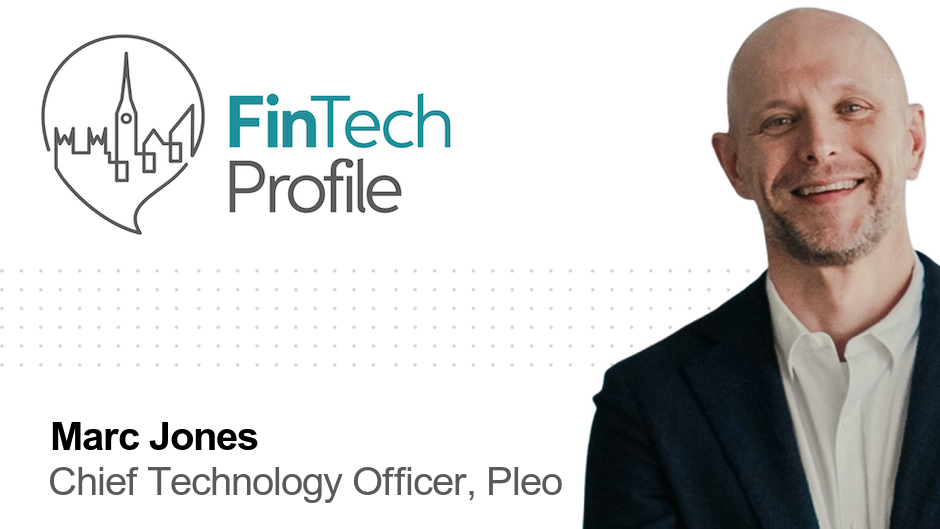
Today we're delighted to speak with Marc, the Chief Technology Officer at Pleo. With three decades of experience spanning cloud infrastructure, digital banking, and insurtech, Marc brings a unique perspective on how AI is reshaping financial services and why the next competitive advantage lies in amplifying human expertise rather than replacing it.
As always, my questions are in bold - over to you Marc:
Who are you and what's your background?
I'm Marc Jones, the recently appointed Chief Technology Officer at Pleo. I've spent my career at the intersection of cloud, SaaS and financial technology. Before joining Pleo, I was CTO at Alkami Technology in the U.S., a multi-tenant digital banking platform for credit unions and small to mid-sized banks. Over five and a half years, we grew from about five to over thirteen million users and fully replatformed onto AWS.
After that, I spent three years at Shift Technology in Paris, an insurtech company using AI to help insurers make better decisions around fraud. There, I focused on scaling a global business and driving standardisation on Microsoft Azure across multiple regions.
Earlier in my career, I spent a decade "building the cloud" at Rackspace, SoftLayer and later IBM, where I worked on cloud integration and advised large enterprises on cloud strategy. That experience gave me the technical foundation I've carried through my roles in fintech and now into my work at Pleo.
What is your job title and what are your general responsibilities?
As the Chief Technology Officer at Pleo, I'm responsible for leading our entire technology organisation. A big part of the role is working in close partnership with Product to deliver our solutions to market - what I think of as product engineering, where we build and evolve the product portfolio our customers use every day.
I also oversee platform engineering, which focuses on the core services and infrastructure that underpin everything we do and enable our product teams to move quickly and reliably. Beyond that, I lead our enterprise engineering function, which partners with teams like GTM, Finance, and People to ensure the business has the right internal systems and technology to operate effectively.
Finally, I'm accountable for our security and fraud engineering teams, making sure we maintain a secure platform and continuously strengthen our capabilities around fraud prevention. Together, these areas form the foundation that allows Pleo to build, scale, and support great products for our customers.
Can you give us an overview of your business?
Pleo is all about making business spending straightforward. We give companies modern tools - smart company cards, automated expense reporting, real-time insights - that remove friction from how money moves through an organisation. At its core, the platform is designed to save time, reduce operational overhead, and give teams much better control and visibility around spend.
When you take the complexity out of spend management, you free businesses up to focus on what actually moves them forward: growing, innovating, and serving their customers.
Tell us how you are funded?
Since 2017, the company has secured around DKK 2.7B in venture funding (about EUR 370M / USD 400M). That backing has been critical in giving us the runway to expand our technology foundation, strengthen the organisation and scale at the pace the market demands. It's the kind of support that allows us to think bigger and move faster as we continue building out the platform, evolving from our early days in simple expense management to what is now a platform for full financial intelligence, bringing card payments, subscriptions, invoices and transfers together all in one place.
What's the origin story? Why did you start the company?
Pleo was started by Jeppe Rindom and Niccolo Perra with a straightforward goal: remove the friction that comes with traditional expense management. They saw how much time and energy companies were wasting on manual processes, and set out to build a smarter, more automated way to handle spend.
What the team created is a platform that takes care of the heavy lifting - capturing receipts, and categorising expenses. For employees, it means they can handle spending in a way that's far more intuitive and independent. For finance teams, it brings the control, transparency and operational efficiency they've been asking for.
Finance leaders are now expected to act as strategic partners - but many are still operating in the dark. To lead effectively, they need connected tools, integrated systems and real-time visibility.
Instead, most finance teams are held back by fragmented platforms, manual data entry, and unclear cash flow. Time is wasted chasing receipts, reconciling accounts, and reporting on the past - time that should be spent forecasting and driving the business forward. This gap is one of the biggest constraints on business growth, and it's exactly where Pleo's opportunity lies.
Pleo addresses this by uniting every payment and account in one place. Our platform helps finance teams - from CFOs to executives - integrate accounting, manage compliance, navigate uncertainty, maintain real-time visibility across entities and adopt AI with confidence.
Ultimately, Pleo is about enabling a healthier way of working - one that supports autonomy, encourages innovation and gives organisations the tools to move faster and focus on what actually drives impact.
Who are your target customers? What's your revenue model?
Our core customers span from small and medium-sized businesses to mid-market organisations. We operate on a subscription model, where companies pay based on their usage and team size. It's a straightforward structure that scales with our customers as they grow.
If you had a magic wand, what one thing would you change in the banking and/or FinTech sector?
I'd get rid of the friction and complexity that still show up in everyday financial experiences.
For most people, managing money is harder than it needs to be. It's spread across too many apps, wrapped in confusing language, slowed down by clunky processes, and full of repeated checks that don't feel connected to any real benefit. People don't care which bank, network, or payment rail is behind the scenes. They just want things to work, quickly and clearly.
If we can make identity, onboarding, payments, and money management feel more intuitive and connected, people would spend far less time stressing about finances and more time just getting on with their lives.
The biggest opportunity in fintech isn't adding more features — it's making money feel simple, reliable, and genuinely human. That is what we're doing at Pleo.
What is your message for the larger players in the Financial Services marketplace?
If I look back over my 30 years in tech, I've seen a lot of major innovation cycles - dot-com, cloud, mobile, crypto - but nothing has moved as fast or has the potential to reshape how we operate quite like AI. And what's different this time is that the value is tangible right now. The question isn't if it will impact your business, but how you choose to leverage it.
My message to the industry is this: don't think of AI as a silver bullet or a simple cost-cutting tool. Yes, it can drive efficiencies, but if you only view it through the lens of reducing headcount or shaving expenses, you're missing the bigger opportunity. The real potential is in how it enables teams to work differently - more productively, more creatively, and ultimately in ways that can unlock new growth.
AI should push you to rethink processes, evolve how your organisation operates, and challenge assumptions about what your teams spend their time on. If you approach it as an enabler of productivity and innovation rather than just a lever for savings, you're going to get a fundamentally different - and far more meaningful outcome.
Where do you get your Financial Services/FinTech industry news from?
Most of what I read is actually rooted in broader technology and industry trends, but that naturally gives me good visibility into what's happening across financial services and fintech. I rely on the usual suspects - TechCrunch, The New Stack, Wired - because they tend to surface both the high-level shifts and the early signals of where the market is heading.
One of my biggest sources, though, is Hacker News from Y Combinator. It's a wide-ranging feed that covers everything from deep technical discussions to historical perspectives, and I find it incredibly useful for staying grounded in how technology is evolving more broadly. Even if the content isn't always fintech-specific, it helps me connect the dots on where the industry is going.
Can you list 3 people you rate from the FinTech and/or Financial Services sector that we should be following on LinkedIn, and why?
- Patrick Collison
Patrick is at the helm of Stripe, one of the most influential global payment platforms powering businesses of all sizes. His posts and thought leadership cover the future of payments infrastructure, fintech scale-ups, and real-world trends shaping digital commerce. - Jim Marous
Jim is one of the most widely followed voices in digital banking and fintech trends. He publishes deep dives on digital transformation benchmarks, banking innovation, customer experience, and future strategy. Useful for anyone who wants operationally relevant and data-driven insights rather than just high-level commentary. - Ghela Boskovich
Ghela is a firm fixture in the fintech world and always has an interesting take. Her strength is figuring out how we shake things up and drag old-school banking into the 21st century. A great person to follow for anyone who wants to stop talking about innovation and actually start doing it. Basically making sure fintech and banking innovations actually pay off in the real world.
What FinTech services (and/or apps) do you personally use?
I'll be honest, my personal stack is actually pretty boring. I'm not interested in tech for tech's sake, it's just a distraction. I only use tools that actually make my life simpler.
I primarily stick to my banking and credit card apps. As an expat, having a seamless digital experience is a total dealbreaker for me; it's the only way I can really leverage them effectively while living abroad.
Wise: This is a lifesaver for an expat like me. It makes handling both domestic and international transfers incredibly easy without the usual headache.
Pleo: Of course! It's my go-to for managing expenses.
What's the best new FinTech product or service you've seen recently?
There's so many great new ones out there that are new and exciting but I'm most excited by established apps extending into new areas with genuinely great user experiences - investing being a prime example. Robinhood stands out here; it's rare that I need to look elsewhere because the app makes the entire experience feel so seamless and accessible.
Finally, let's talk predictions. What trends do you think are going to define the next few years in the FinTech sector?
In 2026, the organisations that lead won't be the ones trying to replace people with machines - they'll be the ones using AI to amplify human judgement, not erase it. The next wave of competitive advantage will come from teams who understand that AI is a force multiplier for expertise, creativity and decision-making.
And with that shift, the most valuable talent won't be generic "prompt writers." It will be AI quality engineers, reliability specialists, and performance experts - the people who can probe a model's blind spots, harden it against hallucinations and hold it accountable when it is confidently wrong. They will shape the difference between AI that merely exists and AI that can be trusted.
The era of shipping AI prototypes for the sake of novelty is ending. Competitive advantage will now depend on intentional, customer-obsessed application. Embedding AI into a product is meaningless on its own. What matters is whether you deeply understand your customers' goals - and whether AI makes their experience faster, simpler, smarter, and more contextual.
We're heading into a defining split: Companies that use AI to deliver real insight and solve meaningful problems… and companies that simply decorate their products with the phrase "AI-powered." Customers will know the difference. The market will know the difference. In the end, depth beats noise. Insight beats features. Quality beats volume. Every time.
Thank you to Marc for sharing his insights with us here FinTech Profile. To learn more about Pleo and their approach to simplifying business spending, visit their website.