Lux Thiagarajah, Chief Commercial Officer, OpenPayd
Lux Thiagarajah discusses OpenPayd's universal financial infrastructure, bridging traditional banking with digital assets, and why tokenisation will define fintech's next era.
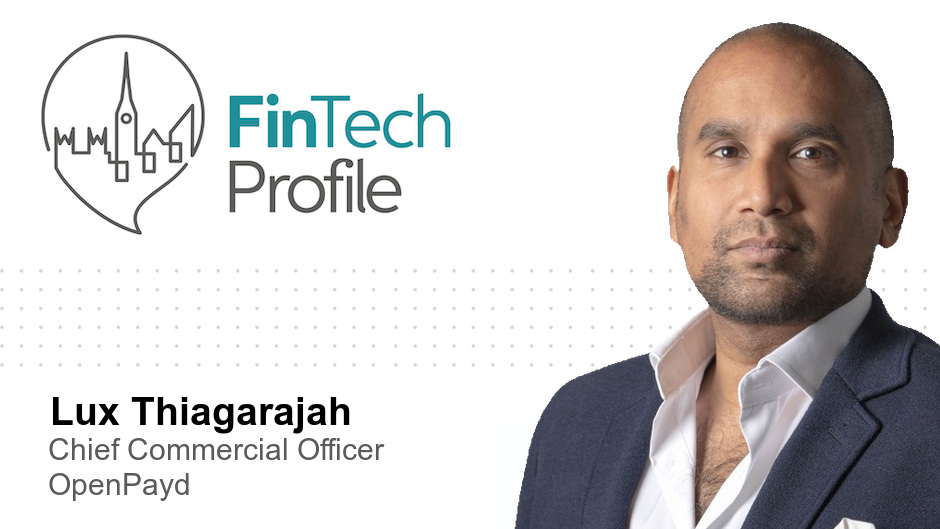
Today we're delighted to speak with Lux, Chief Commercial Officer at OpenPayd, who brings a fascinating journey from JP Morgan's FX trading desk to the forefront of payments and digital asset infrastructure.
In this interview, Lux shares insights on building universal financial infrastructure, the acceleration of stablecoin adoption, and why tokenisation of real-world assets will be one of fintech's defining trends.
My questions are in bold - over to you Lux.
Who are you and what's your background?
I studied at the London School of Economics with a clear ambition to work in investment banking, shaped by internships at HSBC and Lehman Brothers. After graduating, I joined the G10 FX trading desk at JP Morgan, where I spent eight years and ultimately ran the Japanese yen franchise for EMEA.
I then moved to the buy side, leading a macro proprietary trading desk at ADG and managing a team of four. After a decade in markets, I took time to reassess my direction. I wanted to be closer to innovation and pushing the boundaries of disruption, in an environment where decisions moved faster and individual impact was clearer.
That shift brought me into fintech in 2019. I had been interested in crypto since 2013, so exposure to digital assets was essential. I joined BCB and became Chief Revenue Officer, marking my first role in payments and crypto infrastructure.
In 2024, I briefly joined FalconX to establish an FX trading desk. While the role was compelling, it reinforced something important: I missed payments. That realisation led me to OpenPayd, where I am now Chief Commercial Officer, focused on building the next generation of global payments and universal financial infrastructure.
What is your job title and what are your general responsibilities?
As Chief Commercial Officer, my main responsibility is to ensure OpenPayd hits its growth and development goals. Within that remit, I oversee all revenue and client-facing teams - including our trading function (both FX and crypto), new business sales, relationship management, customer success, rev ops, and sales onboarding. I am lucky to have a phenomenal set of direct reports who oversee each department, and together we work as one to ensure OpenPayd continues to grow, win tier 1 business, and ensure our clients are happy and well taken care of.
Can you give us an overview of your business?
OpenPayd is building the universal financial infrastructure that enables businesses to move, manage, and embed money globally. Through a single API, we bridge traditional banking rails with digital assets, giving our clients seamless access to both fiat and stablecoin payments.
We operate under a robust and growing regulatory framework, holding multiple licences, including EMIs in the UK and Malta, a Canadian MSB, a Malta VFA, and a South African digital asset licence, with further licences to be announced soon.
We serve clients across a wide range of verticals, including digital assets, CFDs and FX brokers, financial institutions, gaming, and technology platforms. Across these sectors, we support their global payments and trading needs, helping them scale efficiently in both traditional and digital financial ecosystems.
Tell us how you are funded?
OpenPayd is fully bootstrapped.
What's the origin story of the company? What problems was it created to solve? How did you get involved in the company?
OpenPayd was built to solve a critical issue: the digital economy was evolving faster than the banking and payments infrastructure supporting it. Innovative businesses operating across borders and asset classes were left unbanked or underbanked because legacy systems couldn't deliver real-time, global, interoperable financial services. We set out to build the universal financial infrastructure that those companies needed, seamlessly blending technology and licensing to enable money to move instantly and compliantly across both fiat and digital assets.
Who are your target customers? What's your revenue model?
We're trusted by over 800+ enterprise clients globally, with the majority of those being across CFD, iGaming, digital assets and financial services verticals. We're focused on powering the growth of the digital economy, and our client base is growing all the time, with TON Foundation, VALR, currency.com and Kraken as just some of the clients we've announced in 2025.
If you had a magic wand, what one thing would you change in the banking and/or fintech sector?
Co-ordinated regulatory framework for digital assets globally. The US GENIUS Act and the full implementation of the EU's MiCA framework represent meaningful progress, but the next phase depends on more jurisdictions adopting closely aligned standards. Consistency across regions is what will ultimately give institutions the clarity and confidence needed for innovation to scale.
What is your message for the larger players in the Financial Services marketplace?
The wider banking sector has been slow to fully support and embrace digital assets. In contrast, a new generation of fintechs has secured the right licences and built compliance-first platforms designed specifically for the digital asset economy. As stablecoin adoption continues to accelerate, my message to banks and larger institutions is simple: start engaging now. The foundations are in place and the opportunity is already here.
Where do you get your Financial Services/fintech industry news from?
FT, X (Twitter), CoinDesk and Business Insider - it's important to keep up as the industry moves at a significant pace.
Can you list 3 people you rate from the fintech and/or Financial Services sector that we should be following on LinkedIn, and why?
- Karl Mohan (EVP, Financial Services at Crypto.com): Great insights on stablecoins and their role in the market.
- Markus Thielen (10x Research): Great trading research and commentary on digital assets.
- Raagulan Pathy (CEO at Kast, ex-Circle): A strong stablecoin advocate who is now building a stablecoin neobank.
What fintech services (and/or apps) do you personally use?
Kraken.
What's the best new fintech product or service you've seen recently?
Polymarket - the world's largest prediction market. It launched in 2020 and already has over 30 million global users.
Finally, let's talk predictions. What trends do you think are going to define the next few years in the fintech sector?
The tokenisation of real-world assets will be one of the defining trends of the next few years. As regulatory clarity improves into 2026, we will see institutional capital move decisively into the space. Tokenised assets offer 24/7 settlement, fractional ownership, global accessibility and programmable cashflows. These characteristics position tokenisation as a core bridge between traditional finance and digital assets, shifting it from a speculative concept to blue-chip financial infrastructure, following a similar trajectory to the evolution of stablecoins.
Thank you to Lux for sharing these insights with us. You can connect with Lux on LinkedIn and learn more about OpenPayd on their website.