Krish Subramanian, CEO and Co-founder, Chargebee
Krish Subramanian shares how Chargebee evolved from a Chennai apartment into a global billing and monetisation platform trusted by enterprises across AI, SaaS, and digital commerce.
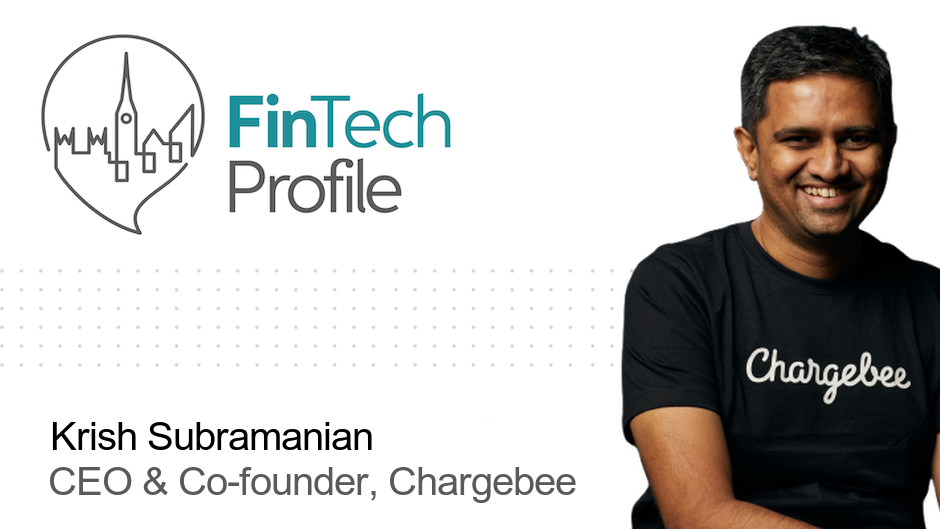
Today we're meeting Krish, CEO and Co-founder at Chargebee. They specialise in billing and monetisation infrastructure for enterprises and high-growth companies operating recurring revenue models across global markets.
Over to you Krish - my questions are in bold:
Who are you and what's your background?
I grew up in Chennai and studied at Bharathidasan University, where a group of us became friends over a shared curiosity for building things. I spent the next decade in engineering and product roles across companies like TCS, Cognizant, and MatexNet, learning how software gets built, shipped, and scaled for global businesses. Those years gave me a deep appreciation for the unglamorous parts of growth: legacy systems, edge cases, and the quiet discipline it takes to solve problems at scale.
But the real story starts earlier, around 2004, when Rajaraman Santhanam, my college friend, shared a spreadsheet. It wasn't a startup pitch; it was a savings plan. The idea was simple: let's start setting money aside now, so when the time comes, we can build something without waiting for permission or capital. That quiet intent set the tone for everything that followed.
We began in Chennai with a simple premise: billing isn't a feature — it's mission-critical infrastructure. That insight has guided our evolution into a global platform trusted by enterprises operating across multiple products, markets, and business models. We focus on the foundational problems every global business must solve at scale — pricing, billing, revenue recognition, and compliance — because these systems determine how companies grow.
Today, Chargebee operates across the US, Europe, and India, powering monetisation for thousands of businesses across AI, SaaS, media, fintech, and global subscription businesses. Our teams and customers span every major market, and the platform is built to handle enterprise-grade scale, audit requirements, and global operations.
What is your job title and what are your general responsibilities?
I'm the Co-founder and CEO of Chargebee. In the early days, my role was extremely hands-on. I wrote code, handled customer support, and spent most of my time learning from every conversation. As we grew, my focus shifted to building the team, shaping culture, and setting direction.
Today, I spend my time thinking about how we scale with clarity. I work closely with our leadership team to align on long-term strategy and make sure we're solving real customer problems. I still try to stay close to the ground, listening to founders, writing, and making time for breakfast conversations and community meetups. I'm most energised when I'm close to customers and teams, translating real-world friction into product and business decisions.
Can you give us an overview of your business?
Chargebee is a billing and monetisation platform for businesses with a subscription or recurring revenue model. We began by helping companies automate recurring billing, but quickly realised that billing is only one layer of a larger system. Modern enterprises need a monetisation platform that orchestrates pricing, packaging, usage, entitlements, revenue recognition, and compliance across regions and product lines. That means supporting everything from pricing experiments to revenue recognition, compliance, collections, usage metering, and more.
Over time, we've evolved into a platform that enables companies to build, test, and scale their monetisation strategy, just like they would with any other part of their product. Some of our most-loved capabilities include real-time usage metering, our flexible Product Catalogue, and business-user-friendly CPQ — tools designed not just to bill, but to help companies iterate pricing with confidence and precision.
Chargebee enables businesses to treat monetisation as a system: one that adapts in real time, unlocks revenue intelligence, and empowers business teams to move fast without waiting on engineering. Our vision for intelligent, adaptable monetisation was recently recognised in the 2025 Gartner® Magic Quadrant™ for Recurring Billing Applications, where Chargebee was placed furthest for Completeness of Vision. We believe that validates our point of view that billing systems shouldn't just process revenue, but unlock it.
We support companies ranging from fast-scaling AI leaders to multi-entity global enterprises across SaaS, media, fintech, and digital commerce — all of whom rely on Chargebee to run pricing and revenue operations across markets. What connects our customers is a shared need to reduce operational complexity without compromising on agility. Our composable platform gives them the flexibility to experiment, adapt, and scale monetisation without being boxed into rigid workflows.
In a world where pricing, packaging, and customer behaviour shift constantly, that flexibility becomes a strategic advantage. Chargebee helps shorten time-to-market for pricing changes, reduce developer dependency, and improve operational efficiency, so teams can focus on growing revenue, not maintaining spreadsheets or brittle code.
Tell us how you are funded?
Chargebee was bootstrapped in its early years, not out of necessity, but by design. From the beginning, we chose to live simply, grow steadily, and build with patience. We focused on long-term levers like product craftsmanship and content-driven inbound marketing to reach global customers from our small apartment in Chennai. That early discipline shaped our culture in ways that still guide us today.
In 2014, after proving that we could acquire and serve customers globally, we partnered with Accel and Tiger Global. Insight Partners, Sapphire Ventures, and Steadview joined in the years that followed. At each stage, we've been deliberate in choosing partners who understand that infrastructure companies compound slowly through deep customer empathy, not speed alone.
Even today, we operate with the same principles that got us here: invest where it creates long-term leverage, stay close to real customer problems, and resist the temptation to optimise for vanity metrics. That mindset has been our compass through market cycles, scale, and change.
What's the origin story? Why did you start the company?
From the start, our goal wasn't to chase a hot market or build a flashy product. We wanted to build something enduring. My cofounders and I had spent over a decade working with global customers, and we were ready to apply those learnings to a product of our own that solved a real, persistent problem.
We gravitated toward billing because it was universally painful. Every company needs to get paid, but few want to invest in building or maintaining their own billing infrastructure. And as the subscription model grew, we noticed that the complexity only multiplied across payments, invoicing, proration, revenue recognition, pricing experiments, and compliance.
We didn't start with all the answers. What we had was a strong instinct to listen. Our early customers pulled us deeper into the problem, and that curiosity shaped our roadmap. That's how Chargebee evolved from a recurring billing tool into a broader billing and monetisation platform. We never set out to become a category leader. We just stayed close to the problem, kept showing up, and let the depth of the pain point pull us forward. In hindsight, that patience and proximity became our moat.
Who are your target customers? What's your revenue model?
We serve businesses of all sizes with a recurring, usage-based, or hybrid revenue model, from high-growth startups to global brands in AI, SaaS, media, eCommerce, and more. We're especially well-suited for businesses navigating multi-product complexity, hybrid GTM motions, and frequent pricing iterations, whether it's a SaaS company expanding into usage-based billing, an AI company scaling rapidly, or a consumer brand testing freemium and new growth loops.
Thousands of businesses, including Zapier, Freshworks, DeepL, Lambda, Condé Nast, and Future, use Chargebee to manage their billing, monetisation, and revenue operations at scale. Our pricing model scales with our customers — from early-stage adoption to complex, multi-product enterprise deployments. Whether it's a fast-moving AI company or a public SaaS enterprise, our customers choose Chargebee to make pricing changes in days (not quarters) and to scale their revenue stack without scaling complexity. Our model is simple: we grow when our customers grow.
If you had a magic wand, what one thing would you change in the banking and/or FinTech sector?
I would accelerate the shift toward interoperable financial infrastructure. Enterprises and startups alike need systems that integrate cleanly across payments, compliance, data, and revenue workflows.
What is your message for the larger players in the Financial Services marketplace?
The most important infrastructure companies earn trust by compounding reliability over time. The strongest partnerships come from building for the next decade of financial innovation—not optimising for legacy constraints.
Where do you get your Financial Services/FinTech industry news from?
I gravitate toward sources that help me see the system behind the surface, especially when it comes to pricing, product strategy, or organisational culture. I gravitate to sources that unpack the behaviours and real decision-making behind pricing, product strategy, and financial systems design.
FirstRound has always been a favourite. Their ability to surface the real decision-making trade-offs (whether it's a pricing pivot or a team structure shift) has shaped how I think and how we build. Some of those ideas have stuck with me for years. Others show up in Slack threads or product reviews almost unconsciously.
Can you list 3 people you rate from the FinTech and/or Financial Services sector that we should be following on LinkedIn, and why?
- Simon Taylor, Founder of FintechBrainfood, has a rare ability to decode complex financial systems with builder-level empathy and analyst-level clarity. He's someone who sees around corners without losing sight of first principles.
- Oliver Smith, Head of Content at Money20/20 Europe, brings a journalist's eye for story, a founder's feel for momentum, and a deep respect for how products actually get built.
- Nik Milanović, who runs This Week in Fintech, has a systems thinker's mind and a designer's eye. He brings clarity to messy product problems, scaling lessons to early-stage teams, and a quiet depth to every conversation about building.
What FinTech services (and/or apps) do you personally use?
N26, which is similar to Revolut.
What's the best new FinTech product or service you've seen recently?
Spice Money, in India. It's not a new company, and I am sure there are many more in this space. It's a rural fintech company. It works via a large network of so-called "Adhikaris" (local agents / nanopreneurs) who serve rural and semi-urban customers — enabling banking and financial services in places where brick-and-mortar bank branches or ATMs are often absent. It's like a "financial inclusion engine", trying to bring essential banking/payment services and digital finance to underserved populations in rural India. It serves about 1.5M agents, who serve millions of people.
Finally, let's talk predictions. What trends do you think are going to define the next few years in the FinTech sector?
Pricing is becoming a real-time system, not a static model. The companies that win will be those that can iterate pricing, packaging, and entitlements as quickly as they ship product — across markets, products, and customer segments.
In the AI era, features move faster than finance teams can model. The winners will be the companies with adaptable monetisation infrastructure — systems that support new products, new markets, new pricing models, and new growth strategies without redesigning their revenue stack.
Thank you Krish. Connect with Krish on LinkedIn and read more about Chargebee at their website.