James Gozney, Founder & CEO, Aslan
James Gozney discusses revolutionising employee pay through payroll-embedded financial services, reducing costs for employers while increasing take-home pay.
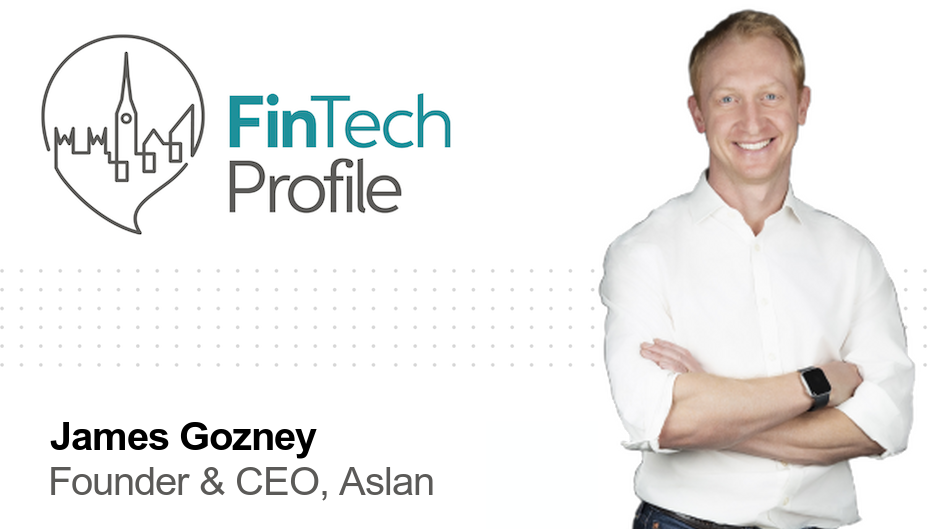
Today we're delighted to speak with James, Founder & CEO of Aslan, a UK fintech that's revolutionising how employees experience pay through a next-generation rewards platform. With employee compensation representing over £1 trillion annually in the UK alone and the cost of living crisis intensifying financial pressures, James shares his vision for embedding smarter financial services directly into payroll to increase take-home pay whilst reducing costs for employers.
My questions are in bold - over to you James:
Who are you and what's your background?
I'm James Gozney, Founder & CEO of Aslan. Aslan is a next-gen financial reward and benefits platform that aims to revolutionise how employees experience pay, with flexibility and rewards built in by design. In short, we increase employees' take-home pay.
I'm the son of a career diplomat so growing up I lived in Spain, Swaziland, Indonesia, Nigeria, Bermuda and the UK. And living in so many different places definitely instilled a love of adventure, and a strong appetite for discovery.
As a kid, I was inspired by Richard Branson's career, having the ability to turn business struggles into a business empire. This gave me a real focus to create something of my own.
After graduating from the University of Bristol with Economics & Management degree, I landed a role at JPMorgan in Corporate Finance, where I advised UK financial services companies after the global financial crisis. In 2014, I went on to co-lead the European Financial Services private equity investment team at the Abu Dhabi Investment Authority.
These experiences gave me a deep understanding of financial services from payroll to payments, while also offering direct access to decision-makers at every stage and scale.
What is your job title and what are your general responsibilities?
I'm the Founder and CEO of Aslan - a UK fintech that offers a next-gen rewards platform, app and cards that increase take-home pay as an employee benefit.
Beyond the core responsibilities of business strategy and keeping the lights on (fundraising!), I consider my job description to be professional problem-solving. I have a superb team. So in general, if something pops into my Slack it means it has got as far as it can elsewhere and someone has a problem that needs unblocking. But then when it does, I will get as hands-on as I need, and I am deeply involved across numerous areas of the business - product development, go-to-market execution, finance, legal… and a lot of HR!
To do that job well requires a strong and holistic understanding of how the business operates to innovate outdated payroll and financial benefit models, so that you can edge towards the employees and companies can feel secure and able to succeed.
I believe that true business success stems from leaders inspiring their teams, aligning them around a common purpose and transforming vision into execution.
Can you give us an overview of your business?
Aslan offers a next-gen employee rewards platform, app and a card programme that increases take-home pay for employees, and reduces cost for employers.
When employees' pay goes further, people are more financially secure and productive, and we save employers significant costs through reduced administration and tax efficiencies.
This need is driven by the outdated nature of many payroll systems and financial benefit, which is exactly why Aslan exists. Employee compensation is the leading concern of employees and the largest cost business face, amounting to more than £1 trillion a year in the UK alone.
Against this backdrop, Aslan is three times more cost-effective than an equivalent pay rise and is used 30x a month by our average user - demonstrating how valuable revamped financial benefits can be.
This value is reinforced through integration into Aslan's benefits via the Aslan card. As a mobile-first, card-based provider, we make it easier for employees to incorporate smarter, more effective finances into their daily routine.
Tell us how you are funded?
Aslan raised an angel round in 2023 to build out the product, launched in 2024, and then raised our first institutional round from Notion Capital, Redstone and experienced angel investors, which ended up being heavily oversubscribed and we capped at $5m on new equity.
Fundraising is hard! And I've been on the other side of the fence - it doesn't matter how good your business is, you're going to hear "no" a lot - many of those reasons will be fund specific and absolutely nothing to do with your business. But then when you do find the right folks to join you on your journey, that is very rewarding.
What's the origin story? Why did you start the company?
Aslan was born out of a personal frustration with rewards cards in the UK. The 'go-to' rewards card is Amex, which is only accepted by half the merchants in the country, many people then use a debit card for the rest earning no rewards, and a third card for overseas spend to avoid foreign exchange fees.
And then you add the societal challenge of reliance on credit cards and overdrafts. Almost a quarter of Amex's revenue is driven by interest charged to cardholders - $18bn! And more broadly, there are now as many credit cards as there are people in the UK - the majority of balances are not paid off in full each month. One-in-three in the UK goes into their overdraft every month, paying 40% interest. Isn't that wild.
The core issue here is payroll. How we deliver pay hasn't kept up with modern life. We live in an economy where everything is now on-demand, yet pay has actually become less frequent over time. Back in 1950, the majority of us were paid weekly, with cash in a brown paper envelope! And the credit card industry was tiny. But bills, expenses and life happen daily, so when most of us are paid monthly, naturally we seek credit solutions.
As above, the scale of the issue is gigantic. So after identifying the large gap in the market, I started discussing these issues directly with HR leaders, payroll teams, and most importantly, the employees who are directly impacted by financial strategy.
The need for these advancements is where my vision began, and Aslan entered the picture. With the cost of living on the rise and take-home pay becoming tighter, people have become more reliant on financial crutches which come with heavy interest that damages personal finances further.
I created Aslan to change that by embedding smarter, more efficient financial services directly into pay - helping stretch money further and reduce reliance on short-term loans. In turn, this supports financial health, reducing employee stress and leaving greater energy for workplace engagement and productivity, helping business operations thrive.
Who are your target customers? What's your revenue model?
We work with innovative employers who want to maximise their workforce's financial wellbeing, across a diversity of industries, from financial services to manufacturing. Our model is B2B2C - organisations offer Aslan to their employees as a benefit, and we charge them a straightforward per-employee, per-month subscription fee.
We then make money on any spend through the relationships we have with merchants. And virtually all of this we pass back to users in the form of tax-free rewards.
The value proposition is clear: employees gain access to rewards and everyday usage of the Aslan card, supported by partnerships with merchants and service providers, which boosts financial wellbeing and encourages smarter spending.
For businesses, this produces Return on Investment (ROI) in a number of ways - including enhanced employee fulfilment and engagement, as well as direct savings generated through reduced administration and tax efficiencies.
If you had a magic wand, what one thing would you change in the banking and/or FinTech sector?
I'd fix the inefficiencies integrated in the way we deliver pay. In response to rising costs, the market must find ways to supercharge compensation, without having to increase spend.
For example, following the recent rises in National Insurance, getting an additional £100 to an employee through payroll now costs UK businesses £180-250. In combination with tax hikes, both businesses and employees are struggling.
If we want employees to feel truly in control of their finances, and the answer to that isn't higher costs for employers - it's unlocking the full potential of payroll-embedded financial services.
What is your message for the larger players in the Financial Services marketplace?
Embedding financial services into employers' payroll leapfrogs the current account, and offers real-time data on the one thing we care about most when serving retail customers - employment history. We'll be expanding beyond transactions into the other verticals of financial services, with partners. The expanded margins could be gigantic - not just for small players, but large ones too.
Where do you get your Financial Services/FinTech industry news from?
I stay up to date via the Fintech Founders community's WhatsApp group, where like-minded professionals share a lot of ideas, commentary, surveys and articles - https://fintech-founders.org/. And, of course, I read The FT every day.
Can you list 3 people you rate from the FinTech and/or Financial Services sector that we should be following on LinkedIn, and why?
Yes, of course, Marcel van Oost, Ruben Dominguez Ibar and Seb Johnson. Marcel's Fintech-specific observations and education is very accurate in my opinion, while Ruben and Seb are generalists covering VC, but naturally cover a lot of Fintech.
What FinTech services (and/or apps) do you personally use?
Wise is fantastic - both professionally and personally. It stands out for its scalability, security and ease of use.
To get the best rates on our FX, we use Bound.co. Service is great, we are both backed by Notion Capital and the founders are great.
And I use Marcus for personal savings.
What's the best new FinTech product or service you've seen recently?
I actually three companies I'd like to highlight:
- Themis for Financial Crime investigation - we use this for our KYB workflows: www.wearethemis.com/uk
- Sequence for revenue operations mgmt: www.sequencehq.com
- 9Fin for market data: www.9fin.com
Finally, let's talk predictions. What trends do you think are going to define the next few years in the FinTech sector?
My hope and expectation is that payroll-embedded services will become mainstream, particularly when it comes to employee benefits and financial wellbeing. Simultaneously, AI will accelerate everything, from personalisation to automation, while open finance will continue to lower barriers across the financial services industry.
Together, these changes will transform how people interact with their money, helping employees make smarter financial decisions that boost their overall wellbeing.
We'd like to thank James for taking the time to share his insights with us. You can learn more about Aslan and their mission to revolutionise employee pay on their website.