Igor Kostyuchenok, Co-Founder/SVP of Engineering, Mbanq
Igor Kostyuchenok shares how Mbanq is revolutionising banking infrastructure globally, his journey from building Germany's first Open Banking API to predicting AI and blockchain's impact on FinTech.
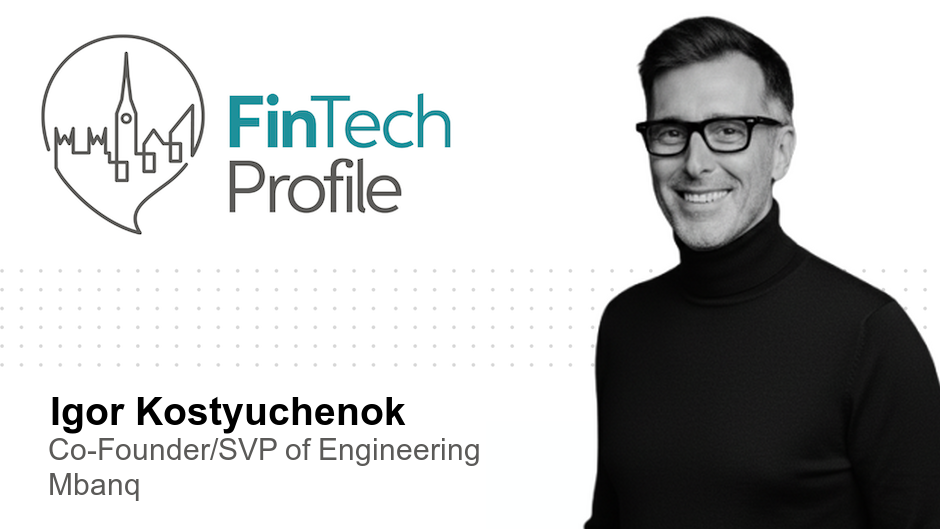
Today we're delighted to speak with Igor Kostyuchenok, Co-Founder and SVP of Engineering at Mbanq, a global Banking-as-a-Service provider. From building the world's first Open Banking API at Fidor Bank to now running banking infrastructure across the US, UK, and Europe, Igor brings a wealth of experience in demystifying the complex world of FinTech innovation.
My questions are in bold - over to you Igor:
Who are you and what's your background?
I'm a co-founder and SVP of Engineering at Mbanq – a global BaaS provider. We're running banks in the US, the UK and Europe and are planning to expand to Asia this year.
I've been with the company from the very beginning and have built our flagship product with two other co-founders of mine almost 7 years ago.
I studied computer science at University of Technology in Berlin when the startup scene was just forming. I've worked for multiple startups during my studies and was quite active in the scene.
After I finished my studies, I moved to Hamburg and joined the company that provides software stack for the largest financial group in Germany – Sparkasse. That's how I got into the FinTech. I went from a guy who builds testing automation software to the Head of Product responsible for shipping the cloud-based solutions.
After moving to Munich, I joined one of the first Neobanks in Germany – Fidor Bank where my responsibility was to build and ship the worldwide first Open Banking API in the world in 4 months – without AI. We shipped on time, integrated with some forward-thinking companies like Ripple to provide affordable crypto-based cross border payments 10 years prior to all the stablecoin craze. At the same time, I started to represent Fidor Bank as a speaker at different events. I still continue doing it but now as an Mbanq Co-Founder.
Right at the time when I decided to move forward and build my own BaaS company, I received a LinkedIn message from Vlad Lounegov (Mbanq's CEO) to meet for coffee and talk about joining him on the quest to reinvent BaaS. Two coffees later I joined Mbanq.
What is your job title and what are your general responsibilities?
My official job title is Co-Founder and SVP of Engineering. I oversee the software engineering department in all our offices in Europe, Asia and the US.
But as a co-founder, I'm jack of all trades and involved in pre-sales, partnership negotiations, hiring, project and product management etc.
I also regularly speak at different FinTech events and try to demystify the topics of banking, payments and tech stuff in general.
In the last 6 months, I've been leading the AI efforts at Mbanq. Despite all the excitement about AI taking over everything, I see both a lot of potential and even more uncertainty about the future of this technology.
Can you give us an overview of your business?
We provide the full banking infrastructure to established banks, FinTechs, Credit Unions and even Sport Clubs. We are not only doing the backend work for you but also provide you with the banking licence through our partner bank network, equip you with all the frontends for your customers – both Mobile and Web Apps and run the full operations for you.
You just need a working idea for your bank and be ready to take the market by the storm because we will launch your fully digital financial institution in a matter of months.
The reaction has been quite positive. We have strong presence on the US market, and we start to establish our business in the UK and Europe now. We also very interested in the Asian market.
Tell us how you are funded?
It's a combination of different funding sources. We started with Friends & Family and angel investment. Later, Temenos and other larger institutional investors recognised our potential and became our investors.
What's the origin story? Why did you start the company? To solve what problems?
Having worked at a Neobank I saw the gap in the banking infrastructure market. Larger banks are running on rather antiquated hard and software and there was a lack of infrastructure for modern small and medium sized banks.
Back at my Fidor days, we had to use the Core Banking software that was originally built for the insurance companies. It hindered us in speed of the execution and was lacking the features that bank needed.
Even now many banking infrastructure companies only offer one part of the solution e.g. Core Banking System. It requires their customers to have the technical knowledge and expertise to cover all the other parts of the infrastructure.
Who are your target customers? What's your revenue model?
Our customer base consists of the entrepreneurs in the financial sector space, who want to launch a specialised bank, the FinTechs, the Credit Unions and the Incumbents who want to overhaul their infrastructure.
We are a classic SaaS company – our customers pay a monthly fee for the infrastructure and services that we provide.
If you had a magic wand, what one thing would you change in the banking and/or FinTech sector?
I know it's impossible because the regulation is very different from market to market, but I would make it possible to transfer the money to anyone in the world just by using their mobile phone number with immediate reconciliation – something that Bitcoin was originally intended for.
Easier access to the capital regardless of the jurisdiction would also give a proper boost to the entrepreneurship.
What is your message for the larger players in the Financial Services marketplace?
They must act not just by buying out the startups but by transforming their culture and taking the risks. What they're trying to do right now is to use legislation to block certain ideas into entering the market and thus create a parallel world or push the entrepreneurs out of the market by blocking them access to certain financial services. It's rather a shortsighted approach. The future belongs to the risk takers.
Where do you get your Financial Services/FinTech industry news from?
Additionally, to the FinTech outlets like FinExtra I have a set of google alerts for different FinTech topics I'm interested in. I also subscribed to many Tech, Startups, VC and Tech related channels on Telegram.
Can you list 3 people you rate from the FinTech and/or Financial Services sector that we should be following on LinkedIn, and why?
Shameless plug – I think you should follow me. I'm regularly writing about FinTech topics and demystify certain technology aspects, the limitations of the industry but also give the outlook into the future.
Jokes and plugs aside, I often read interesting FinTech related stuff posted by Jason Mikula (although you should take some of it with a grain of salt), the former and current employees at 11:FS like Simon Taylor.
The more independent the author the better the news and ideas he's talking about.
What FinTech services (and/or apps) do you personally use?
I use different banking apps both the Europeans and the Asian Super Apps. Plus, as a co-founder of the BaaS startup, I use a lot of 3rd party APIs and Applications we integrate with e.g. Plaid, Comply Advantage, Alloy, Socure and many others.
What's the best new FinTech product or service you've seen recently?
That's a hard one – I haven't seen a lot of cool FinTech products recently. Incumbents haven't introduced anything new lately and European neobanks are trying to catch up with the Asian SuperApps by adding telecommunication services to their offering. We often bash the regulator, but I really like what the Central Bank of Brazil did with Pix – the instant payment system that all the Brazilian banks ought to support. Similar payment scheme was introduced by Central Bank of Russia where everyone can send the money to any phone number in real time. Talking about AI, we recently introduced the AI based banking assistant that covers 75% of all operations. We will soon launch it in Switzerland with one of our new customers.
Finally, let's talk predictions. What trends do you think are going to define the next few years in the FinTech sector?
AI will be big but I'm not sure that we will see a lot of good working products based on AI any time soon. Companies will go for low hanging fruits first and will completely replace customer support with it. Considering the current geopolitical situation and defragmentation of the markets, we will see more local fintech services entering the markets e.g. competitors to Visa, MasterCard, Google and Apple Pay in Europe.
We will also see the large rollout of blockchain based services at larger banks that will help them to reduce costs by utilising smart contracts for loans and mortgages. If we're talking about Europe, I think the cash will be targeted and will be used less and less in the next couple of years. The regulations will get even tighter and the crypto space will become regulated as well. In general, different locations will evolve differently and diverge more.
Thank you to Igor for sharing his insights with us. You can find out more about Mbanq on their website at www.mbanq.com.