Hans Tesselaar, Executive Director, BIAN
Hans Tesselaar discusses how BIAN's standardised banking architecture framework is helping financial institutions break free from legacy systems and vendor lock-in.
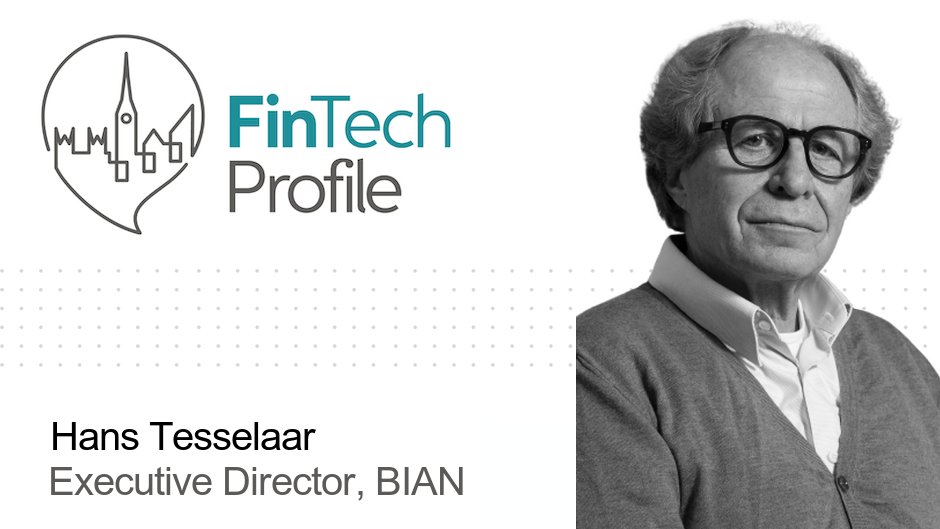
Today we're meeting Hans, Executive Director at BIAN (Banking Industry Architecture Network). They specialise in providing an architectural framework for modern banking infrastructure, enabling financial institutions to embrace emerging technologies through their 'Coreless Banking' approach.
Over to you Hans - my questions are in bold:
Who are you and what's your background?
My interest in innovation started with my role as a programmer, before moving to jobs across IT consultancy, sales, and management. At ING Insurance, I was Chief Architect, seeing the impact of technology on financial institutions first-hand, before a move to become its Director of Sourcing, Innovation & Governance. In 2011, I joined BIAN as an Executive Director, building on my experience to drive interoperability in infrastructure, and ever-changing innovation, across the industry.
What is your job title and what are your general responsibilities?
In my role as Executive Director, I report to the Board of Directors on content delivery, marketing, PR, and acquisition. I'm responsible for the day-to-day operations, discussions with prospective members, preparing board - and general assembly meetings.
Can you give us an overview of BIAN?
BIAN provides an architectural framework for modern banking infrastructure, supporting financial institutions as they embrace emerging technologies for the benefit of employees and customers alike. BIAN's 'Coreless Banking' approach sits at the heart of its expertise, with standards and APIs enabling a 'plug-and-play' structure through which banks can adopt new tools or components for long-term, flexible innovation.
How is BIAN structured and funded?
We only have one type of membership, crafted to enable all members equal power and say in decisions. This collaborative approach is reflected in the working groups, too, enabling member-led teams to create BIAN standards that apply to the real-world situations they face in their work. For leadership, we have the General Assembly, driving to maintain the structure, and the Board of Directors, providing strategic direction. The role to ensure integrity and quality falls to the Committees, Advisors, and General Secretariat. With regards to funding, our income comes only from membership fees.
What's the origin story of BIAN? What problems was it created to solve?
The drive behind BIAN's creation in 2008 was the ancient and inefficient structure of banking architecture. Instead of the legacy technology that organisations across the industry relied on, BIAN's establishing members, including banks and technology providers, wanted to create a standard semantic services landscape, with consistent agreed definitions, to lay the foundation for the future of banking with the sole purpose of lowering the integration costs.
Who are BIAN's members and how do they benefit?
BIAN's members include global banks, from HSBC to Caixa Bank, and leading technology companies, from Salesforce to Zafin. Bringing expertise and research capabilities, membership also encompasses consultancies, including KPMG and McKinsey & Company. The collaborative structure enables the direct influence of industry players on the API and service landscape, as well as the ability to develop new ideas through testing forward-thinking ideas in applicable situations. Through the ability to become involved in our working groups and events, members can network with key industry peers. As well as accessing the BIAN standards to future-proof innovation, they can access training and certifications for the benefit of themselves and their colleagues, proving to the industry that they're bought in to modernisation. Since November 2025 we are also providing state-of-the-art AI design and development tools.
If you had a magic wand, what one thing would you change in the banking and/or FinTech sector?
Facilitating the industry with tools so they can use and implement industry standards without any hassle.
What is your message for banks still working with legacy architectures?
For over half of CIOs, successful modernisation efforts have been challenged by concerns with cost management. Unfortunately, keeping legacy technology in place isn't an alternative, currently draining 70% of IT budgets. To attract and retain customers, a seamless banking journey is required, which is incompatible with the delays and inaccuracies caused by outdated technology. To combat this inefficiency, a long-term transformation strategy is required, capable of evolving with emerging technologies and avoiding the challenges of data siloes. In 2026 our slogan is: Doing nothing is no longer an option. Now it is the time to act.
How do you see FinTechs and traditional banks working together through standards?
According to a recent KPMG survey, 75% of senior leaders acknowledge that partnerships fuel the factors needed for transformation; growth, innovation, and agility. Within banking, the use of common infrastructure frameworks, and the evolution of open banking APIs, has been a catalyst in this drive for collaboration between FinTechs and traditional banks. With an agreed standards and definitions to work with, organisations can cooperate to drive innovation that lasts, beneficial for all participants. It all starts with the desire from FI's to move away from the traditional "vendor lock-in".
Where do you get your Financial Services/FinTech industry news from?
The American Banker and Finastra.
Can you list 3 people you rate from the FinTech/Financial Services sector that we should follow on LinkedIn, and why?
- Paolo Sironi (IBM)
- Al Karim Somji (OpenCoreOS)
- Peter Hinssen
What FinTech / digital banking services do you use personally?
Online banking and in The Netherlands IDEAL and Tikkie.
Finally, let's talk predictions. What trends do you think will define banking architecture and interoperability over the next few years?
In 2026, we'll see traditional banks innovate to meet expectations. According to a recent survey we carried out in association with IBM, the use of agentic AI is gaining momentum, with 17% of financial institutions planning 2026 launches and almost half (42%) already in the pilot stage. To compete, organisations should create a foundation for emerging technology, founded on seamless interoperability. This is where a plug and play approach, driven by microservices, AI agents (or better MCP Agents) combined with open standards, comes in, enabling banks to scale with changes in legislation, growing customer expectations, and the emergence of new technologies in 2026 and beyond.
AI is re-shaping industries, but organisations are not well prepared. Neobanks, on the other hand, have been able to showcase seamless customer offerings, using, for example, Gen AI and AI agents to provide a hyper-personalised service.
Thank you Hans. Connect with Hans on LinkedIn and read more about BIAN at their website.