Fred Krieger, Founder and CEO, Scoro
Fred Krieger shares how Scoro is transforming professional services automation by integrating AI-driven execution and bringing time management to the same level as financial management.
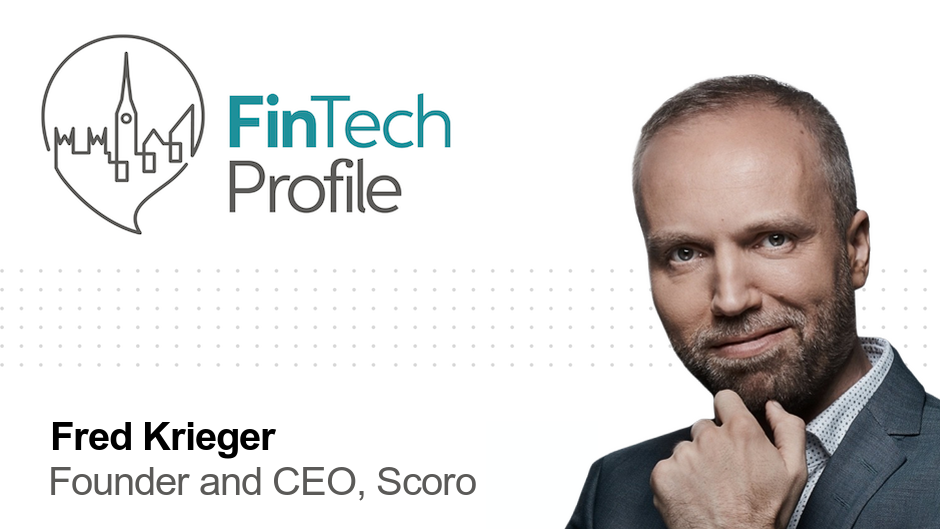
Today we're delighted to speak with Fred, Founder and CEO of Scoro, a leading professional services automation platform. Fred shares his journey from creative entrepreneur to tech founder, his vision for AI that doesn't just assist but actually executes work, and why he believes time deserves the same respect as money in business operations.
My questions are in bold - over to you Fred:
Who are you and what's your background?
I'm Fred Krieger, Founder and CEO of Scoro — a company I started as a result of "scratching my own itch" - solving the everyday chaos of running work in a small business. I was born and raised in Tallinn, Estonia. I started coding when I was about 14 and writing music at the age of 15. Before Scoro, I founded a web design agency and was involved in event management. I'm also actively involved in the music industry as a songwriter and a partner in both a music publishing company and a recording studio.
One of my favourite quotes has become "The ultimate inspiration is the deadline," attributed to Atari founder Nolan Bushnell. It's a reminder that writers and artists don't sit around waiting for a magical moment - a sunset, a mood, or a spark. Instead, consistency beats waiting for a lightning bolt. They create on ordinary days, with ordinary effort, repeated until something clicks.
Working with musicians made me realise that the most talented artists and creative teams were struggling not because they lacked skill, but because they lacked structure. That insight — coupled with my own deep interest in time management - eventually led to the creation of a tool that became Scoro.
While building Scoro I've continued to be active as a songwriter with hundreds of songs released.
My journey into tech and fintech was not a straight line: it was a progression from creative management to building systems that help businesses run better - and, importantly, more profitably.
What is your job title and what are your general responsibilities?
As Founder and CEO, my role is to guide our long-term strategy, product vision, and scale our global impact. On a daily basis, I'm focused on ensuring the team is engaged and constantly innovating for our customers.
Lately, I've shifted a significant portion of my focus to our product roadmap— specifically, integrating AI into our core platform. We aren't just looking for AI to summarise text or offer suggestions; we believe that AI will soon do most of the work.
Our vision is to move beyond passive assistance to active execution. We are building a future where AI doesn't just track the project lifecycle—from planning and delivery to financial control—but actually executes the repetitive, manual tasks within it. Our recent acquisition of Envoice is a cornerstone of this strategy. By bringing AI-driven expense management into the fold, we are ensuring that the financial "heavy lifting" is handled automatically, allowing our users to transition from being operators to being orchestrators.
Can you give us an overview of your business?
Scoro is a professional services automation (PSA) platform that helps service businesses run their entire operation in one place — from selling work to delivering it to getting paid. We bring together CRM, quoting, project delivery, resourcing, billing, and reporting, so leaders have real-time visibility into performance and profitability.
What makes Scoro different is the connected workflow: when sales, delivery, and finance live in one system, you reduce handovers, duplicate data entry, and "version-of-truth" problems. That's how teams move from reactive management to proactive control.
From a FinTech perspective, the next frontier is bringing external cost data into that same real-time picture. That's exactly what we unlock together with Envoice: AI-powered bill and expense capture, categorisation, and approval workflows that feed clean cost data into profitability tracking.
Tell us how you are funded?
We bootstrapped the company for several years before raising our €1.5M Seed round from Tera Ventures and Inventure. Our Series A was a €4.4 million round led by Livonia Partners. Most recently, we closed a €14 million Series B led by Kennet Partners, with participation from Columbia Lake Partners, Inventure, and Tera Ventures. Efficient management and strong funding have been instrumental to our global expansion.
What's the origin story? Why did you start the company? To solve what problems?
Scoro didn't begin with a grand Silicon Valley-style vision. It began with a much simpler, very real frustration.
Back when I was running my production business, I realised I was spending precious hours firefighting, juggling emails, messages, spreadsheets, calendars, invoices, and client commitments across disconnected tools.
I was really struggling. This resulted in a significant loss of weight, sleep deprivation and mental burnout. In hindsight, I've realised it was mainly due to not knowing how to manage my time.
For me, everything changed when I came across the book Getting Things Done by David Allen. This is a proper manual on time and managing oneself, not just some standard wishy-washy motivational talk. I became a fan of time management.
This was a huge inspiration for me to start improving the way I manage my day-to-day work - how I define goals, align priorities and manage my daily projects and tasks. I needed a tool to support my new way of working. But I couldn't find any tools on the market that I liked, so I hacked together the first prototype myself and started using it.
It was a seemingly simple task list that allowed me to list everything I had to get done. But, before starting with the latest and most urgent one, I was able to reprioritise the order of tasks by drag and drop. Also, it allowed me to assign a planned duration for everything in advance. These seemingly simple features helped me, over time, form the habit of validating every small thing on my plate.
At that moment, I didn't realise how common and universal the problem is and how many people and teams struggle with it. But soon, people I worked with wanted to use this tool too, and something just clicked.
We realised that managing work in creative and service businesses was universally messy, chaotic, and fragmented.
That's how Scoro was born: not because we set out to "disrupt an industry," but because we were solving our own problem, and only then shared that solution with others.
Who are your target customers? What's your revenue model?
Our core customers are professional services businesses: agencies, consultancies, IT services firms, software/services teams, and other project-based organisations that need to manage delivery and profitability.
Our revenue model is a SaaS subscription (seat-based), which allows us to scale with our clients as they grow from small teams to global operations.
If you had a magic wand, what one thing would you change in the banking and/or FinTech sector?
I would remove the "latency tax" in business finance — the time delay between revenue and cost happening, and a decision-maker seeing it clearly.
Too many businesses still learn the truth about spend and margin at month-end. FinTech should make financial reality visible in near real time, embedded directly into operational workflows — approvals, categorisation, project/job allocation, forecasting. That's exactly the direction we're pushing with Scoro, and now together with Envoice.
What is your message for the larger players in the Financial Services marketplace?
Time deserves the same level of respect as money.
In finance, we account for every cent. We know exactly where money was spent, what the ROI was, and where we need to cut or invest more. But when it comes to time, which is often a company's most expensive resource, we're far less disciplined.
Most businesses still can't clearly answer simple questions: Where did our people actually spend their time? Which activities created value, and which were just busy work? Are we investing our time in the same deliberate way we invest capital?
That's why time and money need to live in the same system. When estimates, time spent, internal and external costs, and revenue are connected, businesses can understand in real time how they're actually performing - not just financially, but operationally.
Instead of discovering problems when it's too late, leaders can see early signals: where time is being wasted, where margins are under pressure, and where effort should be redirected. The goal isn't more reporting — it's faster, better decisions that help teams focus on the work that truly creates value.
Where do you get your Financial Services/FinTech industry news from?
I keep an eye on Bloomberg, Yahoo Finance and TechCrunch for broader trends. When it comes to SaaS, Kellblog.com and Saastr are some of the best sources of information.
Can you list 3 people you rate from the FinTech and/or Financial Services sector that we should be following on LinkedIn, and why?
- Taavet Hinrikus (Co-founder of Wise): Proof that Estonian tech can disrupt global finance
- Martin Sokk - (Co-founder and CEO of Lightyear): another Estonian FinTech founder, building a multi-market investing platform across 22+ European countries
- Aaron Harris - (Global CTO of Sage, a founding leader of Sage Intacct): A true innovation leader. He has a great perspective on how AI should be applied in FinTech, where accuracy and reliability are absolute must-haves
What FinTech services (and/or apps) do you personally use?
- Yahoo Finance (managing my stocks): finance.yahoo.com
- Fundrbird (managing my fund investments): https://fundrbird.com
- Stripe (powering our customer payments): https://stripe.com
- Envoice (managing cost and expenses): www.envoice.eu
What's the best new FinTech product or service you've seen recently?
Not as a user but I know some of my friends in the construction industry are excited about planyard, a construction-specific accounting tool.
Finally, let's talk predictions. What trends do you think are going to define the next few years in the FinTech sector?
Two trends I'd bet on:
- AI moves from insights to execution. We'll see more AI that doesn't just analyse, but also does the work: extracting documents, routing approvals, coding spend and preparing audit-ready trails. That's already visible in our approach to automated extraction and categorisation.
- Leaders, even in smaller companies, will be expected to run their businesses with far more financial precision, as margins are getting thinner and customers demand transparency. They will need to understand unit economics at a much deeper level. AI will be the accelerant of this trend.
We'd like to thank Fred for taking the time to speak with us. You can find out more about Scoro on their website.